112,95 €
inkl. MwSt.
Sofort per Download lieferbar
56 °P sammeln

Andere Kunden interessierten sich auch für
") Appraising Lakatos (eBook, PDF)112,95 €
Appraising Lakatos (eBook, PDF)112,95 €") New Perspectives on Conceptual Engineering - Volume 3 (eBook, PDF)88,95 €
New Perspectives on Conceptual Engineering - Volume 3 (eBook, PDF)88,95 €") Inquiry as Inquiry: A Logic of Scientific Discovery (eBook, PDF)160,95 €
Inquiry as Inquiry: A Logic of Scientific Discovery (eBook, PDF)160,95 €") Hierarchical Emergent Ontology and the Universal Principle of Emergence (eBook, PDF)72,95 €
Hierarchical Emergent Ontology and the Universal Principle of Emergence (eBook, PDF)72,95 €") Technology and Mathematics (eBook, PDF)120,95 €
Technology and Mathematics (eBook, PDF)120,95 €") Friedrich Waismann - Causality and Logical Positivism (eBook, PDF)112,95 €
Friedrich Waismann - Causality and Logical Positivism (eBook, PDF)112,95 €") Imre Lakatos and Theories of Scientific Change (eBook, PDF)160,95 €
Imre Lakatos and Theories of Scientific Change (eBook, PDF)160,95 €



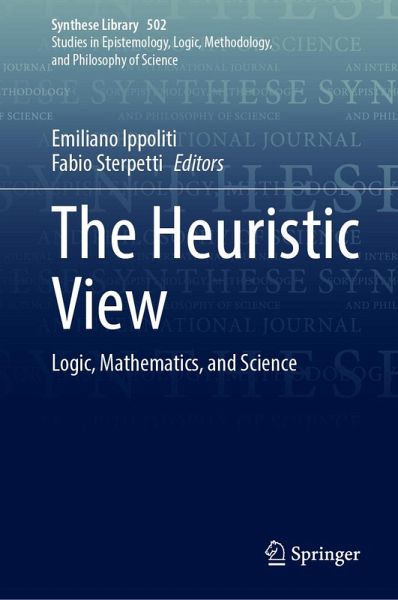
This volume offers a series of thought-provoking analyses that explore non-mainstream perspectives on knowledge acquisition and scientific discovery. A central theme across many of the contributions is the heuristic conception of method, a view that finds its philosophical roots in Imre Lakatos's work in the philosophy of mathematics and, more distantly, in Platonic notions of philosophical inquiry.
Knowledge acquisition is frequently conceptualized as a form of problem-solving, and problem-solving is typically regarded as a rational endeavor. However, the dominant view in the philosophy of science has long held that scientific discovery resists systematic explanation in terms of logic and rationality. If an alternative account of discovery grounded in these terms can be developed, it would represent a significant theoretical advancement.
The essays collected in this book critically assess the promise and limitations of such non-standard accounts, and they investigate the possibility of framing scientific discovery within a logical and rational framework. This volume will be of particular interest to scholars in the philosophy of science, epistemology, philosophy of mathematics, and philosophy of logic, as well as to scientists engaged in theoretical inquiry and graduate students working in these or related areas.
Knowledge acquisition is frequently conceptualized as a form of problem-solving, and problem-solving is typically regarded as a rational endeavor. However, the dominant view in the philosophy of science has long held that scientific discovery resists systematic explanation in terms of logic and rationality. If an alternative account of discovery grounded in these terms can be developed, it would represent a significant theoretical advancement.
The essays collected in this book critically assess the promise and limitations of such non-standard accounts, and they investigate the possibility of framing scientific discovery within a logical and rational framework. This volume will be of particular interest to scholars in the philosophy of science, epistemology, philosophy of mathematics, and philosophy of logic, as well as to scientists engaged in theoretical inquiry and graduate students working in these or related areas.
Dieser Download kann aus rechtlichen Gründen nur mit Rechnungsadresse in A, B, BG, CY, CZ, D, DK, EW, E, FIN, F, GR, HR, H, IRL, I, LT, L, LR, M, NL, PL, P, R, S, SLO, SK ausgeliefert werden.