120,95 €
inkl. MwSt.
Sofort per Download lieferbar
60 °P sammeln

Andere Kunden interessierten sich auch für
") NavigatingNaturalHazardsinMountainousTopographies (eBook, PDF)128,95 €
NavigatingNaturalHazardsinMountainousTopographies (eBook, PDF)128,95 €") The Nature of Geomorphological Hazards in the Nepal Himalaya (eBook, PDF)96,95 €
The Nature of Geomorphological Hazards in the Nepal Himalaya (eBook, PDF)96,95 €") Geophysics of the Cryosphere (eBook, PDF)72,95 €
Geophysics of the Cryosphere (eBook, PDF)72,95 €") Disaster Management in the Complex Himalayan Terrains (eBook, PDF)72,95 €
Disaster Management in the Complex Himalayan Terrains (eBook, PDF)72,95 €") Flash Floods in Vietnam (eBook, PDF)72,95 €
Flash Floods in Vietnam (eBook, PDF)72,95 €") The Formation of Mountains (eBook, PDF)44,95 €
The Formation of Mountains (eBook, PDF)44,95 €") Advances in Geomorphology and Quaternary Studies in Argentina (eBook, PDF)112,95 €
Advances in Geomorphology and Quaternary Studies in Argentina (eBook, PDF)112,95 €


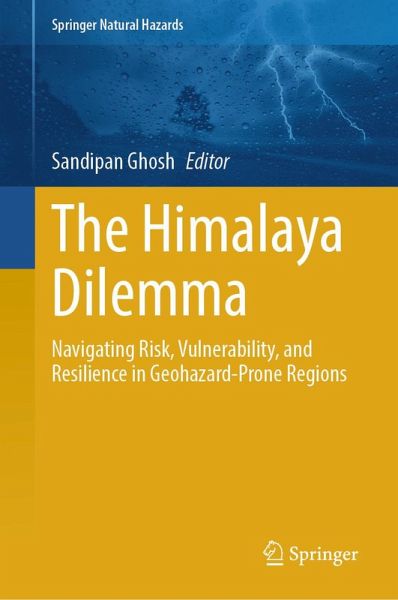
The Himalaya Dilemma: Navigating Risk, Vulnerability, and Resilience in Geohazard-Prone Regions is a collaborative effort to explore and understand the multiple dangers the Himalayas face, including landslides, earthquakes, glacial lake outburst floods, terrain instability, anthropogenic landscape alterations, and ecosystem fragility. Often called the "Roof of the World" and the "Third Pole," the Himalayas are among Earth's most breathtaking yet geologically active mountain ranges. While these majestic peaks inspire awe, they also conceal a complex interplay of geological risks, environmental challenges, and socioeconomic vulnerabilities.
At the heart of the volume lies the theme The Himalaya at Risk, emphasizing the urgent need to bridge the gap between hazard management, community action, policy development, and scientific research. Integrating insights from geology, geomorphology, geography, environmental science, disaster management, and sustainable development, the book offers a comprehensive overview of the region's risk environment.
The Himalaya Dilemma is intended for a diverse readership, including academics and researchers in the fields of geology, environmental science, disaster risk management, and climate studies, policymakers and development practitioners involved in building disaster resilience and promoting sustainable development in mountain regions, as well as students seeking a deeper understanding of Himalayan geohazards and the broader consequences of environmental change.
At the heart of the volume lies the theme The Himalaya at Risk, emphasizing the urgent need to bridge the gap between hazard management, community action, policy development, and scientific research. Integrating insights from geology, geomorphology, geography, environmental science, disaster management, and sustainable development, the book offers a comprehensive overview of the region's risk environment.
The Himalaya Dilemma is intended for a diverse readership, including academics and researchers in the fields of geology, environmental science, disaster risk management, and climate studies, policymakers and development practitioners involved in building disaster resilience and promoting sustainable development in mountain regions, as well as students seeking a deeper understanding of Himalayan geohazards and the broader consequences of environmental change.
Dieser Download kann aus rechtlichen Gründen nur mit Rechnungsadresse in A, B, BG, CY, CZ, D, DK, EW, E, FIN, F, GR, HR, H, IRL, I, LT, L, LR, M, NL, PL, P, R, S, SLO, SK ausgeliefert werden.