2,99 €
2,99 €
inkl. MwSt.
Sofort per Download lieferbar

0 °P sammeln
2,99 €
Als Download kaufen
2,99 €
inkl. MwSt.
Sofort per Download lieferbar
0 °P sammeln
Jetzt verschenken
Alle Infos zum eBook verschenken
2,99 €
inkl. MwSt.
Sofort per Download lieferbar
Alle Infos zum eBook verschenken
0 °P sammeln

Andere Kunden interessierten sich auch für
") Faith and Reason in the Thought of the Church Fathers (eBook, ePUB)2,99 €
Faith and Reason in the Thought of the Church Fathers (eBook, ePUB)2,99 €") The influence of Greek ideas and usages upon the Christian church (eBook, ePUB)1,99 €
The influence of Greek ideas and usages upon the Christian church (eBook, ePUB)1,99 €") Aristotle and Early Christian Thought (eBook, ePUB)42,95 €
Aristotle and Early Christian Thought (eBook, ePUB)42,95 €") Greek Thought and Christian Doctrine in Late Antiquity (eBook, ePUB)3,99 €
Greek Thought and Christian Doctrine in Late Antiquity (eBook, ePUB)3,99 €") Greek Cosmology and the Christian Doctrine of Creation (eBook, ePUB)3,99 €
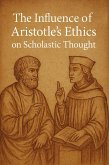
Greek Cosmology and the Christian Doctrine of Creation (eBook, ePUB)3,99 €") The Influence of Aristotle's Ethics on Scholastic Though (eBook, ePUB)2,99 €
The Influence of Aristotle's Ethics on Scholastic Though (eBook, ePUB)2,99 €") The Impact of Greek Philosophy on Jewish Mysticism (eBook, ePUB)3,99 €
The Impact of Greek Philosophy on Jewish Mysticism (eBook, ePUB)3,99 €


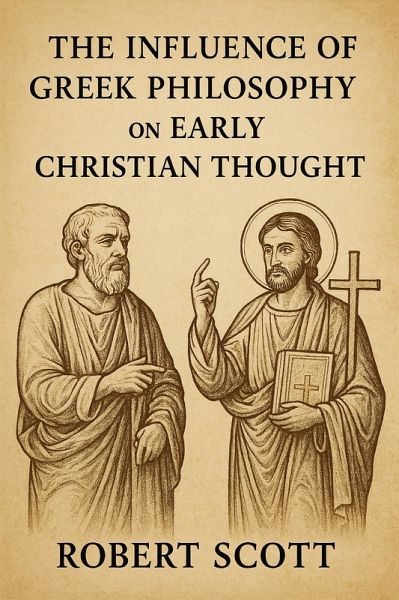
In The Influence of Greek Philosophy on Early Christian Thought, Robert Scott explores the profound and complex relationship between Greek philosophical traditions and the development of Christian doctrine from the 2nd to the 5th centuries CE. The book delves into how early Christian thinkers, faced with the challenge of reconciling their faith with the intellectual traditions of the Greco-Roman world, engaged deeply with Greek philosophy-especially Platonism, Aristotelianism, and Neoplatonism-to form a robust and coherent theological framework.
The narrative begins by tracing the intellectual context of early Christianity, highlighting the philosophical schools that dominated the Mediterranean world. It then turns to key Christian thinkers such as Justin Martyr, Clement of Alexandria, Origen, and Augustine, examining how they adapted and transformed Greek philosophical ideas about the nature of God, the soul, ethics, and cosmology. Their efforts to integrate Greek philosophy with Christian beliefs about creation, salvation, and the nature of the divine led to the formulation of essential doctrines, including the Trinity, the nature of Christ, and the role of divine grace in human salvation.
Scott provides a detailed analysis of how Christian thinkers appropriated concepts such as the soul's ascent, the nature of the Good, and the rationality of creation, reshaping them to fit the Christian revelation of a personal, omnipotent God. Throughout, the book demonstrates the intricate and often subtle ways in which Greek philosophy influenced early Christian theology, paving the way for the philosophical theology of the Middle Ages, particularly the works of thinkers like Thomas Aquinas.
By situating the development of Christian thought within its Greek philosophical context, The Influence of Greek Philosophy on Early Christian Thought offers a comprehensive exploration of the intellectual history that shaped the course of Christian theology. It is an essential work for understanding how the early Church adapted the intellectual legacy of Greece to develop a faith that was both intellectually rigorous and spiritually transformative.
The narrative begins by tracing the intellectual context of early Christianity, highlighting the philosophical schools that dominated the Mediterranean world. It then turns to key Christian thinkers such as Justin Martyr, Clement of Alexandria, Origen, and Augustine, examining how they adapted and transformed Greek philosophical ideas about the nature of God, the soul, ethics, and cosmology. Their efforts to integrate Greek philosophy with Christian beliefs about creation, salvation, and the nature of the divine led to the formulation of essential doctrines, including the Trinity, the nature of Christ, and the role of divine grace in human salvation.
Scott provides a detailed analysis of how Christian thinkers appropriated concepts such as the soul's ascent, the nature of the Good, and the rationality of creation, reshaping them to fit the Christian revelation of a personal, omnipotent God. Throughout, the book demonstrates the intricate and often subtle ways in which Greek philosophy influenced early Christian theology, paving the way for the philosophical theology of the Middle Ages, particularly the works of thinkers like Thomas Aquinas.
By situating the development of Christian thought within its Greek philosophical context, The Influence of Greek Philosophy on Early Christian Thought offers a comprehensive exploration of the intellectual history that shaped the course of Christian theology. It is an essential work for understanding how the early Church adapted the intellectual legacy of Greece to develop a faith that was both intellectually rigorous and spiritually transformative.
Dieser Download kann aus rechtlichen Gründen nur mit Rechnungsadresse in A, B, CY, CZ, D, DK, EW, E, FIN, F, GR, H, IRL, I, LT, L, LR, M, NL, PL, P, R, S, SLO, SK ausgeliefert werden.