11,95 €
11,95 €
inkl. MwSt.
Sofort per Download lieferbar

6 °P sammeln
11,95 €
Als Download kaufen
11,95 €
inkl. MwSt.
Sofort per Download lieferbar
6 °P sammeln
Jetzt verschenken
Alle Infos zum eBook verschenken
11,95 €
inkl. MwSt.
Sofort per Download lieferbar
Alle Infos zum eBook verschenken
6 °P sammeln

Andere Kunden interessierten sich auch für
") The Language Instinct (eBook, ePUB)9,49 €
The Language Instinct (eBook, ePUB)9,49 €") The Development of L2 Interactional Competence (eBook, ePUB)0,00 €
The Development of L2 Interactional Competence (eBook, ePUB)0,00 €") The Dawn of Language (eBook, ePUB)2,99 €
The Dawn of Language (eBook, ePUB)2,99 €") Developing Interactional Competence at the Workplace (eBook, ePUB)39,95 €
Developing Interactional Competence at the Workplace (eBook, ePUB)39,95 €") Classroom Discourse Analysis (eBook, ePUB)48,95 €
Classroom Discourse Analysis (eBook, ePUB)48,95 €") Discourse Analysis (eBook, ePUB)39,95 €
Discourse Analysis (eBook, ePUB)39,95 €") Interactional Dynamics in Remote Interpreting (eBook, ePUB)39,95 €
Interactional Dynamics in Remote Interpreting (eBook, ePUB)39,95 €


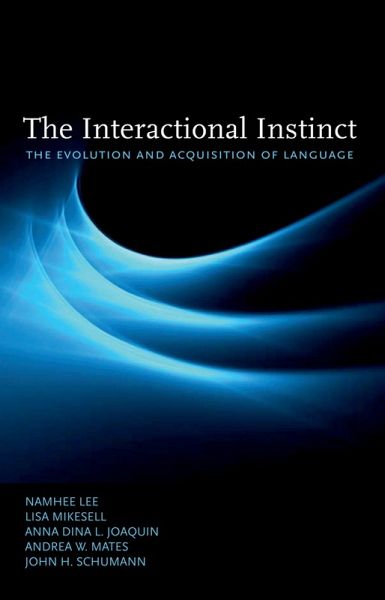
The Interactional Instinct explores the evolution of language from the theoretical view that language could have emerged without a biologically instantiated Universal Grammar. In the first part of the book, the authors speculate that a hominid group with a lexicon of about 600 words could combine these items to make larger meanings. Combinations that are successfully produced, comprehended, and learned become part of the language. Any combination that is incompatible with human mental capacities is abandoned. The authors argue for the emergence of language structure through interaction constrained by human psychology and physiology. In the second part of the book, the authors argue that language acquisition is based on an "interactional instinct" that emotionally entrains the infant on caregivers. This relationship provides children with a motivational and attentional mechanism that ensures their acquisition of language. In adult second language acquisition, the interactional instinct is no longer operating, but in some individuals with sufficient aptitude and motivation, successful second-language acquisition can be achieved. The Interactional Instinct presents a theory of language based on linguistic, evolutionary, and biological evidence indicating that language is a culturally inherited artifact that requires no a priori hard wiring of linguistic knowledge.
Dieser Download kann aus rechtlichen Gründen nur mit Rechnungsadresse in A, B, BG, CY, CZ, D, DK, EW, E, FIN, F, GR, HR, H, IRL, I, LT, L, LR, M, NL, PL, P, R, S, SLO, SK ausgeliefert werden.