Sie sind bereits eingeloggt. Klicken Sie auf 2. tolino select Abo, um fortzufahren.
Bitte loggen Sie sich zunächst in Ihr Kundenkonto ein oder registrieren Sie sich bei bücher.de, um das eBook-Abo tolino select nutzen zu können.
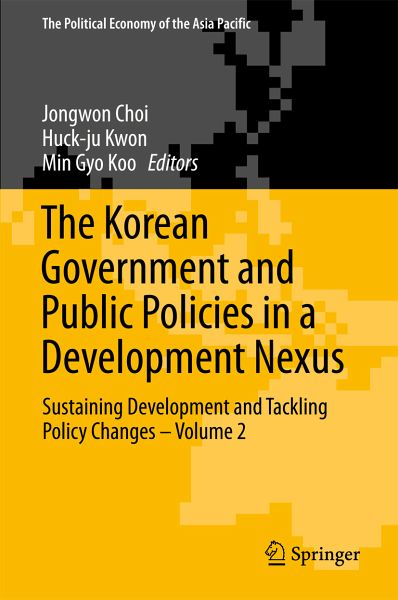
Discusses South Korea's economic and social development since the 1990's Sheds new light on the political and institutional adaptations and modifications of South Korean government's administrative capacities and post-growth policies Explores key public policy areas where the South Korean government has successfully adapted to new policy challenges and environments
Discusses South Korea's economic and social development since the 1990's
Sheds new light on the political and institutional adaptations and modifications of South Korean government's administrative capacities and post-growth policies
Explores key public policy areas where the South Korean government has successfully adapted to new policy challenges and environments
Dieser Download kann aus rechtlichen Gründen nur mit Rechnungsadresse in A, B, BG, CY, CZ, D, DK, EW, E, FIN, F, GR, HR, H, IRL, I, LT, L, LR, M, NL, PL, P, R, S, SLO, SK ausgeliefert werden.
Die Herstellerinformationen sind derzeit nicht verfügbar.
Autorenporträt
Jongwon Choi is Professor of the Graduate School of Public Administration and Director of the Asia Development Institute at Seoul National University. He graduated from Seoul National University (B.A. in Economics in 1982 and MPA in 1984) and obtained Ph. D. in public policy from University of Michigan in 1989. He was the Dean of Graduate School of Public Administration (2008-2010). Previously he worked for Economic Planning Board (EPB) and Korea Development Institute (KDI). He was a non-standing commissioner of Korean Fair Trade Commission, the Republic of Korea (2008-2011). He also was the chairman of Korean Public Enterprise Evaluation Committee (2012-2013). He is the President of the Korean Society of Public Enterprises since 2009. He was the editor of the Korean Public Administration Review. His research interest is on policy-making and policy implementation theories and empirical studies. His publications include: "James G. March and Policy Studies in Korea" ( Korean Policy Studies Journal, 2014), "On ICT Governance and Regulation" ( ICT Forum, 2014), "Institutional Leadership and Perceived Performance: Evidence from the Korean Minister Survey" (Korean Journal of Policy Studies , 2011), Consumers and the Rule of Law (Seoul National University Press, 2008, co-author), Korean National Governance System: Challenges and Strategies (Seoul: Nanam, 2008, co-author), and the like. Huck-ju Kwon is Professor of the Graduate School of Public Administration and Deputy Director of the Asia Development Institute at Seoul National University. He is also the Editor of the Korean Public Administration Review and Co-editor of Global Social Policy (Sage). His research interest is on comparative social policy in East Asia, international development policy and global governance. He was Director of the Global Research Network on Social Protection in East Asia, funded by the Korea Research Council(2010- 2013) and Visiting Scholar at the Harvard Yenching Institute (2013-2014). Previously he worked as the Research Coordinator at the United Nations Research Institute for Social Development (UNRISD) (2002-2005). His publications include "Poverty Reduction and Good Governance" (Development and Change, 2014), Transforming the Developmental Welfare State in East Asia (Palgrave, 2005), The East Asian Welfare Model: the State and Welfare Orientalism (Routledge, 1998, co-author) and The Korean State and Social Policy (Oxford University Press, 2011). Min Gyo Koo is Associate Professor of the Graduate School of Public Administration at Seoul National University. His research interests include East Asian political economy and maritime affairs. Among his many publications is Island Disputes and Maritime Regime Building in East Asia: Between a Rock and a Hard Place (2010, Springer). Aside from many book chapters, he has published his research in a wide range of journals, including International Relations of the Asia-Pacific, The Pacific Review, Pacific Affairs, Asian Perspective, European Journal of East Asia Studies, and Journal of East Asian Studies. He has also co-edited (with Vinod K. Aggarwal) Asia's New Institutional Architecture: Evolving Structures for Managing Trade, Financial, and Security Relations (2008, Springer). From fall 2005 to spring 2007, he served as a postdoctoral fellow at the Center for International Studies and as a full time lecturer in the School of International Relations at the University of Southern California. He also taught at Yonsei University in Korea from fall 2007 to spring 2010. He currently serves as Visiting Scholar at the Harvard Yenching Institute (2015-2016).
Inhaltsangabe
1. Introduction: The Role of Government in South Korea's Consolidation of Economic and Social Development.- 2. The Changes of Political Environment of Public Policy.- 3. The Changes in The Rationale of Governance.- 4. The Changes of the State and Society Relations.- 5. The Decline of Economic Growth Potentials and Future Development of Korea.- 6. The Evolution of the Korean Welfare State in Response to the Societal Change.- 7. Policy Responses to New International Economic Environment in the Post-Uruguay Round Period.- 8. Foreign Policy Challenges and Government Responses.- 9. Summary and Conclusion.
1. Introduction: The Role of Government in South Korea's Consolidation of Economic and Social Development.- 2. The Changes of Political Environment of Public Policy.- 3. The Changes in The Rationale of Governance.- 4. The Changes of the State and Society Relations.- 5. The Decline of Economic Growth Potentials and Future Development of Korea.- 6. The Evolution of the Korean Welfare State in Response to the Societal Change.- 7. Policy Responses to New International Economic Environment in the Post-Uruguay Round Period.- 8. Foreign Policy Challenges and Government Responses.- 9. Summary and Conclusion.
Es gelten unsere Allgemeinen Geschäftsbedingungen: www.buecher.de/agb
Impressum
www.buecher.de ist ein Internetauftritt der buecher.de internetstores GmbH
Geschäftsführung: Monica Sawhney | Roland Kölbl | Günter Hilger
Sitz der Gesellschaft: Batheyer Straße 115 - 117, 58099 Hagen
Postanschrift: Bürgermeister-Wegele-Str. 12, 86167 Augsburg
Amtsgericht Hagen HRB 13257
Steuernummer: 321/5800/1497
USt-IdNr: DE450055826