0,49 €
inkl. MwSt.
Sofort per Download lieferbar
0 °P sammeln

Andere Kunden interessierten sich auch für
 (eBook, ePUB)") Following the Guidon (Summarized Edition) (eBook, ePUB)0,49 €
Following the Guidon (Summarized Edition) (eBook, ePUB)0,49 €") Building an American Empire (eBook, ePUB)17,95 €
Building an American Empire (eBook, ePUB)17,95 €") Feeding Gotham (eBook, ePUB)21,95 €
Feeding Gotham (eBook, ePUB)21,95 €") 'To Save the People from Themselves' (eBook, ePUB)35,95 €
'To Save the People from Themselves' (eBook, ePUB)35,95 €") Frontier Ways (eBook, ePUB)13,95 €
Frontier Ways (eBook, ePUB)13,95 €") Ibrahim Pasha: Grand Vizir of Suleiman the Magnificent (eBook, ePUB)1,99 €
Ibrahim Pasha: Grand Vizir of Suleiman the Magnificent (eBook, ePUB)1,99 €") George Washington's Washington (eBook, ePUB)18,18 €
George Washington's Washington (eBook, ePUB)18,18 €

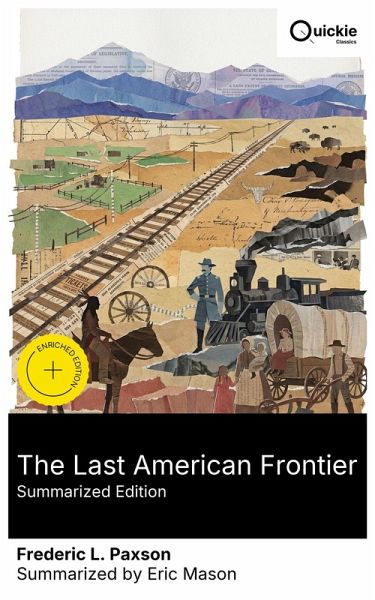
The Last American Frontier charts the transformation of the trans-Mississippi West from contested borderlands to an integrated national region. In lucid prose, Paxson follows gold rushes, the cattle kingdom, homesteading, railroads, and army posts, interweaving land policy, speculative capital, and aridity to explain settlement's tempo and violence. Written under the sway of the Turner thesis, it fuses social, political, and economic history into an interpretive arc. Frederic L. Paxson, a leading historian of the American West and student of Frederick Jackson Turner, brought Progressive-era concerns with institutions, markets, and democracy to frontier studies. Trained at Wisconsin and a Pulitzer Prize-winning scholar, he mined government reports, travel narratives, and newspapers. His focus on transportation networks and federal policy foregrounds railroads, land laws, and the army as engines of incorporation and conflict. Readers seeking a foundational synthesis of the West's nineteenth century will find this study indispensable. Pair it with recent Indigenous-centered scholarship to balance perspectives, and trace how policy, environment, and capital converged on plains and mountains. Clear and integrative, The Last American Frontier rewards students and general readers who want to see how an earlier generation framed the closing of the frontier-and why that framing endures. Quickie Classics summarizes timeless works with precision, preserving the author's voice and keeping the prose clear, fast, and readable-distilled, never diluted. Enriched Edition extras: Introduction · Synopsis · Historical Context · Brief Analysis · 4 Reflection Q&As · Editorial Footnotes.
Dieser Download kann aus rechtlichen Gründen nur mit Rechnungsadresse in A, B, BG, CY, CZ, D, DK, EW, E, FIN, F, GR, H, IRL, I, LT, L, LR, M, NL, PL, P, R, S, SLO, SK ausgeliefert werden.