42,95 €
42,95 €
inkl. MwSt.
Sofort per Download lieferbar

21 °P sammeln
42,95 €
Als Download kaufen
42,95 €
inkl. MwSt.
Sofort per Download lieferbar
21 °P sammeln
Jetzt verschenken
Alle Infos zum eBook verschenken
42,95 €
inkl. MwSt.
Sofort per Download lieferbar
Alle Infos zum eBook verschenken
21 °P sammeln

Andere Kunden interessierten sich auch für
") The Linguistic Landscape in Israel through Palestinian Eyes (eBook, PDF)42,95 €
The Linguistic Landscape in Israel through Palestinian Eyes (eBook, PDF)42,95 € Die Rolle der Frau in der islamischen Gesellschaft und der Palästinakonflikt in der Literatur. "The Arab Woman and the Palestine Problem" von Matiel Mogannam (eBook, ePUB)2,99 €
") The Impact of Global English on Cultural Identities in the United Arab Emirates (eBook, ePUB)42,95 €
The Impact of Global English on Cultural Identities in the United Arab Emirates (eBook, ePUB)42,95 €") World Englishes in the Arab Gulf States (eBook, ePUB)39,95 €
World Englishes in the Arab Gulf States (eBook, ePUB)39,95 €") Translation in the Arab World (eBook, ePUB)41,95 €
Translation in the Arab World (eBook, ePUB)41,95 €") Power, Affect, and Identity in the Linguistic Landscape (eBook, ePUB)39,95 €
Power, Affect, and Identity in the Linguistic Landscape (eBook, ePUB)39,95 €") The Politics of Palestinian Multilingualism (eBook, ePUB)39,95 €
The Politics of Palestinian Multilingualism (eBook, ePUB)39,95 €





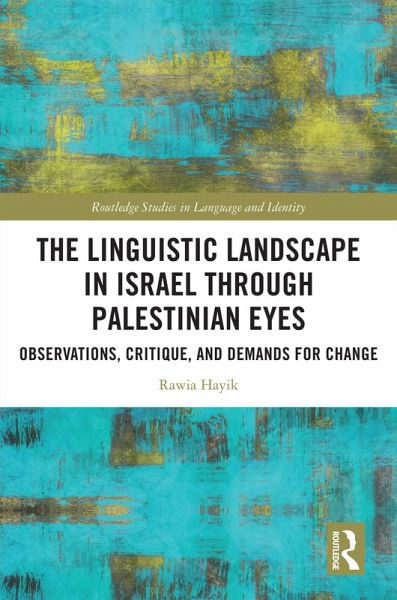
This book uses a sociolinguistic framework to explore how language serves as a marker of national identity in conflict zones, focusing on the dystopian representation of Arabic as a minority language in Israel through the perspectives of Israeli Palestinian students. Using a documentary photography research tool, PhotoVoice, minoritized college students from Northern Israel were invited to document and reflect on the signage in their area. Content analysis of students' reflections revealed not only a problematic linguistic reality in which the presence of Arabic was limited and inaccurate, but also their experience of the space as local inhabitants. The book chapters shed light on their profound perceptions and aspirations as passers-by toward the (mis)representation of their native language in the country. The contribution of the book lies in demonstrating the potential of the innovative tool PhotoVoice in developing awareness of the explicit and implicit messages delivered through linguistic landscapes. It encourages action for achieving utopian, more inclusive linguistic realities where minority languages are appropriately represented.
Dieser Download kann aus rechtlichen Gründen nur mit Rechnungsadresse in A, B, BG, CY, CZ, D, DK, EW, E, FIN, F, GR, HR, H, IRL, I, LT, L, LR, M, NL, PL, P, R, S, SLO, SK ausgeliefert werden.