Sie sind bereits eingeloggt. Klicken Sie auf 2. tolino select Abo, um fortzufahren.
Bitte loggen Sie sich zunächst in Ihr Kundenkonto ein oder registrieren Sie sich bei bücher.de, um das eBook-Abo tolino select nutzen zu können.
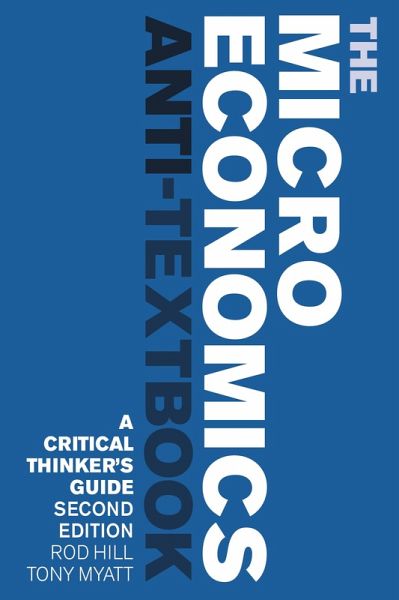
Mainstream textbooks present economics as an objective science, free from value judgements. The Microeconomics Anti-Textbook demonstrates this to be a myth - one which serves to make such textbooks not only off-puttingly bland, but also dangerously misleading in their justification of the status quo and neglect of alternatives. In this fully updated and expanded edition of their celebrated book, Professors Rod Hill and Tony Myatt lay out the essentials of each topic in the standard texts in a clear and concise way, before presenting an 'anti-text' analysis and critique. Challenging the…mehr
Mainstream textbooks present economics as an objective science, free from value judgements. The Microeconomics Anti-Textbook demonstrates this to be a myth - one which serves to make such textbooks not only off-puttingly bland, but also dangerously misleading in their justification of the status quo and neglect of alternatives. In this fully updated and expanded edition of their celebrated book, Professors Rod Hill and Tony Myatt lay out the essentials of each topic in the standard texts in a clear and concise way, before presenting an 'anti-text' analysis and critique. Challenging the assumptions, arguments, and models, Hill and Myatt provide the essential guide to decoding the textbooks, and show that real economics is far more interesting - and subversive - than the simplistic version presented to students.
Die Herstellerinformationen sind derzeit nicht verfügbar.
Autorenporträt
Rod Hill is a Professor of Economics in the Faculty of Business at the University of New Brunswick's Saint John campus.
Inhaltsangabe
Introduction - Our Goals, Audience, and Principal Themes 1. What is economics? Where you start influences where you go 2. Introducing economic models 3. How markets work (in an imaginary world) 4. People as consumers 5. The firm 6. Market Structure and Efficiency - or why perfect competition isn't so perfect after all. 7. Externalities, common access resources and public goods: the ubiquity of market failure 8. The marginal productivity theory of income distribution - or you're worth what you can get 9. Government, taxation, and the (re)distribution of income: is a just society just too expensive? 10. Trade and globalization without the rose-tinted glasses Conclusion Postscript: A case study of climate change and the textbooks
Es gelten unsere Allgemeinen Geschäftsbedingungen: www.buecher.de/agb
Impressum
www.buecher.de ist ein Internetauftritt der buecher.de internetstores GmbH
Geschäftsführung: Monica Sawhney | Roland Kölbl | Günter Hilger
Sitz der Gesellschaft: Batheyer Straße 115 - 117, 58099 Hagen
Postanschrift: Bürgermeister-Wegele-Str. 12, 86167 Augsburg
Amtsgericht Hagen HRB 13257
Steuernummer: 321/5800/1497
USt-IdNr: DE450055826