Sie sind bereits eingeloggt. Klicken Sie auf 2. tolino select Abo, um fortzufahren.
Bitte loggen Sie sich zunächst in Ihr Kundenkonto ein oder registrieren Sie sich bei bücher.de, um das eBook-Abo tolino select nutzen zu können.
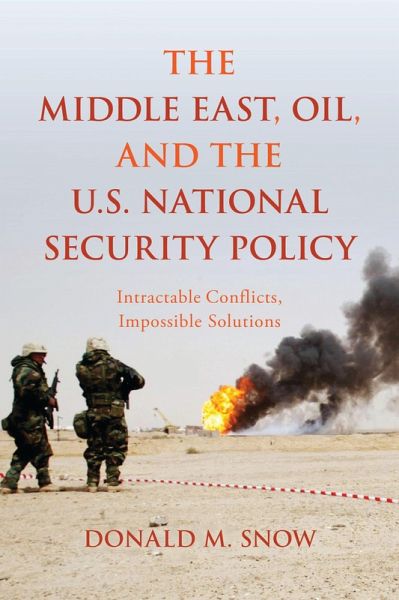
Three interrelated subject areas are at the heart of the current foreign and national security dilemma. One is the Middle East, which has been the epicenter of most U.S. policy activity for over a third of a century. The second is energy policy, particularly as it is affected by the development and exploitation of shale oil and gas reserves in the United States. This is linked to the Middle East because it has been American dependence on Middle East petroleum that has created the interest the U.S. has in this region. The third area is military manpower policy and two simultaneous wars in the…mehr
Three interrelated subject areas are at the heart of the current foreign and national security dilemma. One is the Middle East, which has been the epicenter of most U.S. policy activity for over a third of a century. The second is energy policy, particularly as it is affected by the development and exploitation of shale oil and gas reserves in the United States. This is linked to the Middle East because it has been American dependence on Middle East petroleum that has created the interest the U.S. has in this region. The third area is military manpower policy and two simultaneous wars in the new century have raised questions about the all-volunteer force policy in place since 1972. It is increasingly evident that foreign and defense policy are strained and in need of fresh conceptualization. The three areas identified are the most obvious examples of policy dysfunction. The key area is the Middle East region. As long as the United States remains heavily committed to this part of the world, especially with military force and essentially because of its energy needs, there will be strains on manpower resources that could force a reexamination of the all-volunteer concept. At the same time, the reduction of U.S. dependence on Middle Eastern oil loosens the bonds that seem to impel American activism in the region. The result could be true opportunities for a less confrontational, adversary-driven foreign and defense posture.
Die Herstellerinformationen sind derzeit nicht verfügbar.
Autorenporträt
Donald M. Snow is Professor Emeritus in Political Science at The University of Alabama, where he served on the faculty for 37 years. During that period, he was also Director of International Studies within the College of Arts and Sciences, Director of Faculty Development and Services within the Office of Academic Affairs, and Chair of the Tenure and Promotions Committee within the Political Science Department. He also served as Visiting Professor at the United States Air, Army, and Naval War Colleges and the Air Command and Staff College. Within the discipline, he served as national Chair of the International Security Studies Section of the International Studies Association and of the Arms Control and International Studies Section of the American Political Science Association. He was a frequent lecturer as professional military education schools and conferences sponsored by organizations such as the Freedoms Foundation at Valley Forge. Snow has published over 60 academic books and monographs on international relations, foreign and national security topics for a variety of publishers. His most recent books include National Security, seventh edition (2020), The Middle East and American National Security (2021), and Cases in International Relations, ninth edition (2022). He resides with his wife on Hilton Head Island, South Carolina, and has a son and three grandchildren who live nearby.
Inhaltsangabe
Preface Part I: Introduction Chapter 1: The Foreign and National Security Inheritance: The Cold War Paradigm Chapter 2: Military Manpower: Who Serves His (or Her) Country Part II: Energy and U.S. Foreign and National Security Policy Chapter 3: Energy and Policy Determination: Oil Addiction and Its Consequences Chapter 4: A Return to Energy Independence and Its Consequences: Shale Oil and Gas Part III: The U.S. and the Middle East Chapter 5: The Vexatious Middle East Chapter 6: The U. S. Posture in the Middle East Chapter 7: One size doesn't Fit All: Policy toward Very Different Places Chapter 8: Moving Ahead: Time for a Change
Preface Part I: Introduction Chapter 1: The Foreign and National Security Inheritance: The Cold War Paradigm Chapter 2: Military Manpower: Who Serves His (or Her) Country Part II: Energy and U.S. Foreign and National Security Policy Chapter 3: Energy and Policy Determination: Oil Addiction and Its Consequences Chapter 4: A Return to Energy Independence and Its Consequences: Shale Oil and Gas Part III: The U.S. and the Middle East Chapter 5: The Vexatious Middle East Chapter 6: The U. S. Posture in the Middle East Chapter 7: One size doesn't Fit All: Policy toward Very Different Places Chapter 8: Moving Ahead: Time for a Change
Es gelten unsere Allgemeinen Geschäftsbedingungen: www.buecher.de/agb
Impressum
www.buecher.de ist ein Internetauftritt der buecher.de internetstores GmbH
Geschäftsführung: Monica Sawhney | Roland Kölbl | Günter Hilger
Sitz der Gesellschaft: Batheyer Straße 115 - 117, 58099 Hagen
Postanschrift: Bürgermeister-Wegele-Str. 12, 86167 Augsburg
Amtsgericht Hagen HRB 13257
Steuernummer: 321/5800/1497
USt-IdNr: DE450055826