192,95 €
192,95 €
inkl. MwSt.
Sofort per Download lieferbar

96 °P sammeln
192,95 €
Als Download kaufen
192,95 €
inkl. MwSt.
Sofort per Download lieferbar
96 °P sammeln
Jetzt verschenken
Alle Infos zum eBook verschenken
192,95 €
inkl. MwSt.
Sofort per Download lieferbar
Alle Infos zum eBook verschenken
96 °P sammeln

Andere Kunden interessierten sich auch für
") The Minipig in Biomedical Research (eBook, PDF)192,95 €
The Minipig in Biomedical Research (eBook, PDF)192,95 €") The IACUC Handbook (eBook, ePUB)98,95 €
The IACUC Handbook (eBook, ePUB)98,95 €") Handbook of Laboratory Animal Science (eBook, ePUB)225,95 €
Handbook of Laboratory Animal Science (eBook, ePUB)225,95 €") The Minipig in Biomedical Research (eBook, ePUB)186,95 €
The Minipig in Biomedical Research (eBook, ePUB)186,95 €") Anatomy and Histology of the Pig (eBook, ePUB)196,95 €
Anatomy and Histology of the Pig (eBook, ePUB)196,95 €") Non-Clinical Vascular Infusion Technology, Volume II (eBook, ePUB)63,95 €
Non-Clinical Vascular Infusion Technology, Volume II (eBook, ePUB)63,95 €") The Care and Feeding of an IACUC (eBook, ePUB)47,95 €
The Care and Feeding of an IACUC (eBook, ePUB)47,95 €
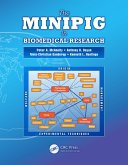
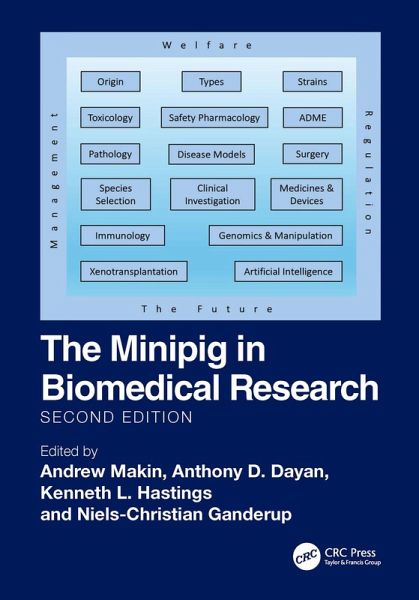
The second edition of The Minipig in Biomedical Research is a comprehensive resource for research scientists on the use of the minipig in basic and applied biomedical research. Written by experts in the field, coverage extends from the minipig's origins, anatomy, genetics, immunology, pathology and physiology to its welfare, health, and husbandry; practical dosing and examination procedures; surgical techniques; and all areas of toxicity testing and the uses of the minipig as a disease model. The book represents the state of the art, recognising the growing influence of Artificial Intelligence, and where appropriate, relevant databases are referenced. The future of minipigs with respect to genome editing and possible use in transplantation research makes this a very interesting model.
Since the first edition was published there has been a considerable increase in scientific, industrial and regulatory interest in the minipig; in some jurisdictions, for instance the UK, it is mandated that the minipig should be considered as a first-line non-rodent model. The expert authors in this new edition have given practical details and extensive examples of its successful application in many fields including surgery, drug development and safety testing. Greater emphasis is given to the origins and uses of several different strains of minipig, the greater understanding of genomics, genetic manipulation, immunology, their value in the development of novel exploratory and therapeutic implantable devices, and genetic and surgical procedures.
The second edition includes full color throughout, with high-quality illustrations, making it the go-to guide and resource for present and potential new users of minipigs.
Since the first edition was published there has been a considerable increase in scientific, industrial and regulatory interest in the minipig; in some jurisdictions, for instance the UK, it is mandated that the minipig should be considered as a first-line non-rodent model. The expert authors in this new edition have given practical details and extensive examples of its successful application in many fields including surgery, drug development and safety testing. Greater emphasis is given to the origins and uses of several different strains of minipig, the greater understanding of genomics, genetic manipulation, immunology, their value in the development of novel exploratory and therapeutic implantable devices, and genetic and surgical procedures.
The second edition includes full color throughout, with high-quality illustrations, making it the go-to guide and resource for present and potential new users of minipigs.
Dieser Download kann aus rechtlichen Gründen nur mit Rechnungsadresse in A, B, BG, CY, CZ, D, DK, EW, E, FIN, F, GR, HR, H, IRL, I, LT, L, LR, M, NL, PL, P, R, S, SLO, SK ausgeliefert werden.