19,99 €
inkl. MwSt.
Sofort per Download lieferbar
0 °P sammeln

Andere Kunden interessierten sich auch für
") Telescopic Work for Starlight Evenings (eBook, ePUB)19,99 €
Telescopic Work for Starlight Evenings (eBook, ePUB)19,99 €") Astronomy (eBook, ePUB)19,99 €
Astronomy (eBook, ePUB)19,99 €") The New Astronomy (eBook, ePUB)19,99 €
The New Astronomy (eBook, ePUB)19,99 €") The Moon (eBook, ePUB)19,99 €
The Moon (eBook, ePUB)19,99 €") The moon (eBook, ePUB)19,99 €
The moon (eBook, ePUB)19,99 €") Through the Telescope (eBook, ePUB)19,99 €
Through the Telescope (eBook, ePUB)19,99 €") Coming of Age in the Milky Way (eBook, ePUB)23,53 €
Coming of Age in the Milky Way (eBook, ePUB)23,53 €

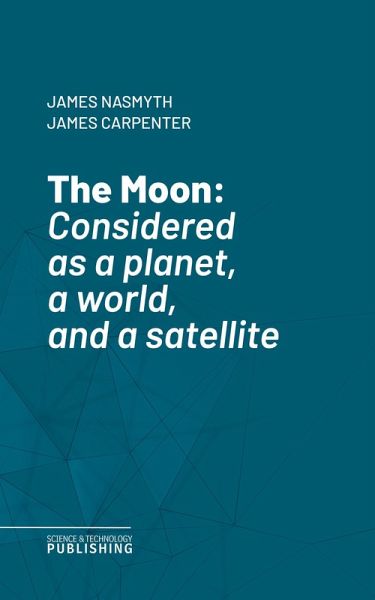
The Moon: Considered as a Planet, a World, and a Satellite by James Nasmyth and James Carpenter is a pioneering 19th-century scientific work that offers a comprehensive exploration of Earth's only natural satellite. First published in 1874, the book stands as a landmark in lunar studies, blending meticulous observation, scientific analysis, and innovative illustration. Nasmyth, an engineer and inventor, and Carpenter, an astronomer, combine their expertise to present the Moon not merely as a distant object in the sky, but as a dynamic world with its own geological history and physical characteristics. The book is divided into three main sections, each examining the Moon from a different perspective. As a planet, the authors discuss the Moon's size, mass, and orbit, comparing it to other bodies in the solar system and considering its place in the cosmic order. As a world, they delve into the Moon's surface features-its mountains, craters, valleys, and plains-drawing on telescopic observations and the latest scientific theories of their time. The authors are particularly renowned for their use of detailed plaster models, which they photographed under controlled lighting to simulate lunar conditions, resulting in some of the most accurate and evocative images of the Moon available before the space age. As a satellite, the book explores the Moon's relationship with Earth, including its phases, eclipses, tidal effects, and the mechanics of its orbit. Nasmyth and Carpenter also speculate on the Moon's origin and evolution, offering early hypotheses about its formation and the processes that shaped its surface. Throughout, the text is accessible yet authoritative, aiming to engage both the scientific community and the general reader. Richly illustrated with engravings and photographs, The Moon: Considered as a Planet, a World, and a Satellite captures the wonder and mystery of lunar science in the Victorian era. It remains a testament to human curiosity and ingenuity, reflecting the spirit of discovery that continues to drive our exploration of the cosmos.
Dieser Download kann aus rechtlichen Gründen nur mit Rechnungsadresse in A, B, BG, CY, CZ, D, DK, EW, E, FIN, F, GR, HR, H, IRL, I, LT, L, LR, M, NL, PL, P, R, S, SLO, SK ausgeliefert werden.