Sie sind bereits eingeloggt. Klicken Sie auf 2. tolino select Abo, um fortzufahren.
Bitte loggen Sie sich zunächst in Ihr Kundenkonto ein oder registrieren Sie sich bei bücher.de, um das eBook-Abo tolino select nutzen zu können.
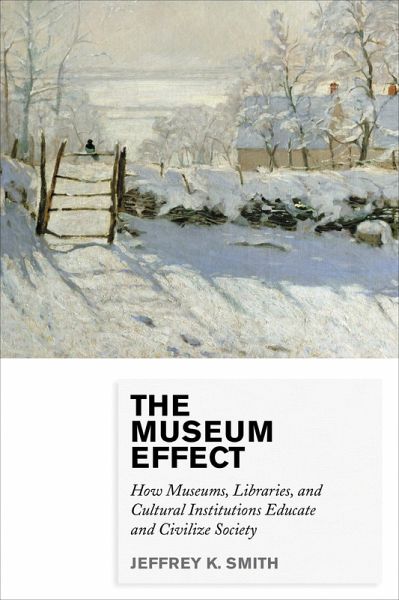
Museums, libraries, and cultural institutions provide opportunities for people to understand and celebrate who they are, were, and might be. These institutions educate the public and civilize society in a variety of ways, ranging from community events to a single child making a first visit. The Museum Effect documents this phenomenon, explains how it happens, and shows how institutions can facilitate this process. Cultural institutions vary dramatically in size, nature and purpose, but they all allow visitors to hold conversations with artists and authors perhaps long dead. These…mehr
Museums, libraries, and cultural institutions provide opportunities for people to understand and celebrate who they are, were, and might be. These institutions educate the public and civilize society in a variety of ways, ranging from community events to a single child making a first visit. The Museum Effect documents this phenomenon, explains how it happens, and shows how institutions can facilitate this process. Cultural institutions vary dramatically in size, nature and purpose, but they all allow visitors to hold conversations with artists and authors perhaps long dead. These conversations, sometimes with others present, and sometimes with artists, scientists, explorers, or authors not present, allow visitors to explore their lives and their "possible selves." Cultural institutions inspire personal reflection, and help visitors better themselves, in that they leave having contemplated what is noble, excellent, or exemplary about the society in which they live. The "museum effect" is a process through which cultural institutions educate and civilize us as individuals and as societies. These institutions allow visitors to spend some time with their thoughts elevated, and leave the institution better people in some meaningful fashion than when they entered. This visionary book presents the underlying idea and the argument for the museum effect, along with empirical research supporting that argument. It will help those working in museums, libraries, and archivists to facilitate this process, and study how this is working in their own institutions.
Die Herstellerinformationen sind derzeit nicht verfügbar.
Autorenporträt
Jeffrey K. Smith holds a chaired professorship at the University of Otago in New Zealand. He serves as Dean of the College of Education at the University. Prior to Otago, he was Professor and Chair of the Educational Psychology Department at Rutgers University, where he had been a faculty member for twenty-nine years. His AB is from Princeton University and his PhD is from the University of Chicago. From 1988 through 2005, he also founded and served as Head of the Office of Research and Evaluation at The Metropolitan Museum of Art in New York. He studies issues in the psychology of aesthetics, learning in cultural institutions, and educational assessment.
Inhaltsangabe
Acknowledgments Preface Chapter 1 : Introduction -Who We were, Who We are, Who We Might Become Chapter 2 The Nature of Visits to Cultural Institutions Five museum visits Who goes to cultural institutions and events, and why? What do people do during their visit? What are their visiting preferences? Time and number of works viewed Locus of attention The influence of art-related knowledge Summary Chapter 3 Time, Flow, and the Unit of Analysis What is a museum like? Time and museums Experiencing flow in museums The unit of analysis in looking at art Setting the stage Chapter 4 DefiningThe Museum Effect How should we look at art versus how do we look at art? A brief tour of model city What (all) happens when we look at art? Art as mirror The model of the Museum Effect Investigating the Museum Effect What to make of all this? Chapter 5 Expanding the Museum Effect to Other Cultural Institutions and Events What is essential about the museum effect? What is similar and different about various cultural institutions? What is a painting like? So, does the Museum Effect extend to other cultural institutions? Chapter 6 How to Enhance the Museum Effect How best to interact with visitors? The "right way" to look at a painting The basics: "We are in your hands!" The options, current and future Looking ahead Chapter 7 Investigating the Museum Effect and Other Research in Cultural Institutions The nature of asking questions, in particular, research questions Models of the processes involved in research and evaluation Examples and extensions Extending what we know about the Museum Effect A Final Word Index
Es gelten unsere Allgemeinen Geschäftsbedingungen: www.buecher.de/agb
Impressum
www.buecher.de ist ein Internetauftritt der buecher.de internetstores GmbH
Geschäftsführung: Monica Sawhney | Roland Kölbl | Günter Hilger
Sitz der Gesellschaft: Batheyer Straße 115 - 117, 58099 Hagen
Postanschrift: Bürgermeister-Wegele-Str. 12, 86167 Augsburg
Amtsgericht Hagen HRB 13257
Steuernummer: 321/5800/1497
USt-IdNr: DE450055826