4,49 €
4,49 €
inkl. MwSt.
Erscheint vor. 05.12.25

0 °P sammeln
4,49 €
Als Download kaufen
4,49 €
inkl. MwSt.
Erscheint vor. 05.12.25
0 °P sammeln
Jetzt verschenken
Alle Infos zum eBook verschenken
4,49 €
inkl. MwSt.
Erscheint vor. 05.12.25
Alle Infos zum eBook verschenken
0 °P sammeln

Andere Kunden interessierten sich auch für
") The Chess Game of Reality (eBook, ePUB)5,49 €
The Chess Game of Reality (eBook, ePUB)5,49 € (eBook, ePUB)") Código Cuántico: Descifrando la Matriz de la Realidad (Quantum Code Decoding the Matrix of Reality, #1) (eBook, ePUB)6,99 €
Código Cuántico: Descifrando la Matriz de la Realidad (Quantum Code Decoding the Matrix of Reality, #1) (eBook, ePUB)6,99 €") Free Will (eBook, ePUB)10,95 €
Free Will (eBook, ePUB)10,95 € (eBook, ePUB)") The Source Field - How Consciousness Rendered the Universe (The Architecture of Reality) (eBook, ePUB)6,49 €
The Source Field - How Consciousness Rendered the Universe (The Architecture of Reality) (eBook, ePUB)6,49 €") The Quantum Enigma (eBook, ePUB)7,99 €
The Quantum Enigma (eBook, ePUB)7,99 €") Unseen Arcitect (eBook, ePUB)5,49 €
Unseen Arcitect (eBook, ePUB)5,49 €") Quantum Awakening: The Journey Beyond Time and Space (eBook, ePUB)3,99 €
Quantum Awakening: The Journey Beyond Time and Space (eBook, ePUB)3,99 €

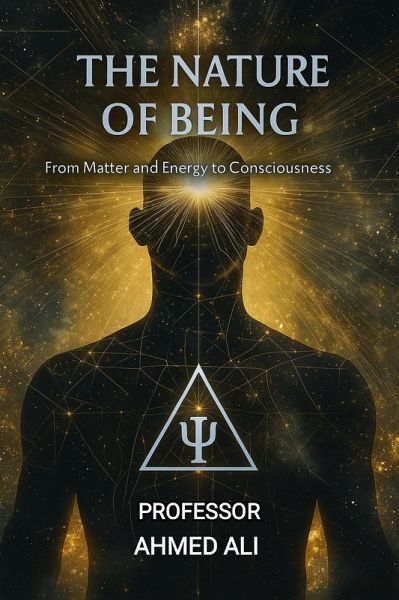
"The Nature of Being" is an ambitious philosophical-scientific work that aims to present a unified theory of reality, integrating modern physics (such as quantum mechanics and cosmology), studies of consciousness, philosophy, and theology. The book's core purpose is to challenge the traditional divides between these fields and search for a coherent picture of being that explains who we are, why we are here, and the nature of the universe we inhabit.
Key Ideas and Main Themes
A Critique of Traditional Origin Narratives: The book examines religious and scientific accounts of the origin of the universe (such as Genesis and the Big Bang theory) and concludes that neither is sufficient on its own. Religion offers irrefutable answers (based on faith), while science describes the "how" but remains silent on the "why" (the problem of the fine-tuning of the universe).
Deconstructing the Idea of a "First Cause" or "Prime Mover": The book argues that the question "Who created God?" is structurally flawed because it imposes human concepts (such as temporality and factorization) onto something transcendent. Instead, it proposes a shift from searching for a "factor" to analyzing the "architecture" of reality.
The Simulation Hypothesis: The book explores the possibility that our universe is a complex computer simulation, citing evidence such as the "quantum of spacetime" (the length and length of Planck spacetime), the existence of a speed limit (the speed of light), the inconsistent efficiency of mathematics, and quantum mechanical phenomena (such as measurement termination).
Consciousness as a Fundamental Property, Not a Byproduct: This is one of the book's central tenets. Consciousness is presented not as a product of the brain, but as a fundamental property of the universe. The brain acts as a receiver and transmitter of consciousness, not as its producer.
Death as an Illusion and Transition, Not as Annihilation: The book presents various pieces of evidence (near-death experiences, the laws of thermodynamics, the ORC-OR model) to refute the idea that death is the end of consciousness. Instead, it describes a detailed "transition protocol" for consciousness after the death of the biological body.
Hell as a state of consciousness, not a place: The book deconstructs the traditional concept of hell, arguing that it is not a place of physical torment, but rather a state of consciousness characterized by isolation, a stagnant cycle of remorse, and the feeling of pain inflicted on others.
Cassandra's Prophecy and the Fall of Civilization: The final chapter is a chilling warning. Through an AI-powered simulation, the book predicts that humanity's greatest existential threat is not nuclear war or an asteroid, but a cognitive collapse resulting from information overload, the disintegration of truth, the complexity of fragile infrastructure, and the dichotomy of empathy (us versus them).
Style and Temperament
The book blends academic rigor (quoting scientific and philosophical theories) with poetic depth (rich figurative language and evocative metaphors).
This aims to make complex content accessible and emotionally impactful.
Narrative Style: The book uses thought experiments (such as "The Brain Engineer Disillusioned") and near-death experiences to make abstract ideas tangible and personal.
Analytical Authority (Al-Wasatiyyah): The use of the fictional artificial intelligence system "Al-Wasatiyyah" as a neutral authority for analyzing data and drawing conclusions lends the arguments an aura of objectivity and scientific rigor, even when dealing with unconventional topics.
Reflectional Character: The book does not offer comfortable answers. It pushes the reader to the brink of existential inquiry, challenging their preconceived notions about God, death, and reality. Its deeply reflective tone calls for moral and intellectual vigilance.
Key Ideas and Main Themes
A Critique of Traditional Origin Narratives: The book examines religious and scientific accounts of the origin of the universe (such as Genesis and the Big Bang theory) and concludes that neither is sufficient on its own. Religion offers irrefutable answers (based on faith), while science describes the "how" but remains silent on the "why" (the problem of the fine-tuning of the universe).
Deconstructing the Idea of a "First Cause" or "Prime Mover": The book argues that the question "Who created God?" is structurally flawed because it imposes human concepts (such as temporality and factorization) onto something transcendent. Instead, it proposes a shift from searching for a "factor" to analyzing the "architecture" of reality.
The Simulation Hypothesis: The book explores the possibility that our universe is a complex computer simulation, citing evidence such as the "quantum of spacetime" (the length and length of Planck spacetime), the existence of a speed limit (the speed of light), the inconsistent efficiency of mathematics, and quantum mechanical phenomena (such as measurement termination).
Consciousness as a Fundamental Property, Not a Byproduct: This is one of the book's central tenets. Consciousness is presented not as a product of the brain, but as a fundamental property of the universe. The brain acts as a receiver and transmitter of consciousness, not as its producer.
Death as an Illusion and Transition, Not as Annihilation: The book presents various pieces of evidence (near-death experiences, the laws of thermodynamics, the ORC-OR model) to refute the idea that death is the end of consciousness. Instead, it describes a detailed "transition protocol" for consciousness after the death of the biological body.
Hell as a state of consciousness, not a place: The book deconstructs the traditional concept of hell, arguing that it is not a place of physical torment, but rather a state of consciousness characterized by isolation, a stagnant cycle of remorse, and the feeling of pain inflicted on others.
Cassandra's Prophecy and the Fall of Civilization: The final chapter is a chilling warning. Through an AI-powered simulation, the book predicts that humanity's greatest existential threat is not nuclear war or an asteroid, but a cognitive collapse resulting from information overload, the disintegration of truth, the complexity of fragile infrastructure, and the dichotomy of empathy (us versus them).
Style and Temperament
The book blends academic rigor (quoting scientific and philosophical theories) with poetic depth (rich figurative language and evocative metaphors).
This aims to make complex content accessible and emotionally impactful.
Narrative Style: The book uses thought experiments (such as "The Brain Engineer Disillusioned") and near-death experiences to make abstract ideas tangible and personal.
Analytical Authority (Al-Wasatiyyah): The use of the fictional artificial intelligence system "Al-Wasatiyyah" as a neutral authority for analyzing data and drawing conclusions lends the arguments an aura of objectivity and scientific rigor, even when dealing with unconventional topics.
Reflectional Character: The book does not offer comfortable answers. It pushes the reader to the brink of existential inquiry, challenging their preconceived notions about God, death, and reality. Its deeply reflective tone calls for moral and intellectual vigilance.
Dieser Download kann aus rechtlichen Gründen nur mit Rechnungsadresse in A, B, CY, CZ, D, DK, EW, E, FIN, F, GR, H, IRL, I, LT, L, LR, M, NL, PL, P, R, S, SLO, SK ausgeliefert werden.