13,99 €
13,99 €
inkl. MwSt.
Sofort per Download lieferbar

0 °P sammeln
13,99 €
Als Download kaufen
13,99 €
inkl. MwSt.
Sofort per Download lieferbar
0 °P sammeln
Jetzt verschenken
Alle Infos zum eBook verschenken
13,99 €
inkl. MwSt.
Sofort per Download lieferbar
Alle Infos zum eBook verschenken
0 °P sammeln

Andere Kunden interessierten sich auch für
") India and the Multipolar World (eBook, ePUB)3,99 €
India and the Multipolar World (eBook, ePUB)3,99 €") The End of Western Dominance - The Restructuring of the multipolar World (eBook, ePUB)4,99 €
The End of Western Dominance - The Restructuring of the multipolar World (eBook, ePUB)4,99 €") Impermanence Of Global Hegemony: Is Time Running Out For US Hegemony? Is Multipolar World The Future? (eBook, ePUB)3,99 €
Impermanence Of Global Hegemony: Is Time Running Out For US Hegemony? Is Multipolar World The Future? (eBook, ePUB)3,99 €") The U.S. Indo-Pacific Strategy & The Prospect of Forging A New Multipolar World (eBook, ePUB)5,49 €
The U.S. Indo-Pacific Strategy & The Prospect of Forging A New Multipolar World (eBook, ePUB)5,49 €") Southeast Asia's Multipolar Future (eBook, ePUB)70,95 €
Southeast Asia's Multipolar Future (eBook, ePUB)70,95 €") International Relations in a multipolar Middle East (eBook, ePUB)85,95 €
International Relations in a multipolar Middle East (eBook, ePUB)85,95 €") Nuclear Deterrence in a Multipolar World (eBook, ePUB)41,95 €
Nuclear Deterrence in a Multipolar World (eBook, ePUB)41,95 €





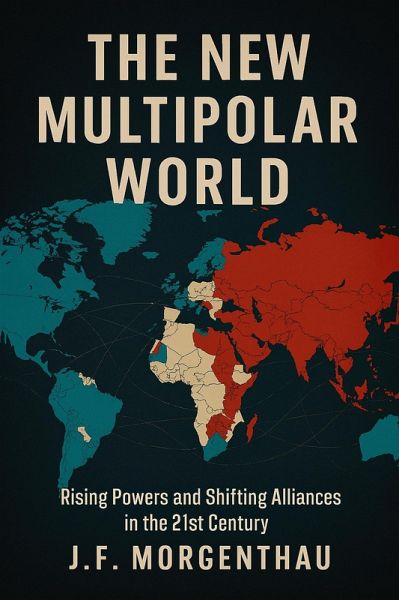
The New Multipolar World: Rising Powers and Shifting Alliances in the 21st Century
How China, Russia, India, and North Korea Are Reshaping Global Order
The world is witnessing the most significant transformation of international power since the end of World War II. The unipolar moment that defined global politics for three decades after the Cold War has given way to a new multipolar system, anchored by an unprecedented alignment between China, Russia, India, and North Korea as a counterweight to Western dominance.
In this comprehensive and timely analysis, leading experts examine how four seemingly incompatible powers despite their different political systems, economic models, and historical rivalries have found common ground in challenging American hegemony and reshaping international order. From Xi Jinping and Vladimir Putin's "no limits" partnership to India's strategic autonomy doctrine and North Korea's nuclear leverage, this book reveals the sophisticated strategies driving the most consequential geopolitical realignment of our time.
Drawing on extensive primary source research, government documents, and interviews with policymakers across multiple continents, The New Multipolar World provides the first systematic examination of how this eastern alignment operates across economic, military, technological, and diplomatic dimensions. The authors analyze the Belt and Road Initiative's geopolitical implications, the deepening Russia-China energy partnerships, India's delicate balancing act between East and West, and North Korea's evolution from isolated pariah to strategic partner.
But this transformation extends far beyond the four powers themselves. Middle powers from Southeast Asia to Latin America must navigate increasingly complex relationships with multiple great powers. International institutions struggle to function as great power competition paralyzes decision-making. Global challenges like climate change require unprecedented cooperation precisely when geopolitical tensions make such cooperation more difficult.
Through detailed case studies and forward-looking scenario analysis, the book examines how different regions and countries are adapting to this new reality. ASEAN's sophisticated hedging strategies, Europe's struggle between economic interests and security imperatives, and Africa's growing agency in multipolar competition all illustrate the diverse ways middle powers are responding to great power rivalry.
The book's final sections explore four possible futures for international order by 2035, from managed competition and institutional coexistence to conflict escalation and system breakdown. These scenarios provide essential strategic planning tools for policymakers while highlighting the human agency that will ultimately determine outcomes.
The New Multipolar World challenges conventional wisdom about alliance formation, economic integration, and international cooperation. It demonstrates that successful multipolarity requires new approaches to diplomacy, institutional design, and strategic thinking that go beyond Cold War-era frameworks. The book shows how opposition to dominance can provide a sufficient foundation for sustained cooperation even among countries with significant differences, and how middle powers possess greater influence than traditional theories suggest.
How China, Russia, India, and North Korea Are Reshaping Global Order
The world is witnessing the most significant transformation of international power since the end of World War II. The unipolar moment that defined global politics for three decades after the Cold War has given way to a new multipolar system, anchored by an unprecedented alignment between China, Russia, India, and North Korea as a counterweight to Western dominance.
In this comprehensive and timely analysis, leading experts examine how four seemingly incompatible powers despite their different political systems, economic models, and historical rivalries have found common ground in challenging American hegemony and reshaping international order. From Xi Jinping and Vladimir Putin's "no limits" partnership to India's strategic autonomy doctrine and North Korea's nuclear leverage, this book reveals the sophisticated strategies driving the most consequential geopolitical realignment of our time.
Drawing on extensive primary source research, government documents, and interviews with policymakers across multiple continents, The New Multipolar World provides the first systematic examination of how this eastern alignment operates across economic, military, technological, and diplomatic dimensions. The authors analyze the Belt and Road Initiative's geopolitical implications, the deepening Russia-China energy partnerships, India's delicate balancing act between East and West, and North Korea's evolution from isolated pariah to strategic partner.
But this transformation extends far beyond the four powers themselves. Middle powers from Southeast Asia to Latin America must navigate increasingly complex relationships with multiple great powers. International institutions struggle to function as great power competition paralyzes decision-making. Global challenges like climate change require unprecedented cooperation precisely when geopolitical tensions make such cooperation more difficult.
Through detailed case studies and forward-looking scenario analysis, the book examines how different regions and countries are adapting to this new reality. ASEAN's sophisticated hedging strategies, Europe's struggle between economic interests and security imperatives, and Africa's growing agency in multipolar competition all illustrate the diverse ways middle powers are responding to great power rivalry.
The book's final sections explore four possible futures for international order by 2035, from managed competition and institutional coexistence to conflict escalation and system breakdown. These scenarios provide essential strategic planning tools for policymakers while highlighting the human agency that will ultimately determine outcomes.
The New Multipolar World challenges conventional wisdom about alliance formation, economic integration, and international cooperation. It demonstrates that successful multipolarity requires new approaches to diplomacy, institutional design, and strategic thinking that go beyond Cold War-era frameworks. The book shows how opposition to dominance can provide a sufficient foundation for sustained cooperation even among countries with significant differences, and how middle powers possess greater influence than traditional theories suggest.
Dieser Download kann aus rechtlichen Gründen nur mit Rechnungsadresse in A, B, CY, CZ, D, DK, EW, E, FIN, F, GR, H, IRL, I, LT, L, LR, M, NL, PL, P, R, S, SLO, SK ausgeliefert werden.