42,95 €
42,95 €
inkl. MwSt.
Sofort per Download lieferbar

21 °P sammeln
42,95 €
Als Download kaufen
42,95 €
inkl. MwSt.
Sofort per Download lieferbar
21 °P sammeln
Jetzt verschenken
Alle Infos zum eBook verschenken
42,95 €
inkl. MwSt.
Sofort per Download lieferbar
Alle Infos zum eBook verschenken
21 °P sammeln

Andere Kunden interessierten sich auch für
 (eBook, ePUB)") Post-Socialist Urban Infrastructures (OPEN ACCESS) (eBook, ePUB)0,00 €
Post-Socialist Urban Infrastructures (OPEN ACCESS) (eBook, ePUB)0,00 €") The Nocturnal City (eBook, ePUB)41,95 €
The Nocturnal City (eBook, ePUB)41,95 €") The Isolated City State (eBook, ePUB)24,95 €
The Isolated City State (eBook, ePUB)24,95 €") Growth and Change in Post-socialist Cities of Central Europe (eBook, ePUB)41,95 €
Growth and Change in Post-socialist Cities of Central Europe (eBook, ePUB)41,95 €") Transport, Mobility, and the Production of Urban Space (eBook, ePUB)47,95 €
Transport, Mobility, and the Production of Urban Space (eBook, ePUB)47,95 €") Rebel Streets and the Informal Economy (eBook, ePUB)45,95 €
Rebel Streets and the Informal Economy (eBook, ePUB)45,95 €") The Routledge Companion to Urban Regeneration (eBook, ePUB)45,95 €
The Routledge Companion to Urban Regeneration (eBook, ePUB)45,95 €


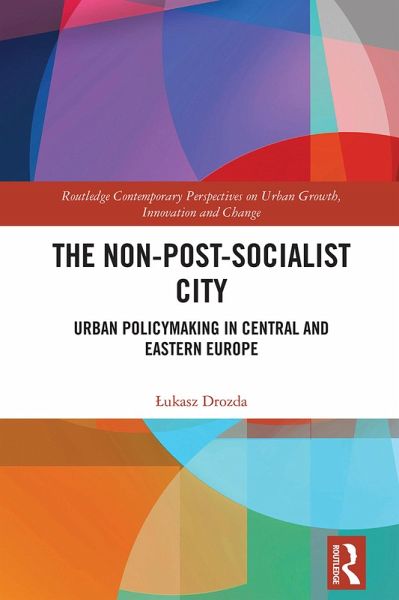
The Non-Post-Socialist City examines contemporary urban policies through case studies of six cities in four states across Central and Eastern Europe and Former Soviet Union (CEE/FSU) region.
This book adopts a rarely used approach in the study of so-called post-socialist cities-combining several years of in-depth empirical research with a broad comparative frame. Building on this foundation, it analyzes urban policymaking processes in Leipzig (Germany), Warsaw and Krakow (Poland), Tallinn (Estonia), and Kyiv and Lviv (Ukraine). The monograph interprets these dynamics through the author's concept of diluted post-socialism, which highlights not only trajectories rooted in the Soviet-dominated era but also a range of pre- or nonsocialist legacies that interact with-and often complicate-the few decades of now-defunct state-socialist rule. Particular attention is given to four policy fields: mobility, green infrastructure, housing, and spatial planning. While these domains pose broadly similar dimensions across the six cities, their organization reveals a highly diverse urban landscape that is too often flattened under the "post-socialist" label.
The book is intended for scholars, analysts, students, and anyone interested in urbanization processes in the former Eastern bloc, as well as in the impact of the global populist turn on urban policymaking within this region and in a broader urban context.
This book adopts a rarely used approach in the study of so-called post-socialist cities-combining several years of in-depth empirical research with a broad comparative frame. Building on this foundation, it analyzes urban policymaking processes in Leipzig (Germany), Warsaw and Krakow (Poland), Tallinn (Estonia), and Kyiv and Lviv (Ukraine). The monograph interprets these dynamics through the author's concept of diluted post-socialism, which highlights not only trajectories rooted in the Soviet-dominated era but also a range of pre- or nonsocialist legacies that interact with-and often complicate-the few decades of now-defunct state-socialist rule. Particular attention is given to four policy fields: mobility, green infrastructure, housing, and spatial planning. While these domains pose broadly similar dimensions across the six cities, their organization reveals a highly diverse urban landscape that is too often flattened under the "post-socialist" label.
The book is intended for scholars, analysts, students, and anyone interested in urbanization processes in the former Eastern bloc, as well as in the impact of the global populist turn on urban policymaking within this region and in a broader urban context.
Dieser Download kann aus rechtlichen Gründen nur mit Rechnungsadresse in A, B, BG, CY, CZ, D, DK, EW, E, FIN, F, GR, HR, H, IRL, I, LT, L, LR, M, NL, PL, P, R, S, SLO, SK ausgeliefert werden.