37,95 €
inkl. MwSt.
Sofort per Download lieferbar
19 °P sammeln

Andere Kunden interessierten sich auch für
") The Psychology of Education (eBook, PDF)44,95 €
The Psychology of Education (eBook, PDF)44,95 €") From the Laboratory to the Classroom (eBook, PDF)52,95 €
From the Laboratory to the Classroom (eBook, PDF)52,95 €") The Social Psychology of the Classroom (eBook, PDF)49,95 €
The Social Psychology of the Classroom (eBook, PDF)49,95 €") Dialogue and the Development of Children's Thinking (eBook, PDF)47,95 €
Dialogue and the Development of Children's Thinking (eBook, PDF)47,95 €") In Search of Pedagogy Volume I (eBook, PDF)37,95 €
In Search of Pedagogy Volume I (eBook, PDF)37,95 €") International Handbook of the Learning Sciences (eBook, PDF)129,95 €
International Handbook of the Learning Sciences (eBook, PDF)129,95 €") Metacognition in Educational Theory and Practice (eBook, PDF)76,95 €
Metacognition in Educational Theory and Practice (eBook, PDF)76,95 €


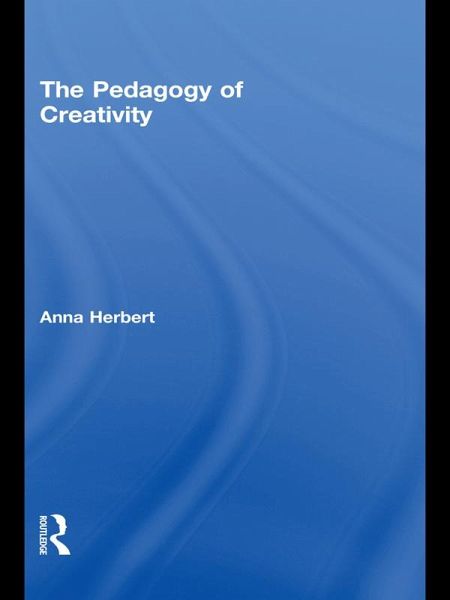
The Pedagogy of Creativity represents a groundbreaking study linking the pedagogy of classroom creativity with psychoanalytical theories. Taking a classroom-based example of poststructuralist methodology as its starting point, Anna Herbert's investigation explores the relationship between creativity seen in psychological activity, such as dreams, and creativity seen in the classroom, asking the following questions:
Exploring the ideas of a number of psychological analysts including Jacques Lacan's four discourses, concepts of 'the other' and the theories of Postructuralist thinkers including Levinas, Mead and Kristeva, Herbert explains how different theories can be used to develop creativity in the classroom and surmount obstacles preventing creative environments.
Clearly presenting both theoretical positions and their bearing on classroom practice, teachers at all levels will benefit from this innovative approach to creativity, as will school psychologists and all professionals interested in the links between psychoanalysis and pedagogy.
Herbert clearly communicates both theoretical positions and their bearing on classroom practice. Teacher at all levels will benefit from this innovative approach to creativity, as will school psychologists and other professionals interested in the links between psychoanalysis and pedagogy.
- What might a methodology which taps into different forms of creativity look like?
- Could such a methodology support current neuropsychological theories of memory and learning?
- What are the consequences of imaginary and symbolic orders of knowledge for the understanding of both conscious and unconscious creativity in the classroom?
Exploring the ideas of a number of psychological analysts including Jacques Lacan's four discourses, concepts of 'the other' and the theories of Postructuralist thinkers including Levinas, Mead and Kristeva, Herbert explains how different theories can be used to develop creativity in the classroom and surmount obstacles preventing creative environments.
Clearly presenting both theoretical positions and their bearing on classroom practice, teachers at all levels will benefit from this innovative approach to creativity, as will school psychologists and all professionals interested in the links between psychoanalysis and pedagogy.
Herbert clearly communicates both theoretical positions and their bearing on classroom practice. Teacher at all levels will benefit from this innovative approach to creativity, as will school psychologists and other professionals interested in the links between psychoanalysis and pedagogy.
Dieser Download kann aus rechtlichen Gründen nur mit Rechnungsadresse in A, B, BG, CY, CZ, D, DK, EW, E, FIN, F, GR, HR, H, IRL, I, LT, L, LR, M, NL, PL, P, R, S, SLO, SK ausgeliefert werden.