45,95 €
inkl. MwSt.
Sofort per Download lieferbar
23 °P sammeln

Andere Kunden interessierten sich auch für
") The Periodical Press Revolution (eBook, ePUB)45,95 €
The Periodical Press Revolution (eBook, ePUB)45,95 €") Election Politics and the Mass Press in Long Edwardian Britain (eBook, PDF)19,95 €
Election Politics and the Mass Press in Long Edwardian Britain (eBook, PDF)19,95 €") Researching the Nineteenth-Century Periodical Press (eBook, PDF)45,95 €
Researching the Nineteenth-Century Periodical Press (eBook, PDF)45,95 €") Key Readings in Journalism (eBook, PDF)71,95 €
Key Readings in Journalism (eBook, PDF)71,95 €") The Disputed Freedoms of a Disrupted Press (eBook, PDF)21,95 €
The Disputed Freedoms of a Disrupted Press (eBook, PDF)21,95 €") A Narrative History of the American Press (eBook, PDF)45,95 €
A Narrative History of the American Press (eBook, PDF)45,95 €") Perceptions of the Press in Nineteenth-Century British Periodicals (eBook, PDF)32,95 €
Perceptions of the Press in Nineteenth-Century British Periodicals (eBook, PDF)32,95 €

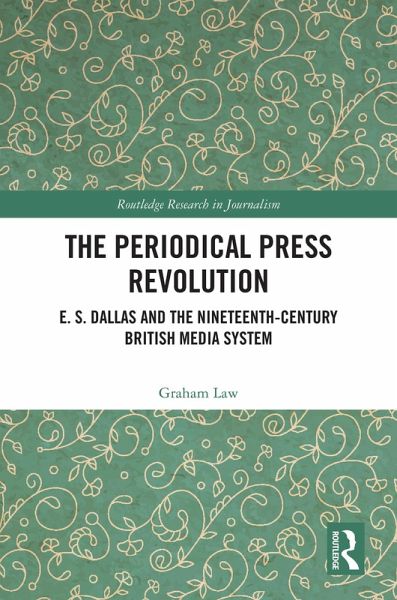
This book explores a key aspect of journalism history from a sociological perspective: the rise of the periodical press. With a focus not on the economic and technological causes of this revolution but on the social and political consequences, the book takes a global look at this key development in the British press.
Taking as a point of departure the theory of E.S. Dallas, who defined the periodical as 'the great event in modern history', the book explores these premises and conclusions regarding authorship, publishing, and readership, considering the nineteenth century as a whole. After an introductory section discussing questions of theory and method, the analysis first offers an overview of the quantitative growth of the periodical market, whether measured in terms of publications, readership, or authorship, before turning to a more detailed consideration of its qualitative determinants and effects, again distinguishing the same three aspects.
Offering new insight into this key turning point in journalism history, this book will be of interest to all students and scholars of journalism and journalism history, media history, media and communication studies, British history, and modern history.
Taking as a point of departure the theory of E.S. Dallas, who defined the periodical as 'the great event in modern history', the book explores these premises and conclusions regarding authorship, publishing, and readership, considering the nineteenth century as a whole. After an introductory section discussing questions of theory and method, the analysis first offers an overview of the quantitative growth of the periodical market, whether measured in terms of publications, readership, or authorship, before turning to a more detailed consideration of its qualitative determinants and effects, again distinguishing the same three aspects.
Offering new insight into this key turning point in journalism history, this book will be of interest to all students and scholars of journalism and journalism history, media history, media and communication studies, British history, and modern history.
Dieser Download kann aus rechtlichen Gründen nur mit Rechnungsadresse in A, B, BG, CY, CZ, D, DK, EW, E, FIN, F, GR, HR, H, IRL, I, LT, L, LR, M, NL, PL, P, R, S, SLO, SK ausgeliefert werden.
Awarded Honorary Mention in the prestigious annual RSVP (Research Society for Victorian Periodicals) Colby Book Prize for 2024!
"The award committee praised The Periodical Press Revolution for offering 'a bold and ambitious argument centred on E. S. Dallas's influential 1859 essays for Blackwood's Magazine. Based on an intertwined methodology of quantitative data and qualitative argument, this is an impressive book about press transformations underpinned by a media theory approach. Graham Law gives fresh and valuable perspectives in particular on structural change and developments in the British nineteenth-century press through Dallas as an organizing figure.'"
Fionnuala Dillane, Professor, University College Dublin
"The award committee praised The Periodical Press Revolution for offering 'a bold and ambitious argument centred on E. S. Dallas's influential 1859 essays for Blackwood's Magazine. Based on an intertwined methodology of quantitative data and qualitative argument, this is an impressive book about press transformations underpinned by a media theory approach. Graham Law gives fresh and valuable perspectives in particular on structural change and developments in the British nineteenth-century press through Dallas as an organizing figure.'"
Fionnuala Dillane, Professor, University College Dublin