Sie sind bereits eingeloggt. Klicken Sie auf 2. tolino select Abo, um fortzufahren.
Bitte loggen Sie sich zunächst in Ihr Kundenkonto ein oder registrieren Sie sich bei bücher.de, um das eBook-Abo tolino select nutzen zu können.
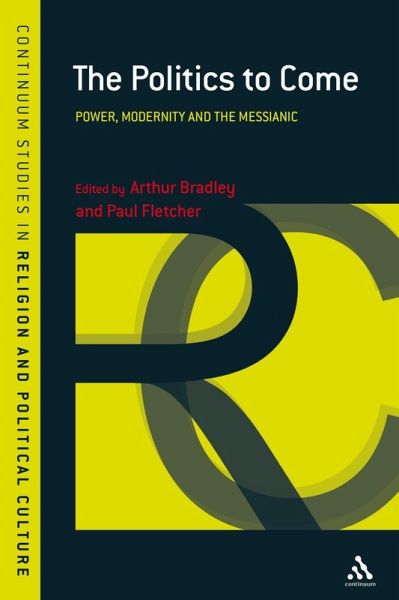
The Politics to Come brings together an international collection of thinkers to consider the meaning of liberal democratic modernity at a moment when its future has never been less certain. It examines the explosive threats the liberal order confronts today: financial meltdown, religious extremism, environmental catastrophe. Yet, it also seeks to place these - singularly modern - crises within a much longer history. For the contributors to this collection, it is the ancient religious tradition called 'the messianic' that provides the critical lens through which modernity may be interrogated.…mehr
The Politics to Come brings together an international collection of thinkers to consider the meaning of liberal democratic modernity at a moment when its future has never been less certain. It examines the explosive threats the liberal order confronts today: financial meltdown, religious extremism, environmental catastrophe. Yet, it also seeks to place these - singularly modern - crises within a much longer history.
For the contributors to this collection, it is the ancient religious tradition called 'the messianic' that provides the critical lens through which modernity may be interrogated. In its ongoing struggles with the messianic, liberal modernity confronts the promise and threat of a radically new Politics to Come.
So what are the Politics to Come? How do they manifest themselves throughout history? Why does the possibility of a messianic judgement continue to haunt the western political imaginary? This collection offers a series of political, philosophical and theological perspectives from which the future of liberal modernity - if it has one - can be imagined.
Die Herstellerinformationen sind derzeit nicht verfügbar.
Autorenporträt
Arthur Bradley is Senior Lecturer in Literary and Cultural Studies at Lancaster University, UK. He is the author of Negative Theology and Modern French Philosophy; Derrida's Of Grammatology: A Philosophical Guide and (with Andrew Tate) The New Atheist Novel: Fiction, Philosophy and Polemic after 9/11. Paul Fletcher (1965-2008) was Lecturer in Religious Studies at Lancaster University, UK. He is the author of Disciplining the Divine: Toward an (Im)political Theology.
Inhaltsangabe
Introduction Part I: Questioning Political Religion 1. Messianic Politics: A Secular Response, Richard Beardsworth (American University of Paris, France) 2. Politics without the Messianic or a 'Messianic without Messianism'?: A Response to Richard Beardswiorth, Adam Thurschwell (Cleveland State University, USA) 3. 'Messianic Power' for a Secular Generation, Pamela Sue Anderson (University of Oxford, UK) 4. Are We Really Secular?: The Limits of la-vie-la-mort, Joanna Hodge (Manchester Metropolitan University, UK) Part II: Questioning Political Modernity 5. Economies of Promise: Fiscal and Christian, Philip Goodchild (University of Nottingham, UK) 6. Messianic Deposition: Representation and the Flight of the Gods, Lawrence Paul Hemming (University of London, UK) 7. Liberal Peace and Endemic (Messianic) Insecurity, Michael Dillon (Lancaster University, UK) 8. Pre-Secular Philosophy: Deconstruction, Messianism, Secularism, Arthur Bradley (Lancaster University, UK) Part III: Historical and Theoretical Analyses 9. Hegel: The Messianic and the Dialectic of Secularism, Graham Ward (University of Manchester, UK) 10. The Politics of Grace: Hobbes and Redemption from Nature, Paul Fletcher (Lancaster University, UK) 11. Minimal Messianity in Benjamin, Werner Hamacher (University of Frankfurt, Germany) 12. The Kat-echon and Schmitt, Michael Hoelzl (University of Manchester, UK) 13. Weak Messianic Power and the Holocaust, Robert Eaglestone (Royal Holloway, University of London, UK) Index
Introduction Part I: Questioning Political Religion 1. Messianic Politics: A Secular Response, Richard Beardsworth (American University of Paris, France) 2. Politics without the Messianic or a 'Messianic without Messianism'?: A Response to Richard Beardswiorth, Adam Thurschwell (Cleveland State University, USA) 3. 'Messianic Power' for a Secular Generation, Pamela Sue Anderson (University of Oxford, UK) 4. Are We Really Secular?: The Limits of la-vie-la-mort, Joanna Hodge (Manchester Metropolitan University, UK) Part II: Questioning Political Modernity 5. Economies of Promise: Fiscal and Christian, Philip Goodchild (University of Nottingham, UK) 6. Messianic Deposition: Representation and the Flight of the Gods, Lawrence Paul Hemming (University of London, UK) 7. Liberal Peace and Endemic (Messianic) Insecurity, Michael Dillon (Lancaster University, UK) 8. Pre-Secular Philosophy: Deconstruction, Messianism, Secularism, Arthur Bradley (Lancaster University, UK) Part III: Historical and Theoretical Analyses 9. Hegel: The Messianic and the Dialectic of Secularism, Graham Ward (University of Manchester, UK) 10. The Politics of Grace: Hobbes and Redemption from Nature, Paul Fletcher (Lancaster University, UK) 11. Minimal Messianity in Benjamin, Werner Hamacher (University of Frankfurt, Germany) 12. The Kat-echon and Schmitt, Michael Hoelzl (University of Manchester, UK) 13. Weak Messianic Power and the Holocaust, Robert Eaglestone (Royal Holloway, University of London, UK) Index
Es gelten unsere Allgemeinen Geschäftsbedingungen: www.buecher.de/agb
Impressum
www.buecher.de ist ein Internetauftritt der buecher.de internetstores GmbH
Geschäftsführung: Monica Sawhney | Roland Kölbl | Günter Hilger
Sitz der Gesellschaft: Batheyer Straße 115 - 117, 58099 Hagen
Postanschrift: Bürgermeister-Wegele-Str. 12, 86167 Augsburg
Amtsgericht Hagen HRB 13257
Steuernummer: 321/5800/1497
USt-IdNr: DE450055826