19,99 €
inkl. MwSt.
Sofort per Download lieferbar
0 °P sammeln

Andere Kunden interessierten sich auch für
") An Essay on the Application of the Lunar Caustic in the Cure of Certain Wounds and Ulcers (eBook, ePUB)19,99 €
An Essay on the Application of the Lunar Caustic in the Cure of Certain Wounds and Ulcers (eBook, ePUB)19,99 €") The Cleveland Medical Gazette (eBook, ePUB)19,99 €
The Cleveland Medical Gazette (eBook, ePUB)19,99 €") Dissertations on Inflammation (eBook, ePUB)19,99 €
Dissertations on Inflammation (eBook, ePUB)19,99 €") Observations on M. Laennec's method of forming a diagnosis of the diseases of the chest (eBook, ePUB)19,99 €
Observations on M. Laennec's method of forming a diagnosis of the diseases of the chest (eBook, ePUB)19,99 €") An Account of the Sore Throat Attended With Ulcers (eBook, ePUB)19,99 €
An Account of the Sore Throat Attended With Ulcers (eBook, ePUB)19,99 €") Intestinal Ills (eBook, ePUB)19,99 €
Intestinal Ills (eBook, ePUB)19,99 €") A Practical Treatise on Smallpox (eBook, ePUB)19,99 €
A Practical Treatise on Smallpox (eBook, ePUB)19,99 €




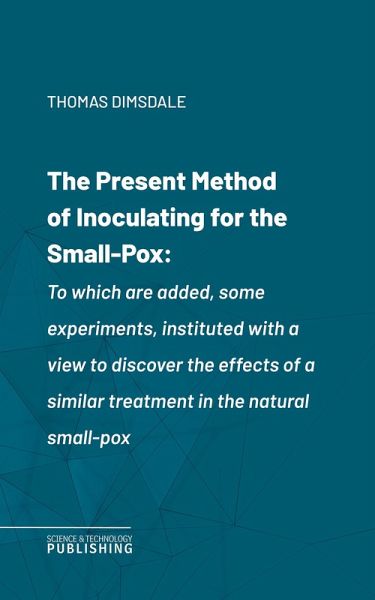
The Present Method of Inoculating for the Small-Pox is a comprehensive 18th-century treatise that explores the practice of smallpox inoculation, a groundbreaking medical procedure of its time. Authored by Dr. Thomas Dimsdale, the book provides a detailed account of the methods, rationale, and outcomes associated with inoculating individuals against smallpox, a disease that was both highly contagious and deadly. Dimsdale meticulously outlines the step-by-step process of inoculation, including the preparation of patients, the selection and handling of infectious material, and the post-inoculation care required to ensure the best possible outcomes. The book also delves into the historical context and prevailing attitudes toward smallpox and its prevention, offering insights into the debates and controversies surrounding inoculation. Dimsdale supplements his practical guidance with a series of experiments designed to compare the effects of inoculation with those of naturally acquired smallpox, providing valuable data and observations that contributed to the evolving understanding of immunity and disease transmission. Throughout the text, Dimsdale emphasizes the importance of careful observation, scientific rigor, and ethical considerations in medical practice. He addresses common fears and misconceptions about inoculation, presenting evidence to support its safety and efficacy. The book serves not only as a manual for physicians and surgeons but also as an informative resource for the general public, aiming to promote acceptance of inoculation as a means of controlling smallpox outbreaks. Rich in historical detail and medical insight, The Present Method of Inoculating for the Small-Pox stands as a significant work in the history of medicine, reflecting the early efforts to combat infectious diseases through preventive measures. It captures the challenges, innovations, and hopes of an era striving to overcome one of humanity's most formidable scourges.
Dieser Download kann aus rechtlichen Gründen nur mit Rechnungsadresse in A, B, BG, CY, CZ, D, DK, EW, E, FIN, F, GR, HR, H, IRL, I, LT, L, LR, M, NL, PL, P, R, S, SLO, SK ausgeliefert werden.