Sie sind bereits eingeloggt. Klicken Sie auf 2. tolino select Abo, um fortzufahren.
Bitte loggen Sie sich zunächst in Ihr Kundenkonto ein oder registrieren Sie sich bei bücher.de, um das eBook-Abo tolino select nutzen zu können.
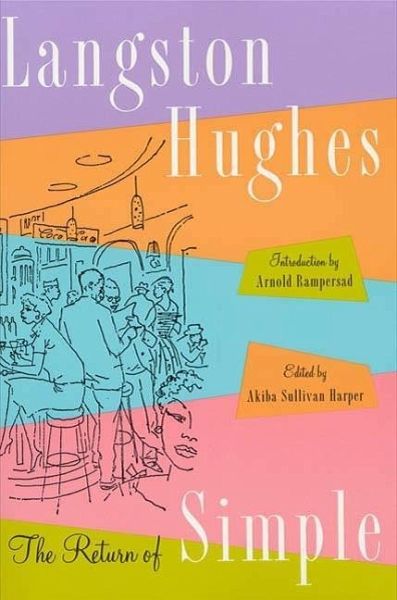
Collected humorous stories from the iconic American writer's newspaper column, featuring his most memorable and spirited fictional character. In 1940, Langston Hughes introduced Jesse B. Semple, or "Simple," to readers in his Chicago Defender column, "From Here to Yonder." From his familiar perch in a fictional Harlem bar, Simple held forth on a variety of subjects-low wages, interracial marriage, birth control, race riots, the police-then central to black life in urban America. More than fifty years later, Simple's concerns are, startlingly, still ours, and his voice, ringing with poetic…mehr
Collected humorous stories from the iconic American writer's newspaper column, featuring his most memorable and spirited fictional character. In 1940, Langston Hughes introduced Jesse B. Semple, or "Simple," to readers in his Chicago Defender column, "From Here to Yonder." From his familiar perch in a fictional Harlem bar, Simple held forth on a variety of subjects-low wages, interracial marriage, birth control, race riots, the police-then central to black life in urban America. More than fifty years later, Simple's concerns are, startlingly, still ours, and his voice, ringing with poetic wisdom and humor, reminds us of the rich African American folk tradition Langston Hughes helped to revive. This brilliantly edited collection by Akiba Sullivan Harper brings together the best stories from a number of Simple volumes long out of print and a few never before published. Its feel is so contemporary and relevant to American life one must marvel at Hughes's ability to pass through the barrier of time. Praise for The Return of Simple "A glorious revelation... a chance for fairweather Hughes fans to acquaint themselves with something other than his poems and plays. This is the author as loquacious unleashed social commentator, who-prompted by 'just one more beer, my friend'-holds up a mirror and shows us the world, which hasn't changed very much, not in all this time." - Boston Globe "Hughes's slices of urban black life belong also to the larger continuum of great American humor, from Mark Twain to Armistead Maupin. Quite simply, an indispensable part of our cultural heritage." - Kirkus Reviews
Dieser Download kann aus rechtlichen Gründen nur mit Rechnungsadresse in D ausgeliefert werden.
Die Herstellerinformationen sind derzeit nicht verfügbar.
Autorenporträt
James Mercer Langston Hughes (February 1, 1901[1] - May 22, 1967) was an American poet, social activist, novelist, playwright, and columnist from Joplin, Missouri. He moved to New York City as a young man, where he made his career. One of the earliest innovators of the then-new literary art form called jazz poetry, Hughes is best known as a leader of the Harlem Renaissance. He famously wrote about the period that "the negro was in vogue", which was later paraphrased as "when Harlem was in vogue."[2] Growing up in a series of Midwestern towns, Hughes became a prolific writer at an early age. He graduated from high school in Cleveland, Ohio and soon began studies at Columbia University in New York City. Although he dropped out, he gained notice from New York publishers, first in The Crisis magazine, and then from book publishers and became known in the creative community in Harlem. He eventually graduated from Lincoln University. In addition to poetry, Hughes wrote plays, and short stories. He also published several non-fiction works. From 1942 to 1962, as the civil rights movement was gaining traction, he wrote an in-depth weekly column in a leading black newspaper, The Chicago Defender. First published in 1921 in The Crisis - official magazine of the National Association for the Advancement of Colored People (NAACP) - "The Negro Speaks of Rivers", which became Hughes's signature poem, was collected in his first book of poetry The Weary Blues (1926).[47] Hughes's first and last published poems appeared in The Crisis; more of his poems were published in The Crisis than in any other journal.[48] Hughes' life and work were enormously influential during the Harlem Renaissance of the 1920s, alongside those of his contemporaries, Zora Neale Hurston,[49] Wallace Thurman, Claude McKay, Countee Cullen, Richard Bruce Nugent, and Aaron Douglas. Except for McKay, they worked together also to create the short-lived magazine Fire!! Devoted to Younger Negro Artists.
Es gelten unsere Allgemeinen Geschäftsbedingungen: www.buecher.de/agb
Impressum
www.buecher.de ist ein Internetauftritt der buecher.de internetstores GmbH
Geschäftsführung: Monica Sawhney | Roland Kölbl | Günter Hilger
Sitz der Gesellschaft: Batheyer Straße 115 - 117, 58099 Hagen
Postanschrift: Bürgermeister-Wegele-Str. 12, 86167 Augsburg
Amtsgericht Hagen HRB 13257
Steuernummer: 321/5800/1497
USt-IdNr: DE450055826