42,95 €
42,95 €
inkl. MwSt.
Sofort per Download lieferbar

21 °P sammeln
42,95 €
Als Download kaufen
42,95 €
inkl. MwSt.
Sofort per Download lieferbar
21 °P sammeln
Jetzt verschenken
Alle Infos zum eBook verschenken
42,95 €
inkl. MwSt.
Sofort per Download lieferbar
Alle Infos zum eBook verschenken
21 °P sammeln

Andere Kunden interessierten sich auch für
") The Rise of Digital Management (eBook, ePUB)42,95 €
The Rise of Digital Management (eBook, ePUB)42,95 €") The Untapped Power of Discovery (eBook, PDF)31,95 €
The Untapped Power of Discovery (eBook, PDF)31,95 €") Aesthetics, Organization, and Humanistic Management (eBook, PDF)41,95 €
Aesthetics, Organization, and Humanistic Management (eBook, PDF)41,95 €") Management Theory, Innovation, and Organisation (eBook, PDF)41,95 €
Management Theory, Innovation, and Organisation (eBook, PDF)41,95 €") The Routledge Companion to Philosophy in Organization Studies (eBook, PDF)43,95 €
The Routledge Companion to Philosophy in Organization Studies (eBook, PDF)43,95 €") Organizational Aesthetics (eBook, PDF)21,95 €
Organizational Aesthetics (eBook, PDF)21,95 €") Peter Drucker and Management (eBook, PDF)38,95 €
Peter Drucker and Management (eBook, PDF)38,95 €







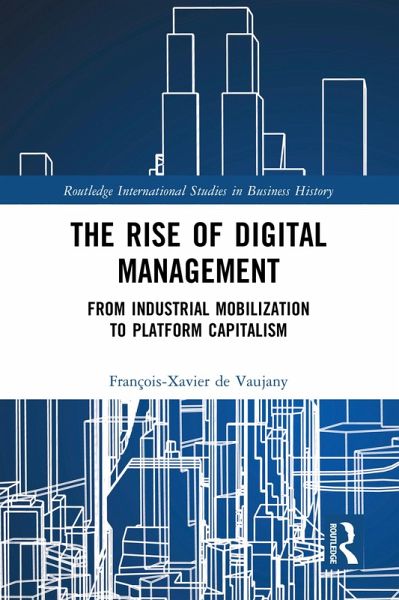
This book analyzes the history of management, placing it in perspective with both American history and the genealogy of digital technology. Focusing on the years of industrial mobilization in the United States (from 1937 to 1945) and their extension into the Cold War, it shows particularly how "scientific management" was reconfigured and re-legitimized in favor of a new profoundly American geopolitics. In a context where the future was at a standstill, this research also explains what became of the managerial processes at the heart of capitalism from the 40s onwards: the shift from a managerial capitalism of calculation to a narrative capitalism made up of "desiring machines". This digital management no longer simply contributes, along with others, to unveiling and revealing the future. Aligned with the American obsession with novelty, it is the very process of revelation and unveiling, with managers and consumers alike becoming the intersecting subjects of desires borne of managerial apocalypses.
To explore this period of American history, the author has combined a triple narrative anchored in three types of archives: an intimate history of this reconfiguration from the presence in New York of Saint-Exupéry, Burnham and Wiener; a description of the great historical moment of industrial mobilization; and a philosophical speculation about reconfiguration and its links to American history.
To explore this period of American history, the author has combined a triple narrative anchored in three types of archives: an intimate history of this reconfiguration from the presence in New York of Saint-Exupéry, Burnham and Wiener; a description of the great historical moment of industrial mobilization; and a philosophical speculation about reconfiguration and its links to American history.
Dieser Download kann aus rechtlichen Gründen nur mit Rechnungsadresse in A, B, BG, CY, CZ, D, DK, EW, E, FIN, F, GR, HR, H, IRL, I, LT, L, LR, M, NL, PL, P, R, S, SLO, SK ausgeliefert werden.
"Francois-Xavier de Vaujany has effectively re-written the history of management in our digital age, and possibly also pre-saged its future - this book should be read by anybody with hopes or fears about where our technology might lead us!" Matt Statler, Richman Family Director of Business Ethics and Social Impact Programming, Clinical Professor of Business and Society, NYU Stern School of Business
"A great book that shows once more how the history of management is profoundly linked to geopolitical and institutional orders. The analysis of the contemporary digital revolution adds a piece to the story of how management creates strudtures of wanting and desires, hope and beliefs." Paolo Quattrone, Professor of Accounting, Governance and Society, Alliance Manchester Business School
"This book offers an interesting and complex tapestry of the role of management in the continual production and expression of the 'American Event' by weaving together a number of threads including: stories of influential characters; social, scientific, economic and political events; and the institutionalizing values of what the author calls the 'managerial apocalypse'." Ann L Cunliffe, Professor of Organization Studies, Fundação Getúlio Vargas-EAESP, Brazil
"A great book that shows once more how the history of management is profoundly linked to geopolitical and institutional orders. The analysis of the contemporary digital revolution adds a piece to the story of how management creates strudtures of wanting and desires, hope and beliefs." Paolo Quattrone, Professor of Accounting, Governance and Society, Alliance Manchester Business School
"This book offers an interesting and complex tapestry of the role of management in the continual production and expression of the 'American Event' by weaving together a number of threads including: stories of influential characters; social, scientific, economic and political events; and the institutionalizing values of what the author calls the 'managerial apocalypse'." Ann L Cunliffe, Professor of Organization Studies, Fundação Getúlio Vargas-EAESP, Brazil