54,95 €
54,95 €
inkl. MwSt.
Sofort per Download lieferbar

27 °P sammeln
54,95 €
Als Download kaufen
54,95 €
inkl. MwSt.
Sofort per Download lieferbar
27 °P sammeln
Jetzt verschenken
Alle Infos zum eBook verschenken
54,95 €
inkl. MwSt.
Sofort per Download lieferbar
Alle Infos zum eBook verschenken
27 °P sammeln

Andere Kunden interessierten sich auch für
") The Routledge Encyclopedia of Film Theory (eBook, PDF)54,95 €
The Routledge Encyclopedia of Film Theory (eBook, PDF)54,95 €") Materialist Film (eBook, ePUB)44,95 €
Materialist Film (eBook, ePUB)44,95 €") Film Theory (eBook, ePUB)51,95 €
Film Theory (eBook, ePUB)51,95 €") New Media (eBook, ePUB)38,95 €
New Media (eBook, ePUB)38,95 €") Neo-Feminist Cinema (eBook, ePUB)42,95 €
Neo-Feminist Cinema (eBook, ePUB)42,95 €") Stardom (eBook, ePUB)37,95 €
Stardom (eBook, ePUB)37,95 €") Screening the Past (eBook, ePUB)38,95 €
Screening the Past (eBook, ePUB)38,95 €
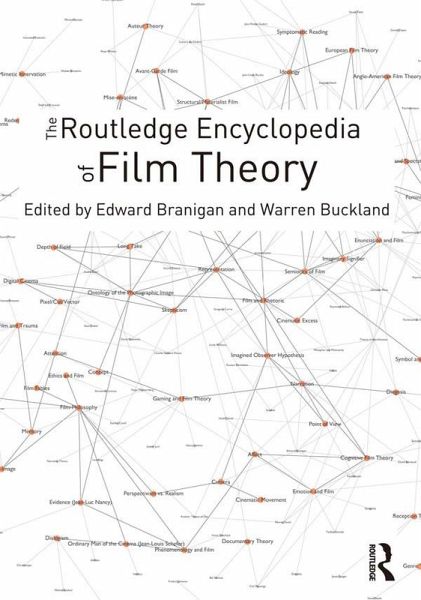
The Routledge Encyclopedia of Film Theory is an international reference work representing the essential ideas and concepts at the centre of film theory from the beginning of the twentieth century, to the beginning of the twenty-first.
When first encountering film theory, students are often confronted with a dense, interlocking set of texts full of arcane terminology, inexact formulations, sliding definitions, and abstract generalities. The Routledge Encyclopedia of Film Theory challenges these first impressions by aiming to make film theory accessible and open to new readers.
Edward Branigan and Warren Buckland have commissioned over 50 scholars from around the globe to address the difficult formulations and propositions in each theory by reducing these difficult formulations to straightforward propositions.
The result is a highly accessible volume that clearly defines, and analyzes step by step, many of the fundamental concepts in film theory, ranging from familiar concepts such as 'Apparatus', 'Gaze', 'Genre', and 'Identification', to less well-known and understood, but equally important concepts, such as Alain Badiou's 'Inaesthetics', Gilles Deleuze's 'Time-Image', and Jean-Luc Nancy's 'Evidence'.
The Routledge Encyclopedia of Film Theory is an ideal reference book for undergraduates of film studies, as well as graduate students new to the discipline.
When first encountering film theory, students are often confronted with a dense, interlocking set of texts full of arcane terminology, inexact formulations, sliding definitions, and abstract generalities. The Routledge Encyclopedia of Film Theory challenges these first impressions by aiming to make film theory accessible and open to new readers.
Edward Branigan and Warren Buckland have commissioned over 50 scholars from around the globe to address the difficult formulations and propositions in each theory by reducing these difficult formulations to straightforward propositions.
The result is a highly accessible volume that clearly defines, and analyzes step by step, many of the fundamental concepts in film theory, ranging from familiar concepts such as 'Apparatus', 'Gaze', 'Genre', and 'Identification', to less well-known and understood, but equally important concepts, such as Alain Badiou's 'Inaesthetics', Gilles Deleuze's 'Time-Image', and Jean-Luc Nancy's 'Evidence'.
The Routledge Encyclopedia of Film Theory is an ideal reference book for undergraduates of film studies, as well as graduate students new to the discipline.
Dieser Download kann aus rechtlichen Gründen nur mit Rechnungsadresse in A, B, BG, CY, CZ, D, DK, EW, E, FIN, F, GR, HR, H, IRL, I, LT, L, LR, M, NL, PL, P, R, S, SLO, SK ausgeliefert werden.
"The Routledge Encyclopedia of Film Theory is an astonishing achievement. Comprehensive - organized around no fewer than 83 distinct concepts - and authored by recognized specialists, it is sure to establish itself as a great teaching resource. Entries are concise and informative, written in clear language, which makes them especially helpful to students coming to film theory for the first time and seeking a user-friendly, but focused guide. The Editors are to be highly commended for the way they cross-list entries and map the connections between them."
Thomas Elsaesser, Professor Emeritus, University of Amsterdam
"Branigan and Buckland's Encyclopedia of Film Theory is an extraordinary accomplishment. The entries present with clarity and order concepts from the entire history of film theory, often revealing surprising connections and filiations among ideas and authors. In the crowded field of theory overviews, this will be the essential reference work for many years to come for both beginning and advanced researchers."
D. N. Rodowick, Glen A. Lloyd Distinguished Service Professor in Cinema and Media Studies, The University of Chicago
"The Routledge Encyclopedia of Film Theory is both a wonderful map and intriguing maze. The encyclopedia retraces the history of film theory through more than eighty entries. Each reconstructs a debate, but also offers an up-dated perspective. My advice to the reader: (1) investigate your question; (2) then proceed randomly, as if you were surfing the Internet; (3) make connections be as strange as possible; (4) challenge the path from light to dark suggested by Branigan in the Epilogue, and disrupt it by finding new ways to make film live. Above all, savour the reading: it brings to light important chapters in the history of thought, and rediscovers what we thought we knew and what we think now."
Francesco Casetti, Professor, Film Studies Program, Yale University
"This volume attempts to address shortcomings in previous guides to film theory, which often can seem unwelcoming to the uninitiated... [and] offers a reference that is accessible to novice users through the use of concise, straightforward prose, which grounds discussion of key concepts in a limited number of canonical texts...this should prove to be a valuable reference for students engaged in film studies...Summing Up: Recommended."
W. D. Walsh, Georgia State University, in CHOICE
Thomas Elsaesser, Professor Emeritus, University of Amsterdam
"Branigan and Buckland's Encyclopedia of Film Theory is an extraordinary accomplishment. The entries present with clarity and order concepts from the entire history of film theory, often revealing surprising connections and filiations among ideas and authors. In the crowded field of theory overviews, this will be the essential reference work for many years to come for both beginning and advanced researchers."
D. N. Rodowick, Glen A. Lloyd Distinguished Service Professor in Cinema and Media Studies, The University of Chicago
"The Routledge Encyclopedia of Film Theory is both a wonderful map and intriguing maze. The encyclopedia retraces the history of film theory through more than eighty entries. Each reconstructs a debate, but also offers an up-dated perspective. My advice to the reader: (1) investigate your question; (2) then proceed randomly, as if you were surfing the Internet; (3) make connections be as strange as possible; (4) challenge the path from light to dark suggested by Branigan in the Epilogue, and disrupt it by finding new ways to make film live. Above all, savour the reading: it brings to light important chapters in the history of thought, and rediscovers what we thought we knew and what we think now."
Francesco Casetti, Professor, Film Studies Program, Yale University
"This volume attempts to address shortcomings in previous guides to film theory, which often can seem unwelcoming to the uninitiated... [and] offers a reference that is accessible to novice users through the use of concise, straightforward prose, which grounds discussion of key concepts in a limited number of canonical texts...this should prove to be a valuable reference for students engaged in film studies...Summing Up: Recommended."
W. D. Walsh, Georgia State University, in CHOICE