43,95 €
43,95 €
inkl. MwSt.
Sofort per Download lieferbar

22 °P sammeln
43,95 €
Als Download kaufen
43,95 €
inkl. MwSt.
Sofort per Download lieferbar
22 °P sammeln
Jetzt verschenken
Alle Infos zum eBook verschenken
43,95 €
inkl. MwSt.
Sofort per Download lieferbar
Alle Infos zum eBook verschenken
22 °P sammeln

Andere Kunden interessierten sich auch für
") Challenges, Opportunities and Innovations in Social Work Field Education (eBook, ePUB)39,95 €
Challenges, Opportunities and Innovations in Social Work Field Education (eBook, ePUB)39,95 €") Doing Critical Social Work (eBook, PDF)38,95 €
Doing Critical Social Work (eBook, PDF)38,95 €") Social Work: The Basics (eBook, PDF)18,95 €
Social Work: The Basics (eBook, PDF)18,95 €") The Routledge Handbook of Social Work Field Education in the Global South (eBook, PDF)43,95 €
The Routledge Handbook of Social Work Field Education in the Global South (eBook, PDF)43,95 €") The Routledge Handbook of Service User Involvement in Human Services Research and Education (eBook, PDF)44,95 €
The Routledge Handbook of Service User Involvement in Human Services Research and Education (eBook, PDF)44,95 €") Social Workers and Compassion (eBook, PDF)36,95 €
Social Workers and Compassion (eBook, PDF)36,95 €") Human Rights-Based Approach to Short-Term Study Abroad (eBook, PDF)40,95 €
Human Rights-Based Approach to Short-Term Study Abroad (eBook, PDF)40,95 €


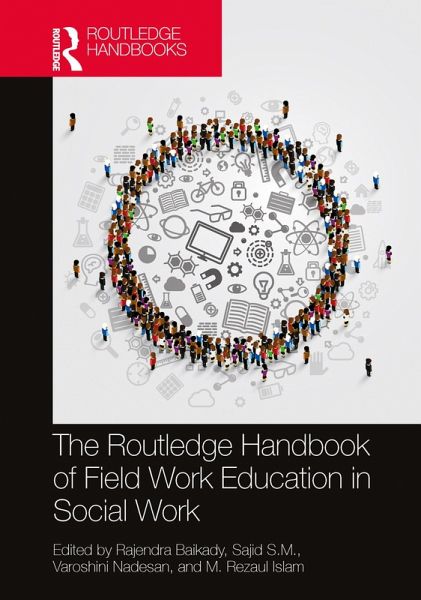
This Handbook provides an authoritative account of international fieldwork education in social work. It presents an overview of advances in research in social work field education through in-depth analyses and global case studies.
Key features:
This Handbook will be an essential resource for scholars and researchers of social work, development studies, social anthropology, sociology, and education. It will also be useful to educators and practitioners of social work in global institutions of higher studies as well as civil society organisations.
Key features:
- Discusses critical issues in teaching social work and curriculum development; health care social work; stimulated learning; field education policies; needs, challenges, and solutions in fieldwork education; reflexivity training; creativity and partnership; resilience enhancement; integrated and holistic education for social workers; student experience; practice education; and ethical responsibility of social work field instructors
- Covers social work field education across geographical regions (Asia and the Pacific; North and South America; Australia and Oceania; Europe) and major themes and trends from several countries (U.S.A.; Canada; Australia; China; Hong Kong; Sweden; Aotearoa New Zealand; England; Ukraine; Spain; Estonia; Italy; Ireland; Slovenia; Poland; Romania; Greece; Norway; Turkey; and the Czech Republic)
- Brings together international comparative perspectives on fieldwork education in social work from leading experts and social work educators
This Handbook will be an essential resource for scholars and researchers of social work, development studies, social anthropology, sociology, and education. It will also be useful to educators and practitioners of social work in global institutions of higher studies as well as civil society organisations.
Dieser Download kann aus rechtlichen Gründen nur mit Rechnungsadresse in A, B, BG, CY, CZ, D, DK, EW, E, FIN, F, GR, HR, H, IRL, I, LT, L, LR, M, NL, PL, P, R, S, SLO, SK ausgeliefert werden.
'Fieldwork is a key component of social work education and so a book that introduces students, practitioners, and academics to fieldwork with a global lens is timely and extremely welcomed. Introducing the readers to current practices and concerns from Europe, North and South America, Australia, and Oceania this handbook gathers key issues shared by the international community to provide effective and innovative fieldwork. As an international profession it is crucial that social work students receive up to date, relevant and innovative information that will inform their training and their future practice and to make connections with the global community of social workers and link its practice with current thinking and debates. As this book includes voices from many countries and perspectives it invites readers to think both locally and globally about undertaking the linkage of practice with theory as a crucial element of fieldwork. Informed by theory and evidence-based practice this timely and much need book identifies the challenges and its future directions. In pursuit of social justice practice this book makes an important contribution to 21st-century fieldwork for the education of social workers across the globe. I thoroughly recommend its inclusion into the global and national social work curricula.'
Carolyn Noble, Professor of Social Work, Australian College of Applied Psychology, Sydney, Australia
'This Handbook is an impressive and important contribution to promote sustainable futures of field work education. It actualises the complexity of becoming social worker across entangled local, national, and global contexts. The reading awakened memories and questions from my own field placement as a student and teacher for international field work education. How had textbooks prepared me to work towards anti-oppression, capacity building, hope and creativity? What did I know about the geopolitical history of my place(ment)? How could I practice critical reflexivity to un-learn privilege and change oppressive structures? This book demonstrates the richness and multiple forms of social work, where structural privilege and marginalization, but also resistance and innovation, shapes spaces for field work education. As a contribution to global social work education, I warmly recommend it to be read through the lens of glocality, a fusion of local and global, that promotes seeing the many contributions as interlinked across communities and regions in the world.'
Mona B. Livholts, Professor of Social Work, University of Helsinki, Finland; Executive Board Member European Association of Schools of Social Work, EASSW
Carolyn Noble, Professor of Social Work, Australian College of Applied Psychology, Sydney, Australia
'This Handbook is an impressive and important contribution to promote sustainable futures of field work education. It actualises the complexity of becoming social worker across entangled local, national, and global contexts. The reading awakened memories and questions from my own field placement as a student and teacher for international field work education. How had textbooks prepared me to work towards anti-oppression, capacity building, hope and creativity? What did I know about the geopolitical history of my place(ment)? How could I practice critical reflexivity to un-learn privilege and change oppressive structures? This book demonstrates the richness and multiple forms of social work, where structural privilege and marginalization, but also resistance and innovation, shapes spaces for field work education. As a contribution to global social work education, I warmly recommend it to be read through the lens of glocality, a fusion of local and global, that promotes seeing the many contributions as interlinked across communities and regions in the world.'
Mona B. Livholts, Professor of Social Work, University of Helsinki, Finland; Executive Board Member European Association of Schools of Social Work, EASSW