43,95 €
43,95 €
inkl. MwSt.
Sofort per Download lieferbar

22 °P sammeln
43,95 €
Als Download kaufen
43,95 €
inkl. MwSt.
Sofort per Download lieferbar
22 °P sammeln
Jetzt verschenken
Alle Infos zum eBook verschenken
43,95 €
inkl. MwSt.
Sofort per Download lieferbar
Alle Infos zum eBook verschenken
22 °P sammeln

Andere Kunden interessierten sich auch für
") The Routledge Handbook of Human-Animal Relations in the Byzantine World (eBook, PDF)46,95 €
The Routledge Handbook of Human-Animal Relations in the Byzantine World (eBook, PDF)46,95 €") War and Masculinity in Roman and Medieval Culture (eBook, PDF)42,95 €
War and Masculinity in Roman and Medieval Culture (eBook, PDF)42,95 €") The Routledge Handbook on Identity in Byzantium (eBook, PDF)43,95 €
The Routledge Handbook on Identity in Byzantium (eBook, PDF)43,95 €") Sex and Sexuality in Europe, 1100-1750 (eBook, PDF)39,95 €
Sex and Sexuality in Europe, 1100-1750 (eBook, PDF)39,95 €") The Routledge Handbook of Byzantine Visual Culture in the Danube Regions, 1300-1600 (eBook, PDF)47,95 €
The Routledge Handbook of Byzantine Visual Culture in the Danube Regions, 1300-1600 (eBook, PDF)47,95 €") The Routledge Handbook of the Mongols and Central-Eastern Europe (eBook, PDF)43,95 €
The Routledge Handbook of the Mongols and Central-Eastern Europe (eBook, PDF)43,95 €") The Routledge Handbook of Identity and the Environment in the Classical and Medieval Worlds (eBook, PDF)46,95 €
The Routledge Handbook of Identity and the Environment in the Classical and Medieval Worlds (eBook, PDF)46,95 €



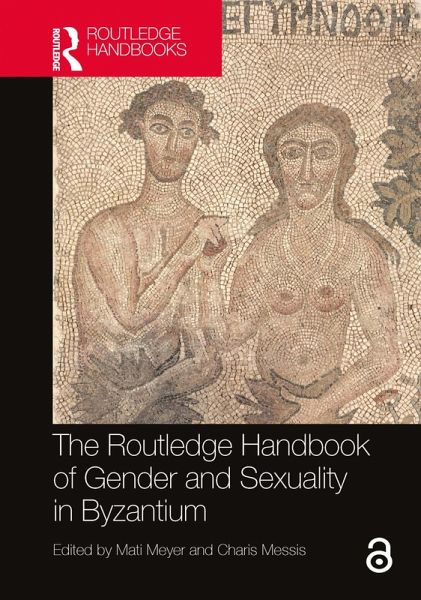
This Handbook is the first to consider the interrelated subjects of gender and sexuality in the Eastern Roman Empire from an interdisciplinary perspective. Drawing on both modern theories and Byzantine perceptions, and considering multiple periods and religions (Eastern Orthodox, Islamic, and Jewish), it provides evidentiary textual and visual material support for an analysis of the two linked themes.
Broadly, the essays demonstrate that gender and sexual constructs in Byzantium were porous. As a result, they expand our knowledge of not only how sex and gender were conceived and performed but also how ideas and practices shaped Byzantine life.
The Routledge Handbook of Gender and Sexuality in Byzantium will be an indispensable guide for students and scholars of late antique and Byzantine religion, history, culture, and art, who will find it a useful critical survey of current scholarship and one that shines new light in their areas of research. The focus on issues of gender and sexuality may also be of interest to individuals concerned with Eastern Mediterranean culture, as well as to the broader public.
Chapter 21 of this book is freely available as a downloadable Open Access PDF at http://www.taylorfrancis.com under a Creative Commons Attribution-Non Commercial-No Derivatives (CC-BY-NC-ND) 4.0 license.
Broadly, the essays demonstrate that gender and sexual constructs in Byzantium were porous. As a result, they expand our knowledge of not only how sex and gender were conceived and performed but also how ideas and practices shaped Byzantine life.
The Routledge Handbook of Gender and Sexuality in Byzantium will be an indispensable guide for students and scholars of late antique and Byzantine religion, history, culture, and art, who will find it a useful critical survey of current scholarship and one that shines new light in their areas of research. The focus on issues of gender and sexuality may also be of interest to individuals concerned with Eastern Mediterranean culture, as well as to the broader public.
Chapter 21 of this book is freely available as a downloadable Open Access PDF at http://www.taylorfrancis.com under a Creative Commons Attribution-Non Commercial-No Derivatives (CC-BY-NC-ND) 4.0 license.
Dieser Download kann aus rechtlichen Gründen nur mit Rechnungsadresse in A, B, BG, CY, CZ, D, DK, EW, E, FIN, F, GR, HR, H, IRL, I, LT, L, LR, M, NL, PL, P, R, S, SLO, SK ausgeliefert werden.