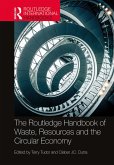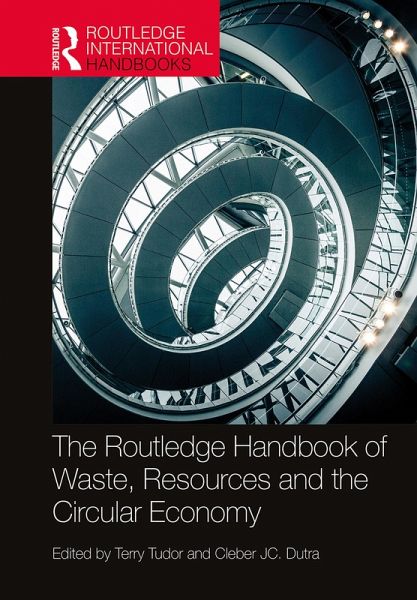
The Routledge Handbook of Waste, Resources and the Circular Economy (eBook, PDF)
Redaktion: Tudor, Terry; Dutra, Cleber JC.
Alle Infos zum eBook verschenken
The Routledge Handbook of Waste, Resources and the Circular Economy (eBook, PDF)
Redaktion: Tudor, Terry; Dutra, Cleber JC.
- Format: PDF
- Merkliste
- Auf die Merkliste
- Bewerten Bewerten
- Teilen
- Produkt teilen
- Produkterinnerung
- Produkterinnerung

Hier können Sie sich einloggen

Bitte loggen Sie sich zunächst in Ihr Kundenkonto ein oder registrieren Sie sich bei bücher.de, um das eBook-Abo tolino select nutzen zu können.
The Handbook introduces, contextualises, critiques, and discusses a range of perspectives associated with the concept of the circular economy. These perspectives span an array of subjects including economics, environmental policymaking, sociology, environmental science, environmental and industrial engineering, management, international development, and human geography.
A fundamental underpinning of the Handbook is that it takes account of a wide range of sectors, as well as geographical perspectives that incorporate both a Global North and Global South world context. This approach is…mehr
- Geräte: PC
- mit Kopierschutz
- eBook Hilfe
The Routledge Handbook of Waste, Resources and the Circular Economy (eBook, ePUB)44,95 €
Digital Innovations for a Circular Plastic Economy in Africa (eBook, PDF)0,00 €
Social and Cultural Aspects of the Circular Economy (eBook, PDF)41,95 €
Digital Innovations for a Circular Plastic Economy in Africa (eBook, ePUB)0,00 €
Kaitlin KishEcological Limits of Development (eBook, PDF)0,00 €
Mark KanazawaNatural Resources and the Environment (eBook, PDF)41,95 €
Social and Cultural Aspects of the Circular Economy (eBook, ePUB)41,95 €-
-
-
A fundamental underpinning of the Handbook is that it takes account of a wide range of sectors, as well as geographical perspectives that incorporate both a Global North and Global South world context. This approach is crucial because it is only within such a holistic perspective that the circular economy concept can truly be examined. In addition, these issues are examined both from a theoretical as well as a practical perspective, using real-world case studies for illustration.
Given its wide subject, sectoral, and geographical areas of focus, the Handbook should be of value not only for those undertaking research in the field of circular economy, but also stakeholders involved in policymaking, as well as decision-making on the front line.
Dieser Download kann aus rechtlichen Gründen nur mit Rechnungsadresse in A, B, BG, CY, CZ, D, DK, EW, E, FIN, F, GR, HR, H, IRL, I, LT, L, LR, M, NL, PL, P, R, S, SLO, SK ausgeliefert werden.
- Produktdetails
- Verlag: Taylor & Francis eBooks
- Seitenzahl: 468
- Erscheinungstermin: 27. Dezember 2020
- Englisch
- ISBN-13: 9781000259599
- Artikelnr.: 60654791
- Verlag: Taylor & Francis eBooks
- Seitenzahl: 468
- Erscheinungstermin: 27. Dezember 2020
- Englisch
- ISBN-13: 9781000259599
- Artikelnr.: 60654791
- Herstellerkennzeichnung Die Herstellerinformationen sind derzeit nicht verfügbar.
need for and challenges surrounding circularity 2. Natural resources.
Consumption, pollution, and health risks: developed versus developing
economies 3. Consumption and materialism: from acquisitive to responsible
materialism 4. Embedding more circular approaches to the management of
resources 5. Environmental justice, waste management, and the circular
economy: global perspectives 6. Resource consumption and the associated
health risks: a brief overview 7. The Sustainable Development Goals as
drivers for change 8. Triggers for industrial symbiosis: lessons learnt
from twenty-five case studies 9. Bought today, gone tomorrow? From linear
to circular consumption Part 2: Measuring and implementing circularity 10.
Africa - juxtaposition between rapid urbanisation, industrialisation, and
the need to preserve traditional circular systems 11. Circular start-ups:
five business model archetypes as frontrunners of circular disruption 12.
Ecodesign and circular design of products: concepts, assessment, and
strategies 13. Approaches to monitoring and evaluation of resource recovery
from waste towards a circular economy 14. Complexity and the circular
economy: systems approaches for change 15. Circular economy meso-level
planning: an approach with 'distributed economies' Part 3: Policy and
legislative considerations 16. The role of policy in creating a more
circular economy 17. Legal considerations for a circular economy 18.
Economic and trade considerations of circular economy approaches 19.
Managing waste at the national and local levels Part 4: Sharing economies
and capacity building 20. Making sustainable markets and the forming of a
circular economy 21. Becoming eco-literate through experiential encounters
with food 22. Implementing low carbon strategies - analysis of barriers 23.
Overcoming financial, social, and environmental challenges faced by
cooperatives: case studies from the State of Rio Grande do Sul, Brazil 24.
The informal recycling sector - environmental criminals or the future of
the circular economy? 25. Refugee camps and circular economy in Palestinian
West Bank: challenges and opportunities Part 5: Recycling 26. Exploring
household dynamics for recycling in the UK: a case study of recycling
habits in Greater London 27. Circular start-ups: five business model
archetypes as frontrunners of circular disruption 28. Enablers and barriers
for industrial symbiosis: lessons learnt from twenty-five case studies 29.
A proposed approach for a solid waste collection system in an African rural
town: a case study from Kenya 30. Circular economy opportunities in Africa
- emerging sectors and missing narratives Part 6: Reuse 31. Modular
Smartphones and Circular Design Strategies: The Shape of Things to Come?
32. The Use of By-Products in New Materials 33. Using circular supply
chains to create community biogas 34. Circular economy initiatives in
India: a case study approach Part 7: Use of technologies 35.
Product-service system business models and circular economy 36. Circular
business models in selected geographical contexts: an analysis of two cases
37. Implementing low carbon strategies in SMEs: auditing strategies 38.
Circular economy principles in Africa: the case of the off-grid solar in
Kenya 39. Circular supply chain: emerging opportunities and challenges 40.
Conclusion: closing thoughts
need for and challenges surrounding circularity 2. Natural resources.
Consumption, pollution, and health risks: developed versus developing
economies 3. Consumption and materialism: from acquisitive to responsible
materialism 4. Embedding more circular approaches to the management of
resources 5. Environmental justice, waste management, and the circular
economy: global perspectives 6. Resource consumption and the associated
health risks: a brief overview 7. The Sustainable Development Goals as
drivers for change 8. Triggers for industrial symbiosis: lessons learnt
from twenty-five case studies 9. Bought today, gone tomorrow? From linear
to circular consumption Part 2: Measuring and implementing circularity 10.
Africa - juxtaposition between rapid urbanisation, industrialisation, and
the need to preserve traditional circular systems 11. Circular start-ups:
five business model archetypes as frontrunners of circular disruption 12.
Ecodesign and circular design of products: concepts, assessment, and
strategies 13. Approaches to monitoring and evaluation of resource recovery
from waste towards a circular economy 14. Complexity and the circular
economy: systems approaches for change 15. Circular economy meso-level
planning: an approach with 'distributed economies' Part 3: Policy and
legislative considerations 16. The role of policy in creating a more
circular economy 17. Legal considerations for a circular economy 18.
Economic and trade considerations of circular economy approaches 19.
Managing waste at the national and local levels Part 4: Sharing economies
and capacity building 20. Making sustainable markets and the forming of a
circular economy 21. Becoming eco-literate through experiential encounters
with food 22. Implementing low carbon strategies - analysis of barriers 23.
Overcoming financial, social, and environmental challenges faced by
cooperatives: case studies from the State of Rio Grande do Sul, Brazil 24.
The informal recycling sector - environmental criminals or the future of
the circular economy? 25. Refugee camps and circular economy in Palestinian
West Bank: challenges and opportunities Part 5: Recycling 26. Exploring
household dynamics for recycling in the UK: a case study of recycling
habits in Greater London 27. Circular start-ups: five business model
archetypes as frontrunners of circular disruption 28. Enablers and barriers
for industrial symbiosis: lessons learnt from twenty-five case studies 29.
A proposed approach for a solid waste collection system in an African rural
town: a case study from Kenya 30. Circular economy opportunities in Africa
- emerging sectors and missing narratives Part 6: Reuse 31. Modular
Smartphones and Circular Design Strategies: The Shape of Things to Come?
32. The Use of By-Products in New Materials 33. Using circular supply
chains to create community biogas 34. Circular economy initiatives in
India: a case study approach Part 7: Use of technologies 35.
Product-service system business models and circular economy 36. Circular
business models in selected geographical contexts: an analysis of two cases
37. Implementing low carbon strategies in SMEs: auditing strategies 38.
Circular economy principles in Africa: the case of the off-grid solar in
Kenya 39. Circular supply chain: emerging opportunities and challenges 40.
Conclusion: closing thoughts