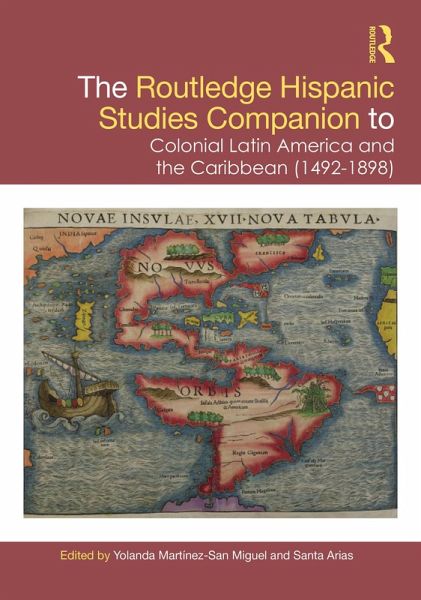
46,95 €
46,95 €
inkl. MwSt.
Sofort per Download lieferbar

23 °P sammeln
46,95 €
Als Download kaufen
46,95 €
inkl. MwSt.
Sofort per Download lieferbar
23 °P sammeln
Jetzt verschenken
Alle Infos zum eBook verschenken
46,95 €
inkl. MwSt.
Sofort per Download lieferbar
Alle Infos zum eBook verschenken
23 °P sammeln

Andere Kunden interessierten sich auch für
 (eBook, PDF)") The Routledge Hispanic Studies Companion to Colonial Latin America and the Caribbean (1492-1898) (eBook, PDF)46,95 €
The Routledge Hispanic Studies Companion to Colonial Latin America and the Caribbean (1492-1898) (eBook, PDF)46,95 €") The Routledge Hispanic Studies Companion to Nineteenth-Century Spain (eBook, ePUB)46,95 €
The Routledge Hispanic Studies Companion to Nineteenth-Century Spain (eBook, ePUB)46,95 €") The Routledge Hispanic Studies Companion to Nineteenth-Century Latin America (eBook, ePUB)47,95 €
The Routledge Hispanic Studies Companion to Nineteenth-Century Latin America (eBook, ePUB)47,95 €") The Routledge Hispanic Studies Companion to Medieval Iberia (eBook, ePUB)43,95 €
The Routledge Hispanic Studies Companion to Medieval Iberia (eBook, ePUB)43,95 €") The Routledge Companion to the Hispanic Enlightenment (eBook, ePUB)46,95 €
The Routledge Companion to the Hispanic Enlightenment (eBook, ePUB)46,95 €") The Routledge Hispanic Studies Companion to Early Modern Spanish Literature and Culture (eBook, ePUB)44,95 €
The Routledge Hispanic Studies Companion to Early Modern Spanish Literature and Culture (eBook, ePUB)44,95 €") The Routledge Companion to Twentieth and Twenty-First Century Latin American Literary and Cultural Forms (eBook, ePUB)44,95 €
The Routledge Companion to Twentieth and Twenty-First Century Latin American Literary and Cultural Forms (eBook, ePUB)44,95 €

The Routledge Hispanic Studies Companion to Colonial Latin America and the Caribbean (1492-1898) brings together an international team of scholars to explore new interdisciplinary and comparative approaches for the study of colonialism.
Using four overarching themes, the volume examines a wide array of critical issues, key texts, and figures that demonstrate the significance of Colonial Latin America and the Caribbean across national and regional traditions and historical periods.
This invaluable resource will be of interest to students and scholars of Spanish and Latin American studies examining colonial Caribbean and Latin America at the intersection of cultural and historical studies; transatlantic, postcolonial and decolonial studies; and critical approaches to archives and materiality. This timely volume assesses the impact and legacy of colonialism and coloniality.
Using four overarching themes, the volume examines a wide array of critical issues, key texts, and figures that demonstrate the significance of Colonial Latin America and the Caribbean across national and regional traditions and historical periods.
This invaluable resource will be of interest to students and scholars of Spanish and Latin American studies examining colonial Caribbean and Latin America at the intersection of cultural and historical studies; transatlantic, postcolonial and decolonial studies; and critical approaches to archives and materiality. This timely volume assesses the impact and legacy of colonialism and coloniality.
Dieser Download kann aus rechtlichen Gründen nur mit Rechnungsadresse in A, B, BG, CY, CZ, D, DK, EW, E, FIN, F, GR, HR, H, IRL, I, LT, L, LR, M, NL, PL, P, R, S, SLO, SK ausgeliefert werden.
One would have to look hard to find a better and more thorough, yet succinct, review of Colonial Studies in the U.S. than the one the editors of this volume provide. We are presented with a dynamic field full of tensions, contradictions-that is, alive-that have made it crucial for Latin American and Early Modern Studies, among others. From its inception to its recent connections to Latinx Studies, the writers deliver what the editors promise: a view into topics that have been the solid standard of the field, to new and promising areas.
Who is an author under colonial conditions of production? What a theory of the frontiers says about colonialism? What if behind the standard language of the archive one finds Quechua, English and Muisca? To whom does this archive belong then? These pages remind us that even though we know much, we have still much to discover and that perhaps we might never know fully. The contributions to theoretical analysis are also important since, as the contributors show, the colonial field helps elucidate key concepts such as what is licit, what is an archive, extraction, extinction, the environment.
Ivonne Del Valle, Associate Professor, UC Berkeley
Tensed by imperial designs, colonial violence, nationalist teleologies, colonial Latin American and Caribbean Studies is a multifaceted site of cultural and political interpellations and interventions that has made this contentious field one of the most productive intellectual traditions of the Global South, producing a rich array of critical concepts for the decolonization of culture.
Strategically organized in four overarching themes, The Routledge Hispanic Studies Companion to Colonial Latin America and the Caribbean (1492-1898) showcases the most progressive and innovative research in the field and draws the paths for an effective critical engagement with the traces of a colonial past that is far from settled.
Luis Fernando Restrepo, University Professor, University of Arkansas
Who is an author under colonial conditions of production? What a theory of the frontiers says about colonialism? What if behind the standard language of the archive one finds Quechua, English and Muisca? To whom does this archive belong then? These pages remind us that even though we know much, we have still much to discover and that perhaps we might never know fully. The contributions to theoretical analysis are also important since, as the contributors show, the colonial field helps elucidate key concepts such as what is licit, what is an archive, extraction, extinction, the environment.
Ivonne Del Valle, Associate Professor, UC Berkeley
Tensed by imperial designs, colonial violence, nationalist teleologies, colonial Latin American and Caribbean Studies is a multifaceted site of cultural and political interpellations and interventions that has made this contentious field one of the most productive intellectual traditions of the Global South, producing a rich array of critical concepts for the decolonization of culture.
Strategically organized in four overarching themes, The Routledge Hispanic Studies Companion to Colonial Latin America and the Caribbean (1492-1898) showcases the most progressive and innovative research in the field and draws the paths for an effective critical engagement with the traces of a colonial past that is far from settled.
Luis Fernando Restrepo, University Professor, University of Arkansas