Sie sind bereits eingeloggt. Klicken Sie auf 2. tolino select Abo, um fortzufahren.
Bitte loggen Sie sich zunächst in Ihr Kundenkonto ein oder registrieren Sie sich bei bücher.de, um das eBook-Abo tolino select nutzen zu können.
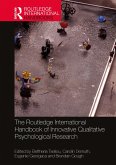
The contemporary world currently faces multi-level challenges, including cross-border migration, economic crises and myriad health issues, including the recent COVID-19 pandemic. Within this wider context of ongoing fluidity, transition and diversity, qualitative research methodologies in psychology are rapidly evolving, featuring innovative ways to examine the dynamic interrelation of societal and psychological processes. The Routledge International Handbook of Innovative Qualitative Psychological Research sets the stage for cutting-edge debates on how innovative approaches in qualitative…mehr
The contemporary world currently faces multi-level challenges, including cross-border migration, economic crises and myriad health issues, including the recent COVID-19 pandemic. Within this wider context of ongoing fluidity, transition and diversity, qualitative research methodologies in psychology are rapidly evolving, featuring innovative ways to examine the dynamic interrelation of societal and psychological processes.
The Routledge International Handbook of Innovative Qualitative Psychological Research sets the stage for cutting-edge debates on how innovative approaches in qualitative research in psychology can contribute to tackling current challenges in our society. The handbook depicts innovation in qualitative research in psychology with respect to methodological approaches like visual methods, arts-based research, discursive and narrative approaches, multimodal approaches, and pluralistic/mixed methodology approaches. It addresses a wide range of contemporary, challenging topics at the intersection of the psychological with the societal sphere, like globalization, climate change, digitalization, urbanization, social marginalization, gender and sexism, youth cultures, global mobility and global health risks. The book also includes contributions from various European countries across different fields of psychology, like clinical, health, social, educational, environmental, developmental, organizational, political and media psychology.
This is a valuable text for anyone teaching qualitative research courses in psychology as well as in related disciplines like mental health, education and sociology. It will also be of great interest to any qualitative researcher in the behavioral and social sciences wishing to have an overview of the latest developments in the field.
Dieser Download kann aus rechtlichen Gründen nur mit Rechnungsadresse in A, B, BG, CY, CZ, D, DK, EW, E, FIN, F, GR, HR, H, IRL, I, LT, L, LR, M, NL, PL, P, R, S, SLO, SK ausgeliefert werden.
Die Herstellerinformationen sind derzeit nicht verfügbar.
Autorenporträt
Eleftheria Tseliou is Professor of Research Methodology and Qualitative Methods at the University of Thessaly, Greece. Carolin Demuth is Associate Professor in Cultural and Developmental Psychology at Aalborg University, Denmark, where she teaches Qualitative Methods, Developmental Psychology and Cultural Psychology. Eugenie Georgaca is Associate Professor in Clinical Psychology at the School of Psychology of the Aristotle University of Thessaloniki, Greece. Brendan Gough is a social psychologist and qualitative researcher based at Leeds Beckett University, UK, and mainly works in the field of masculinity and men's health. He is cofounder and coeditor of the journal Qualitative Research in Psychology.
Inhaltsangabe
FOREWORD Kenneth Gergen PART I. SETTING THE SCENE: QUALITATIVE PSCYHOLOGICAL RESEARCH AND INNOVATION 1. Innovation in qualitative psychological research: Tackling methodological and societal challenges Eleftheria Tseliou, Brendan Gough, Carolin Demuth and Eugenie Georgaca 2. Diversity with a purpose: Reflections on qualitative psychology research Carla Willig 3. The line as a root metaphor for qualitative psychology Svend Brinkmann part II. Innovation in the process of inquiry: Method-focused contributions EDITOR: Eleftheria Tseliou 4. Performative social science Günter Mey 5. Dramatization: Cultural and psychological foundations of performative methodologies Shuangshuang Xu and Luca Tateo 6. Combining narrative inquiry and Foucaultian discourse analysis: Narrative-discursive analysis Marco Gemignani and Viv Burr 7. Sociopsychodrama as a qualitative research method Vedrana Mirkovi¿ and Jana Damjanov 8. Analytical pluralism: An application to the exploration of adult attachment Deborah Bailey-Rodriguez and Nollaig Frost 9. Children's drawings as data in psychology: Replicating William Stern's 1905 study on the Land of Plenty Andrea Kleeberg-Niepage and Johanna Degen 10. Disentangling meaning in hard to understand data through expanding the Listening Guide Franziska Müller, Sasmita Rosari, Jessica Höhn, Marie-Luise Springmann, and Mechthild Kiegelmann 11. Researchers' triangulation in interviews analyses: Inter-subjectivity as an asset for the production of original interpretative ideas An illustration with a French research on intimate partner violence experience Leìa Restivo, Solveig Lelaurain and Theìmis Apostolidis REFLECTION From Epistemology and Integrating Multiple Methods to Performing Social Science Reflections on Section 1 "Innovation in the Process of Inquiry: Method-focused Contributions" Uwe Flick PART III: Innovative participant-centered health and mental health projects EDITOR: Eugenie Georgaca 12. How can incorporating participant-generated photographs with interviews enhance interpretative phenomenological accounts about living with chronic illness? Iain R. Willamson, Periklis Papaloukas, Nicholas Shaw, Emily Print and Kerry Quincey 13. Body mapping the experience of fibromyalgia syndrome Maja Smrdu & Laura Jereb 14. Creative phenomenology within health and social care research: Bridging the gap between experience and expression William Day, Shioma-Lei Craythorne, Tiago Moutela, Katharine Slade, and Gemma Heath 15. Alliance ruptures and repairs as a discursive process: A Conversation Analysis perspective Peter Muntigl & Adam Horvath 16. Tracking change in group psychotherapy: Systematic methodological steps to record the development of clients' inner voices Maria Viou, & Eugenie Georgaca 17. Inner and outer dialogue in couple therapy: The potential of Stimulated Recall Interviews Virpi-Liisa Kykyri, Jarl Wahlström, & Jaakko Seikkula REFLECTION New ways of looking, new things to see: Invited Reflection on Part III Jonathan A Smith PART IV: Innovative COMMUNITY-FOCUSED PROJECTS EDITOR: Brendan Gough 18. Working with, not on unemployed people: How to explore subjective unemployment experiences in the affective economy Sabina Pultz 19. Using Innovative Qualitative Research Methods in Vulnerable Populations: Image-Based Research as Culturally Sensitive Alessandro Pepe and Loredana Addimando 20. Asset Mapping Towards Community Development: Exploring Home-Based Care Services in Cairo, Egypt Yomna M. El-Taweel and Irene Strasser 21. From capturing social issues to art production and community mobilization: A participatory multimodal study of life in Eleusis Issari, P., Karydi, E., Georgaca, E., Koliouli, F., Skali, D., Papadopoulos, N., El Raheb, K., Ioannidis, Y., Kalabratsidou, V., Diamantides, P., Stergiou, M., Gkiokas, P. and Vassilakou, V. 22. Systems thinking, rhizomes, and community-based qualitative research: An introduction to Nomadic Thematic Analysis Alexios Brailas and Konstantinos Papachristopoulos REFLECTION Innovative community-focused projects: critical reflection Rebecca Lawthom PART V: Thinking innovatively about societal issues EDITOR: Carolin Demuth 23. Beyond procedural ethics: four levels of research ethics in qualitative research Laure Kloetzer 24. Collaborative practice research: Inequality in school as an example Charlotte Højholt 25. Applying discursive methodologies to understanding hate speech on social media platforms Simon Goodman, Abigail Locke, Mick Finlay and Rosemary Lobban 26. Toilet talk: (Trans)Gendered negotiation of public spaces John Somers, Shani Burke, Philippa Carr and Mirko Demasi 27. Accessing ambivalences of the (feminist) self?! Advancing psychosocial analyses at the intersection of explicit and implicit knowledge by using the documentary method Katharina Hametner, Natalie Rodax and Sandra Reisch 28. Learning Pluralism and Researching Pluralistically: Pluralistic Qualitative Research as a model for teaching and learning qualitative research in psychology Sarah Foley, Nollaig Frost and Maria Dempsey REFLECTION Methods in Society: Constrained Pluralism Jan Valsiner CLOSING 29. Innovative qualitative psychological research in light of pressing methodological, societal and health challenges - looking ahead Carolin Demuth, Eugenie Georgaca, Brendan Gough and Eleftheria Tseliou
Es gelten unsere Allgemeinen Geschäftsbedingungen: www.buecher.de/agb
Impressum
www.buecher.de ist ein Internetauftritt der buecher.de internetstores GmbH
Geschäftsführung: Monica Sawhney | Roland Kölbl | Günter Hilger
Sitz der Gesellschaft: Batheyer Straße 115 - 117, 58099 Hagen
Postanschrift: Bürgermeister-Wegele-Str. 12, 86167 Augsburg
Amtsgericht Hagen HRB 13257
Steuernummer: 321/5800/1497
USt-IdNr: DE450055826