1,99 €
1,99 €
inkl. MwSt.
Sofort per Download lieferbar

0 °P sammeln
1,99 €
Als Download kaufen
1,99 €
inkl. MwSt.
Sofort per Download lieferbar
0 °P sammeln
Jetzt verschenken
Alle Infos zum eBook verschenken
1,99 €
inkl. MwSt.
Sofort per Download lieferbar
Alle Infos zum eBook verschenken
0 °P sammeln

Andere Kunden interessierten sich auch für
") Astoria; Or, Anecdotes of an Enterprise Beyond the Rocky Mountains (eBook, ePUB)1,99 €
Astoria; Or, Anecdotes of an Enterprise Beyond the Rocky Mountains (eBook, ePUB)1,99 €") By England's Aid; Or, the Freeing of the Netherlands, 1585-1604 (eBook, ePUB)1,99 €
By England's Aid; Or, the Freeing of the Netherlands, 1585-1604 (eBook, ePUB)1,99 €") Delaware Tom; or, The Traitor Guide (eBook, ePUB)1,99 €
Delaware Tom; or, The Traitor Guide (eBook, ePUB)1,99 €") Only One Thing in Life Is Constant-Change. Or, Rise, Fall, and Disappearance of Empires and Powerful Countries. : (eBook, ePUB)0,99 €
Only One Thing in Life Is Constant-Change. Or, Rise, Fall, and Disappearance of Empires and Powerful Countries. : (eBook, ePUB)0,99 €") By England's Aid; Or, the Freeing of the Netherlands, 1585-1604 (eBook, ePUB)0,49 €
By England's Aid; Or, the Freeing of the Netherlands, 1585-1604 (eBook, ePUB)0,49 €") Breaking with the Past; Or, Catholic Principles Abandoned at the Reformation (eBook, ePUB)0,49 €
Breaking with the Past; Or, Catholic Principles Abandoned at the Reformation (eBook, ePUB)0,49 €") The Female Soldier; Or, The Surprising Life and Adventures of Hannah Snell (eBook, ePUB)1,99 €
The Female Soldier; Or, The Surprising Life and Adventures of Hannah Snell (eBook, ePUB)1,99 €







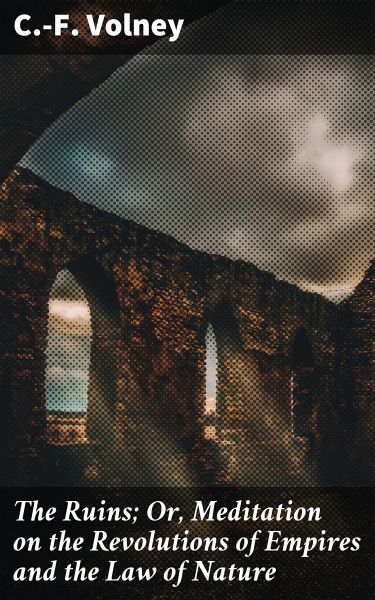
In "The Ruins; Or, Meditation on the Revolutions of Empires and the Law of Nature," C.-F. Volney presents a profound exploration of temporality and civilization's cyclic nature. This philosophical treatise, rich in Enlightenment ideals, critiques historical empires while positing a universal law that governs societal evolution. With a literary style that blends emotive prose with rigorous argumentation, Volney invokes vivid imagery and poignant reflections, making relatable the inevitable decline of civilizations. His meditation not only addresses the political and social upheavals of his time but also transcends the immediate context, delving into a timeless discourse reshaping the understanding of human progress and the moral responsibility of its inhabitants. C.-F. Volney, a French philosopher and historian, lived through the tumultuous periods of the late 18th century, including the French Revolution. These experiences profoundly influenced his thinking, imbuing his work with a sense of urgency and a call for rational reform. Volney's background as a traveler and observer of various cultures allowed him to articulate broader truths about humanity, drawing parallels between ancient histories and contemporary societies, thus enriching the philosophical dialogue of his time. This book is highly recommended for readers interested in political philosophy, history, and the moral dilemmas of governance. Volney's insights resonate with contemporary debates about the sustainability of empires and the cyclical nature of human endeavors, making it not only a historical artifact but a timeless reflection inviting critical thought and personal introspection. In this enriched edition, we have carefully created added value for your reading experience: - A succinct Introduction situates the work's timeless appeal and themes. - The Synopsis outlines the central plot, highlighting key developments without spoiling critical twists. - A detailed Historical Context immerses you in the era's events and influences that shaped the writing. - An Author Biography reveals milestones in the author's life, illuminating the personal insights behind the text. - A thorough Analysis dissects symbols, motifs, and character arcs to unearth underlying meanings. - Reflection questions prompt you to engage personally with the work's messages, connecting them to modern life. - Hand-picked Memorable Quotes shine a spotlight on moments of literary brilliance. - Interactive footnotes clarify unusual references, historical allusions, and archaic phrases for an effortless, more informed read.
Dieser Download kann aus rechtlichen Gründen nur mit Rechnungsadresse in A, B, BG, CY, CZ, D, DK, EW, E, FIN, F, GR, H, IRL, I, LT, L, LR, M, NL, PL, P, R, S, SLO, SK ausgeliefert werden.