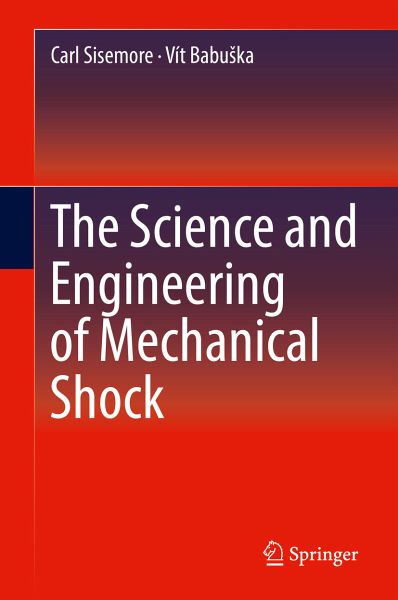
88,95 €
inkl. MwSt.
Sofort per Download lieferbar
44 °P sammeln

Andere Kunden interessierten sich auch für
") Vibrations of Hollow Elastic Bodies (eBook, PDF)112,95 €
Vibrations of Hollow Elastic Bodies (eBook, PDF)112,95 €") Notes on Projectile Impact Analyses (eBook, PDF)72,95 €
Notes on Projectile Impact Analyses (eBook, PDF)72,95 €") Shock & Vibration, Aircraft/Aerospace, Energy Harvesting, Acoustics & Optics, Volume 9 (eBook, PDF)112,95 €
Shock & Vibration, Aircraft/Aerospace, Energy Harvesting, Acoustics & Optics, Volume 9 (eBook, PDF)112,95 €") Experimental Methods of Shock Wave Research (eBook, PDF)104,95 €
Experimental Methods of Shock Wave Research (eBook, PDF)104,95 €") Qualitative Theory in Structural Mechanics (eBook, PDF)120,95 €
Qualitative Theory in Structural Mechanics (eBook, PDF)120,95 €") Topics in Modal Analysis & Testing, Volume 10 (eBook, PDF)112,95 €
Topics in Modal Analysis & Testing, Volume 10 (eBook, PDF)112,95 €") Automation of Finite Element Methods (eBook, PDF)128,95 €
Automation of Finite Element Methods (eBook, PDF)128,95 €




Presents mechanical shock from a structural dynamics perspective
Adopts a flexible structure supporting use as a reference for practicing engineers as well as a textbook for students of mechanical shock
Sheds light on less common and less well-understood spectra techniques, energy spectra methods, and non-spectral methods
Maximizes reader understanding of multi-degree-of-freedom shock spectra and multi-degree-of-freedom testing
Facilitates easy implementation computational analysis with algorithms and pseudo-code
Includes the history of mechanical shock analysis and testing up to the present
Adopts a flexible structure supporting use as a reference for practicing engineers as well as a textbook for students of mechanical shock
Sheds light on less common and less well-understood spectra techniques, energy spectra methods, and non-spectral methods
Maximizes reader understanding of multi-degree-of-freedom shock spectra and multi-degree-of-freedom testing
Facilitates easy implementation computational analysis with algorithms and pseudo-code
Includes the history of mechanical shock analysis and testing up to the present
Dieser Download kann aus rechtlichen Gründen nur mit Rechnungsadresse in A, B, BG, CY, CZ, D, DK, EW, E, FIN, F, GR, HR, H, IRL, I, LT, L, LR, M, NL, PL, P, R, S, SLO, SK ausgeliefert werden.