Sie sind bereits eingeloggt. Klicken Sie auf 2. tolino select Abo, um fortzufahren.
Bitte loggen Sie sich zunächst in Ihr Kundenkonto ein oder registrieren Sie sich bei bücher.de, um das eBook-Abo tolino select nutzen zu können.
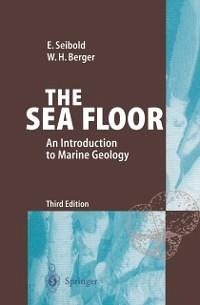
The "Sea Floor" is designed to acquaint students with the most important results achieved in marine geology over the last three decades and the scientists who brought them about. Written by two of marine geology's leading exponents, it lays the groundwork for studies in geology, oceanography and environmental sciences by summarizing modern insights into tectonics and marine morphology, the geological processes at work on the sea floor, and the Earth's climatic history as recorded in deep sea sediments.
The "Sea Floor" is designed to acquaint students with the most important results achieved in marine geology over the last three decades and the scientists who brought them about. Written by two of marine geology's leading exponents, it lays the groundwork for studies in geology, oceanography and environmental sciences by summarizing modern insights into tectonics and marine morphology, the geological processes at work on the sea floor, and the Earth's climatic history as recorded in deep sea sediments.
Dieser Download kann aus rechtlichen Gründen nur mit Rechnungsadresse in A, B, BG, CY, CZ, D, DK, EW, E, FIN, F, GR, HR, H, IRL, I, LT, L, LR, M, NL, PL, P, R, S, SLO, SK ausgeliefert werden.
Die Herstellerinformationen sind derzeit nicht verfügbar.
Autorenporträt
Eugen Seibold was born in Stuttgart. He studied geology in Bonn and in T¿bingen. Subsequently he taught at the University of Tübingen, but moved to Kiel in 1958 to study modern marine sedimentation and manage the Geological-Palaeontological Institute of the University as its director. From 1980 he accepted positions as the President of the DFG (the German National Science Foundation), as Vice-President of the European Science Foundation, and as the President of the International Union of Geological Sciences. He was President of the European Science Foundation from 1984 to 1990, and a member of various academies, including the Leopoldina (Akademie der Naturforscher, Halle in Saxony-Anhalt) and the Académie des Sciences in Paris. Seibold's many contributions to geology were well recognized - he was a recipient of internationally known awards (e.g., the Gustav-Steinmann Medal, the Hans-Stille Medal, the Leopold-von-Buch Plakette), as well as the Walter-KertzMedal in Geophysics and the Blue Planet Prize of the Asahi Foundation. The Asahi Foundation's prize especially recognizes contributions of relevance to society. The prize was used, in part, to fund the Eugen and Ilse Seibold Prize, an award furthering Japanese-German scientific interaction. Among outstanding paradigms within Seibold's many contributions (including geologic education) one might emphasize his insights regarding the role of exchange between marginal basins and the open sea in determining the deposits accumulating in shelf basins. He assigned an estuarine-type exchange to black shale sedimentation and an anti-estuarine type to carbonate deposits. Both types of sediment are prominent in the geologic record (and are conspicuous in the Jurassic of southern Germany, his original training ground). Significantly, black shales are commonly a source for hydrocarbon products, while carbonates often serve as reservoir rocks. Obviously, both rock types help define our time in human history. It is typical for Seibold that he thought we should know about their origin. Wolfgang Berger is an acclaimed researcher in micropaleontology, marine geology, and oceanography. He has published over 200 research articles and several books on a broad array of topics in oceanography and on climate change. Berger earned numerous medals and prizes during his career, among others the Bigelow Medal, the Humboldt Award, and the Steinmann Medal. Berger earned in 1961 his Vordiplom degree in geology at the University of Erlangen and in 1963 his master's degree in geology at the University of Colorado in Boulder. In 1968 he received his PhD in oceanography from the University of California, San Diego (UCSD). From 1968 to 1970 he did research at the UCSD's Scripps Institution of Oceanography, and in 1970/1971 he was an Assistant at the Geological Institute of the University of Kiel. In 1971 he became an assistant professor, in 1974 an associate professor, and then in 1981 a professor at the Scripps Institution, where he was in 1996/1997 the interim director. In 1997 Berger became the director of the California Space Institute in San Diego. His research is especially concerned with the ecology of planktonic foraminifera and the reconstruction of the climate and the marine environment of the Cenozoic.
Inhaltsangabe
1 Origin and Morphology of Ocean Basins.- 2 Origin and Morphology of Ocean Margins.- 3 Sources and Composition of Marine Sediments.- 4 Effects of Waves and Currents.- 5 Sea Level Processes and Effects of Sea Level Change.- 6 Productivity and Benthic Organisms - Distribution, Activity, and Environmental Reconstruction.- 7 Imprint of Climatic Zonation on Marine Sediments.- 8 Deep-Sea Sediments - Patterns, Processes, and Stratigraphic Methods.- 9 Paleoceanography - The Deep-Sea Record.- 10 Resources from the Ocean Floor.- Epilog.- List of Books and Symposia.- A1 Conversion Between Common US Units and Metric Units.- A2 Topographic Statistics.- A3 The Geologic Time Scale.- A4 Common Minerals.- A5 Grain Size Classification for Sediments.- A6 Common Rock Types.- A7 Geochemical Statistics.- A8 Radio-Isotopes and Dating.- A9 Systematic Overview for Major Groups of Common Marine Organisms Important in Sea floor Processes.- Index of Names.
1 Origin and Morphology of Ocean Basins.- 2 Origin and Morphology of Ocean Margins.- 3 Sources and Composition of Marine Sediments.- 4 Effects of Waves and Currents.- 5 Sea Level Processes and Effects of Sea Level Change.- 6 Productivity and Benthic Organisms - Distribution, Activity, and Environmental Reconstruction.- 7 Imprint of Climatic Zonation on Marine Sediments.- 8 Deep-Sea Sediments - Patterns, Processes, and Stratigraphic Methods.- 9 Paleoceanography - The Deep-Sea Record.- 10 Resources from the Ocean Floor.- Epilog.- List of Books and Symposia.- A1 Conversion Between Common US Units and Metric Units.- A2 Topographic Statistics.- A3 The Geologic Time Scale.- A4 Common Minerals.- A5 Grain Size Classification for Sediments.- A6 Common Rock Types.- A7 Geochemical Statistics.- A8 Radio-Isotopes and Dating.- A9 Systematic Overview for Major Groups of Common Marine Organisms Important in Sea floor Processes.- Index of Names.
Rezensionen
"This book is extremely readable for a non-geologist and is an extremely valuable source of information for all marine biologists interested in the interaction of their field with earth sciences." - Marine Ecology "Seibold and Berger's book is a classic!" - Geo Journal
Es gelten unsere Allgemeinen Geschäftsbedingungen: www.buecher.de/agb
Impressum
www.buecher.de ist ein Internetauftritt der buecher.de internetstores GmbH
Geschäftsführung: Monica Sawhney | Roland Kölbl | Günter Hilger
Sitz der Gesellschaft: Batheyer Straße 115 - 117, 58099 Hagen
Postanschrift: Bürgermeister-Wegele-Str. 12, 86167 Augsburg
Amtsgericht Hagen HRB 13257
Steuernummer: 321/5800/1497
USt-IdNr: DE450055826