39,95 €
39,95 €
inkl. MwSt.
Sofort per Download lieferbar

20 °P sammeln
39,95 €
Als Download kaufen
39,95 €
inkl. MwSt.
Sofort per Download lieferbar
20 °P sammeln
Jetzt verschenken
Alle Infos zum eBook verschenken
39,95 €
inkl. MwSt.
Sofort per Download lieferbar
Alle Infos zum eBook verschenken
20 °P sammeln

Andere Kunden interessierten sich auch für
") The Social Psychology of Obedience Towards Authority (eBook, ePUB)39,95 €
The Social Psychology of Obedience Towards Authority (eBook, ePUB)39,95 €") Relational Models Theory (eBook, PDF)56,95 €
Relational Models Theory (eBook, PDF)56,95 €") The Handbook of Personalized Persuasion (eBook, PDF)43,95 €
The Handbook of Personalized Persuasion (eBook, PDF)43,95 €") Digital Gender-Sexual Violations (eBook, PDF)32,95 €
Digital Gender-Sexual Violations (eBook, PDF)32,95 €") The Power of Identity Claims (eBook, PDF)39,95 €
The Power of Identity Claims (eBook, PDF)39,95 €") The Conflicted Mind (eBook, PDF)39,95 €
The Conflicted Mind (eBook, PDF)39,95 €") Social Cognition and the Second Person in Human Interaction (eBook, PDF)39,95 €
Social Cognition and the Second Person in Human Interaction (eBook, PDF)39,95 €



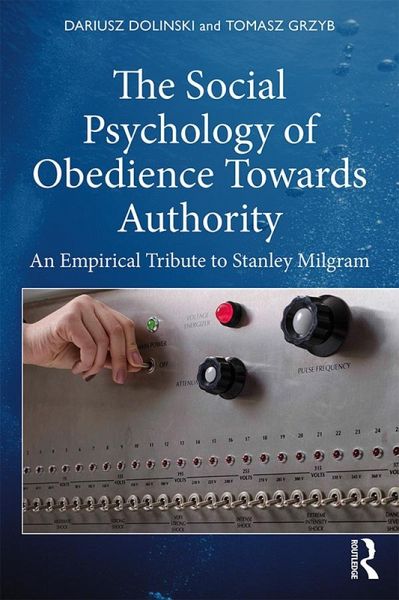
This rich volume explores the complex problem of obedience and conformity, re-examining Stanley Milgram's famous electric shock study, and presenting the findings of the most extensive empirical study on obedience toward authority since Milgram's era.
Dolinski and Grzyb refer to their own series of studies testing various hypotheses from Milgram's and others' research, examining underlying obedience mechanisms as well as factors modifying the degree of obedience displayed by individuals in different situations. They offer their theoretical model explaining subjects' obedience in Milgram's paradigm and describe numerous examples of the destructive effect of thoughtless obedience both in our daily lives as well as in crucial historical events, stressing the need for critical thinking when issued with a command.
Concluding with reflections on how to prevent the danger of destructive obedience to authority, this insightful volume will be fascinating reading for students and academics in social psychology, as well as those in fields concerned with complex social problems.
Dolinski and Grzyb refer to their own series of studies testing various hypotheses from Milgram's and others' research, examining underlying obedience mechanisms as well as factors modifying the degree of obedience displayed by individuals in different situations. They offer their theoretical model explaining subjects' obedience in Milgram's paradigm and describe numerous examples of the destructive effect of thoughtless obedience both in our daily lives as well as in crucial historical events, stressing the need for critical thinking when issued with a command.
Concluding with reflections on how to prevent the danger of destructive obedience to authority, this insightful volume will be fascinating reading for students and academics in social psychology, as well as those in fields concerned with complex social problems.
Dieser Download kann aus rechtlichen Gründen nur mit Rechnungsadresse in A, B, BG, CY, CZ, D, DK, EW, E, FIN, F, GR, HR, H, IRL, I, LT, L, LR, M, NL, PL, P, R, S, SLO, SK ausgeliefert werden.
One of the most important social behavior that contributes to many of the evil conducts is obedience. The book by Dolinski and Grzyb "Social Psychology of Obedience towards Authority" is a comprehensive, systematic, and significant contribution to the understanding of this behavior. On the basis of the seminal studies of Stanley Milgram, who began the journey of investigating obedience in the laboratory, Dolinski and Grzyb continued this line of research to reveal its nature and conditions in order to expand our knowledge about its implications and ramifications. The book is warmly recommended to all those who wish prevent future evilness. - Professor Daniel Bar-Tal, Tel Aviv University
In the vast literature over the past 60 years devoted to the Milgram obedience studies, this new volume is unique. It is written by two researchers who are not only insightful reviewers of the empirical history of the Milgram (and Milgram-inspired) literature, but are, themselves, currently and actively engaged in conducting programmatic and informative empirical research. Their studies closely follow, with needed and instructive changes, the Milgram paradigm. The reader thus will learn the key elements of Milgram's often unrecognized, large program of (many) obedience experiments, important follow-ups by other investigators, and the very latest studies by the present authors. Not to be minimized is the extraordinarily good writing in this book. Needed details of diverse issues, including ethical problems, recent findings from the Milgram archives at Yale, and the many generalizations made to real-world domains of destructive obedience, are fully aired by the authors without losing the reader's attention or interest-not an easy task! The authors's enthusiasm is, in short, captivating. - Professor Arthur Miller, Miami University
Dolinski and Grzyb have given us the gift of the best book ever written on Stanley Milgram's famous investigations into the topic of obedience to authority. This is not the case simply because the book provides the most accurate presentation of the history, methodology, results, and ethics of those specific investigations. In addition, the authors treat us to deep insights into an array of larger issues, ranging from human tendencies to obey authority, in general, to tendencies to say yes to requests from all manner of requesters. It's a book I am thankful for having the opportunity to read. - Professor Robert B. Cialdini, Author of Influence and Pre-Suasion, Arizona State University
In the vast literature over the past 60 years devoted to the Milgram obedience studies, this new volume is unique. It is written by two researchers who are not only insightful reviewers of the empirical history of the Milgram (and Milgram-inspired) literature, but are, themselves, currently and actively engaged in conducting programmatic and informative empirical research. Their studies closely follow, with needed and instructive changes, the Milgram paradigm. The reader thus will learn the key elements of Milgram's often unrecognized, large program of (many) obedience experiments, important follow-ups by other investigators, and the very latest studies by the present authors. Not to be minimized is the extraordinarily good writing in this book. Needed details of diverse issues, including ethical problems, recent findings from the Milgram archives at Yale, and the many generalizations made to real-world domains of destructive obedience, are fully aired by the authors without losing the reader's attention or interest-not an easy task! The authors's enthusiasm is, in short, captivating. - Professor Arthur Miller, Miami University
Dolinski and Grzyb have given us the gift of the best book ever written on Stanley Milgram's famous investigations into the topic of obedience to authority. This is not the case simply because the book provides the most accurate presentation of the history, methodology, results, and ethics of those specific investigations. In addition, the authors treat us to deep insights into an array of larger issues, ranging from human tendencies to obey authority, in general, to tendencies to say yes to requests from all manner of requesters. It's a book I am thankful for having the opportunity to read. - Professor Robert B. Cialdini, Author of Influence and Pre-Suasion, Arizona State University