47,95 €
47,95 €
inkl. MwSt.
Sofort per Download lieferbar

24 °P sammeln
47,95 €
Als Download kaufen
47,95 €
inkl. MwSt.
Sofort per Download lieferbar
24 °P sammeln
Jetzt verschenken
Alle Infos zum eBook verschenken
47,95 €
inkl. MwSt.
Sofort per Download lieferbar
Alle Infos zum eBook verschenken
24 °P sammeln

Andere Kunden interessierten sich auch für
") False Belief and the Meno Paradox (eBook, PDF)33,95 €
False Belief and the Meno Paradox (eBook, PDF)33,95 €") Historical Understanding and Ethics in Social Science (eBook, PDF)39,95 €
Historical Understanding and Ethics in Social Science (eBook, PDF)39,95 €") Biopolitics, Necropolitics, Cosmopolitics (eBook, PDF)41,95 €
Biopolitics, Necropolitics, Cosmopolitics (eBook, PDF)41,95 €") The Politics of Transdisciplinarity (eBook, PDF)42,95 €
The Politics of Transdisciplinarity (eBook, PDF)42,95 €") Bourdieu's Philosophy and Sociology of Science (eBook, PDF)39,95 €
Bourdieu's Philosophy and Sociology of Science (eBook, PDF)39,95 €") Hybrid Political Order and the Politics of Uncertainty (eBook, PDF)40,95 €
Hybrid Political Order and the Politics of Uncertainty (eBook, PDF)40,95 €") Beyond Disciplinarity (eBook, PDF)39,95 €
Beyond Disciplinarity (eBook, PDF)39,95 €







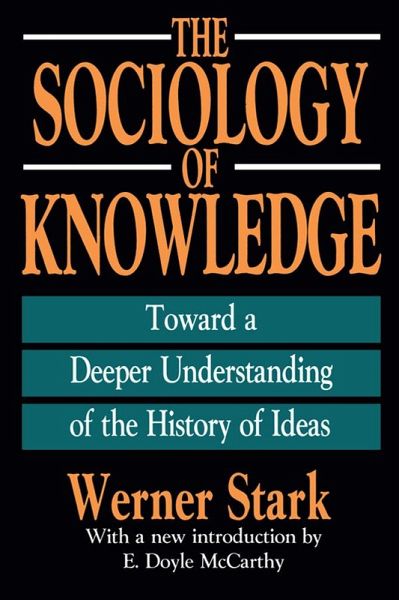
This volume serves as both an introduction to the field of the sociology of knowledge and an interpretation of the thought of the major figures associated with its development More than a compendium of ideas, Stark seeks here to put order into what he regarded as a diffuse tradition of diverse bodies of thought, in particular the seemingly irreconcilable conflict between the study of the political element in thought identified here with Karl Mannheim and the investigation of the social element in thinking associated with the work of Max Scheler.
The sociology of knowledge is primarily directed toward the study of the precise ways that human experience, through the mediation of knowledge, takes on a conscious and communicable shape. While both schools dealt with by Stark assume that the pursuit of truth is not purposeful apart from socially and historically determined structures of meaning, the tradition extending from Marx to Mannheim seeks to expose hidden factors that turn us away from the truth while that of Weber and Scheler attempts to identify social forces that impart a definite direction to our search for it
In order to reconcile opposing theoretical positions, Stark seeks to lay the foundations for a theory of the social determination of thought by directing his inquiry to the philosophical problem of truth in a manner compatible with cultural sociology. Stark's theoretical legacy to the sociology of knowledge is that social influences operate everywhere through a group's ethos. From this, many systems of ideas and social categories emanate, revealing partial glimpses of a synthetic whole.
The outcome of Stark's work is a general theory of social determination remarkably consistent with contemporary interests in the broad range of cultural studies, whose focus is best described as the use of philosophical, literary, and historical approaches to study the social construction of meaning. The Sociology of Knowledge will be of great interest to social scientists, philosophers, and intellectual historians.
The sociology of knowledge is primarily directed toward the study of the precise ways that human experience, through the mediation of knowledge, takes on a conscious and communicable shape. While both schools dealt with by Stark assume that the pursuit of truth is not purposeful apart from socially and historically determined structures of meaning, the tradition extending from Marx to Mannheim seeks to expose hidden factors that turn us away from the truth while that of Weber and Scheler attempts to identify social forces that impart a definite direction to our search for it
In order to reconcile opposing theoretical positions, Stark seeks to lay the foundations for a theory of the social determination of thought by directing his inquiry to the philosophical problem of truth in a manner compatible with cultural sociology. Stark's theoretical legacy to the sociology of knowledge is that social influences operate everywhere through a group's ethos. From this, many systems of ideas and social categories emanate, revealing partial glimpses of a synthetic whole.
The outcome of Stark's work is a general theory of social determination remarkably consistent with contemporary interests in the broad range of cultural studies, whose focus is best described as the use of philosophical, literary, and historical approaches to study the social construction of meaning. The Sociology of Knowledge will be of great interest to social scientists, philosophers, and intellectual historians.
Dieser Download kann aus rechtlichen Gründen nur mit Rechnungsadresse in A, B, BG, CY, CZ, D, DK, EW, E, FIN, F, GR, HR, H, IRL, I, LT, L, LR, M, NL, PL, P, R, S, SLO, SK ausgeliefert werden.