28,95 €
28,95 €
inkl. MwSt.
Sofort per Download lieferbar

14 °P sammeln
28,95 €
Als Download kaufen
28,95 €
inkl. MwSt.
Sofort per Download lieferbar
14 °P sammeln
Jetzt verschenken
Alle Infos zum eBook verschenken
28,95 €
inkl. MwSt.
Sofort per Download lieferbar
Alle Infos zum eBook verschenken
14 °P sammeln

Andere Kunden interessierten sich auch für
") Women in exile in early modern Europe and the Americas (eBook, ePUB)85,95 €
Women in exile in early modern Europe and the Americas (eBook, ePUB)85,95 €") The Italian Boy (eBook, ePUB)10,99 €
The Italian Boy (eBook, ePUB)10,99 €") Towards an Equality of the Sexes in Early Modern France (eBook, ePUB)39,95 €
Towards an Equality of the Sexes in Early Modern France (eBook, ePUB)39,95 €") The Basque Witch-Hunt (eBook, ePUB)21,95 €
The Basque Witch-Hunt (eBook, ePUB)21,95 €") The Domestic Revolution (eBook, ePUB)9,95 €
The Domestic Revolution (eBook, ePUB)9,95 €") The Time Traveller's Guide to Restoration Britain (eBook, ePUB)10,99 €
The Time Traveller's Guide to Restoration Britain (eBook, ePUB)10,99 €") The Afterlives of the Terror (eBook, ePUB)3,99 €
The Afterlives of the Terror (eBook, ePUB)3,99 €




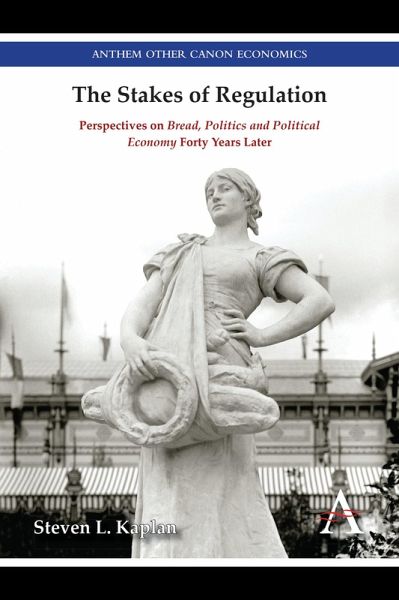
This book has a double agenda. First, it is a series of free-standing essays dealing with the fraught question of regulation in its multiples guises: economic, social, political, cultural and psychological. At the same time, it serves as a companion volume to the re-edition of Kaplan's landmark 'Bread, Politics and Political Economy in the Reign of Louis XV', which first appeared in 1976. The chapters that unfold reveal how Kaplan's thinking has evolved in reaction both to the changing intellectual, epistemological, historiographical and sociopolitical environment, and to some of the significant scholarship that has been accomplished during the past forty years. This study is conceived as a commentary on and a dialogue with 'Bread, Politics' and with researchers who have written in and around the concerns of that book.
Kaplan treats themes with which readers of his first book are conversant: the matrix motif of regulation; agriculture; markets; collective action and the moral economy; the people; order and disorder; the parlements in the age of the Economic Enlightenment; the king and kingship; the monarch and his ministers in the elaboration and execution of public policy; the new historiography of political economy; and the old, persistent tragedy of famine, understood as the problem of food insecurity in its less virulent incarnations.
Kaplan engages them all with keen interest, and his discussion is "problem"-oriented. The author focuses largely on the questions that he considered, or failed to raise or resolve, in his inaugural work. The unity of outlook derives from the triangulation between the 'Bread, Politics' of 1976, a dense selection of the scholarship of the past four decades, and the critical gaze that Kaplan directs toward both. Kaplan remains faithful to the premise of 'Bread, Politics': that the subsistence question, broadly construed, is at the core of eighteenth-century history, and that the issues joined by the struggle over liberalization have marked French (and European/Atlantic) history ever since. These issues continue to shape our destiny today through the bristling tension between liberty and equality, and the debate over the necessity, legitimacy and character of regulation.
Kaplan treats themes with which readers of his first book are conversant: the matrix motif of regulation; agriculture; markets; collective action and the moral economy; the people; order and disorder; the parlements in the age of the Economic Enlightenment; the king and kingship; the monarch and his ministers in the elaboration and execution of public policy; the new historiography of political economy; and the old, persistent tragedy of famine, understood as the problem of food insecurity in its less virulent incarnations.
Kaplan engages them all with keen interest, and his discussion is "problem"-oriented. The author focuses largely on the questions that he considered, or failed to raise or resolve, in his inaugural work. The unity of outlook derives from the triangulation between the 'Bread, Politics' of 1976, a dense selection of the scholarship of the past four decades, and the critical gaze that Kaplan directs toward both. Kaplan remains faithful to the premise of 'Bread, Politics': that the subsistence question, broadly construed, is at the core of eighteenth-century history, and that the issues joined by the struggle over liberalization have marked French (and European/Atlantic) history ever since. These issues continue to shape our destiny today through the bristling tension between liberty and equality, and the debate over the necessity, legitimacy and character of regulation.
Dieser Download kann aus rechtlichen Gründen nur mit Rechnungsadresse in A, D ausgeliefert werden.