13,99 €
13,99 €
inkl. MwSt.
Sofort per Download lieferbar

0 °P sammeln
13,99 €
Als Download kaufen
13,99 €
inkl. MwSt.
Sofort per Download lieferbar
0 °P sammeln
Jetzt verschenken
Alle Infos zum eBook verschenken
13,99 €
inkl. MwSt.
Sofort per Download lieferbar
Alle Infos zum eBook verschenken
0 °P sammeln

Andere Kunden interessierten sich auch für
") Jane on the Brain (eBook, ePUB)12,85 €
Jane on the Brain (eBook, ePUB)12,85 €") Le cerveau, cette équipe de choc (eBook, ePUB)15,99 €
Le cerveau, cette équipe de choc (eBook, ePUB)15,99 €") Pourquoi je ne suis pas mon cerveau (eBook, ePUB)7,99 €
Pourquoi je ne suis pas mon cerveau (eBook, ePUB)7,99 €") Eloge de la passoire (eBook, ePUB)13,99 €
Eloge de la passoire (eBook, ePUB)13,99 €") La médecine du bon sens (eBook, ePUB)13,99 €
La médecine du bon sens (eBook, ePUB)13,99 €") N'ayez pas peur de la morale (eBook, ePUB)9,99 €
N'ayez pas peur de la morale (eBook, ePUB)9,99 €") Life, Death, and Other Inconvenient Truths (eBook, ePUB)12,95 €
Life, Death, and Other Inconvenient Truths (eBook, ePUB)12,95 €

Storytelling, a tradition that built human civilization, may soon destroy it
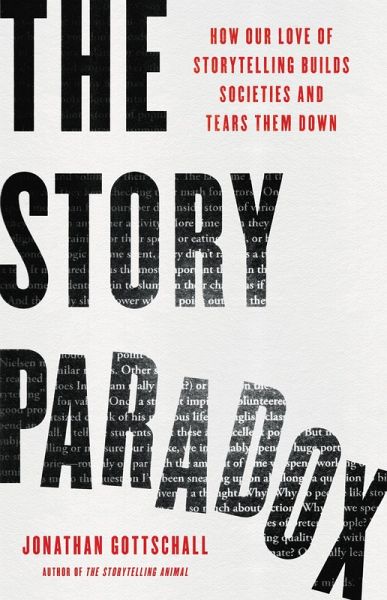
Humans are storytelling animals. Stories are what make our societies possible. Countless books celebrate their virtues. But Jonathan Gottschall, an expert on the science of stories, argues that there is a dark side to storytelling we can no longer ignore. Storytelling, the very tradition that built human civilization, may be the thing that destroys it.
In The Story Paradox, Gottschall explores how a broad consortium of psychologists, communications specialists, neuroscientists, and literary quants are using the scientific method to study how stories affect our brains. The results challenge the idea that storytelling is an obvious force for good in human life. Yes, storytelling can bind groups together, but it is also the main force dragging people apart. And it's the best method we've ever devised for manipulating each other by circumventing rational thought. Behind all civilization's greatest ills-environmental destruction, runaway demagogues, warfare-you will always find the same master factor: a mind-disordering story.
Gottschall argues that societies succeed or fail depending on how they manage these tensions. And it has only become harder, as new technologies that amplify the effects of disinformation campaigns, conspiracy theories, and fake news make separating fact from fiction nearly impossible.
With clarity and conviction, Gottschall reveals why our biggest asset has become our greatest threat, and what, if anything, can be done. It is a call to stop asking, "How we can change the world through stories?" and start asking, "How can we save the world from stories?"
Dieser Download kann aus rechtlichen Gründen nur mit Rechnungsadresse in A, B, BG, CY, CZ, D, DK, EW, E, FIN, F, GR, HR, H, IRL, I, LT, L, LR, M, NL, PL, P, R, S, SLO, SK ausgeliefert werden.