11,89 €
inkl. MwSt.
Sofort per Download lieferbar
0 °P sammeln

Andere Kunden interessierten sich auch für
") The Stranger Secret (eBook, ePUB)11,89 €
The Stranger Secret (eBook, ePUB)11,89 €") The Unevolved and Evolved Ethics (eBook, ePUB)5,94 €
The Unevolved and Evolved Ethics (eBook, ePUB)5,94 €") Serving the Greater Good through Virtue (eBook, ePUB)3,56 €
Serving the Greater Good through Virtue (eBook, ePUB)3,56 €") Propositions, Problems & Poems on the Peculiar Human Ability to Reason, Singular Human Right to Consent & Other Neglected Matters (eBook, ePUB)2,99 €
Propositions, Problems & Poems on the Peculiar Human Ability to Reason, Singular Human Right to Consent & Other Neglected Matters (eBook, ePUB)2,99 €") Conscience & Moral Truth (eBook, ePUB)5,94 €
Conscience & Moral Truth (eBook, ePUB)5,94 €") The Lonestar Method: Human Enchiridion (eBook, ePUB)11,89 €
The Lonestar Method: Human Enchiridion (eBook, ePUB)11,89 €") Lost on the Road to Oz (eBook, ePUB)3,56 €
Lost on the Road to Oz (eBook, ePUB)3,56 €







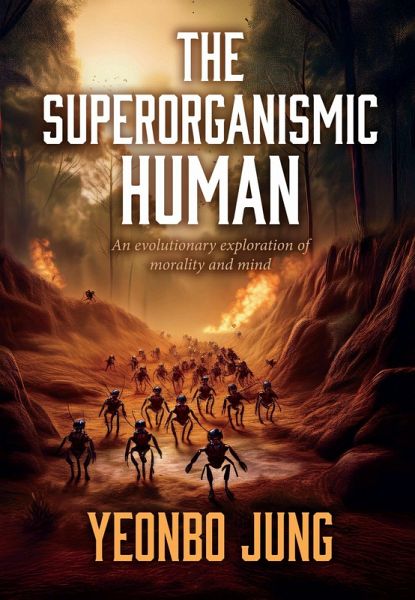
Human beings are deeply social, but to truly understand our behaviors-our loyalties, moral contradictions, and inner tensions-we must look beyond the view of humans as mere individuals or social animals. This book introduces a new framework: to see human life as composed of imperfect superorganisms-groups such as families, communities, companies, religious sects, and nations that operate collectively.In nature, superorganisms like ant colonies or beehives function as unified, reproductive systems. Humans do not reproduce as a group, which makes our superorganisms "imperfect." Yet we exhibit many of the same features: cooperation, altruism, internal discipline, and division of labor. These social structures overlap and shape how we act, think, and judge.This insight sheds light on the moral confusion of modern life. Our moral instincts evolved in small, kin-based bands, but today we belong to many competing social groups. These groups each demand loyalty and impose their own moral codes. What is ethical in one may be condemned in another. The result is fragmented moral reasoning and inner conflict.To address this, the book proposes a biologically grounded model of the human mind-the backbone of mind-composed of three elements:.Desire: evolved instincts that drive behavior toward survival, status, and connection.Reasoning: our capacity for abstract thought, planning, and moral evaluation.The Pleasure Gate: a neural mechanism that filters actions based on anticipated benefit or satisfactionTogether, these elements explain how humans make decisions, negotiate conflicting impulses, and experience what we call "free will"-not as a metaphysical mystery, but as the mind''s ability to select actions through the interaction of desire and reason, governed by the pleasure gate.This model also offers a practical, evolutionary account of the self-a fluid process built from memory, bodily awareness, and cognitive function-and reinterprets philosophical ideals such as dignity, rights, and moral responsibility as manifestations of evolved social needs and desires.By framing morality not as a fixed rulebook but as an adaptive strategy shaped by group life, The Superorganismic Human offers a compelling explanation for persistent human paradoxes:.Why are we kind to strangers in some cases, but hostile in others?.Why do people hold opposing moral views despite sharing the same facts?.Why does social fragmentation persist even in societies with shared values?The answers lie not in flawed reasoning or cultural decline, but in the evolved structure of the human mind and its entanglement in multiple, competing superorganisms.This is not a book of moral prescriptions. It is a scientific-philosophical exploration of the architecture of human thought, the roots of moral judgment, and the tension between individual autonomy and collective belonging. In an era marked by polarization and global complexity, The Superorganismic Human offers a timely and insightful framework for understanding ourselves and the societies we shape-and are shaped by.
Dieser Download kann aus rechtlichen Gründen nur mit Rechnungsadresse in A, B, BG, CY, CZ, D, DK, EW, E, FIN, F, GR, HR, H, IRL, I, LT, L, LR, M, NL, PL, P, R, S, SLO, SK ausgeliefert werden.