3,99 €
inkl. MwSt.
Sofort per Download lieferbar
0 °P sammeln

Andere Kunden interessierten sich auch für
") Liberty And Death At The Alamo (eBook, ePUB)22,95 €
Liberty And Death At The Alamo (eBook, ePUB)22,95 €") The Battle of the Ironclads (eBook, ePUB)2,99 €
The Battle of the Ironclads (eBook, ePUB)2,99 €") The Cristero War (eBook, ePUB)2,99 €
The Cristero War (eBook, ePUB)2,99 €") Light-Horse Harry Lee and Robert E. Lee (eBook, ePUB)4,99 €
Light-Horse Harry Lee and Robert E. Lee (eBook, ePUB)4,99 €") The Caste War of Yucatán (eBook, ePUB)3,99 €
The Caste War of Yucatán (eBook, ePUB)3,99 €") The Fetterman Massacre and the Battle of the Little Bighorn (eBook, ePUB)4,99 €
The Fetterman Massacre and the Battle of the Little Bighorn (eBook, ePUB)4,99 €") Fidel and Che (eBook, ePUB)2,99 €
Fidel and Che (eBook, ePUB)2,99 €





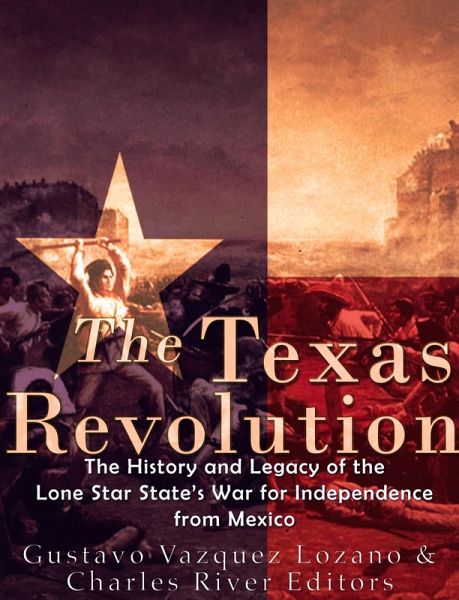
What part of the United States has been under the rule of six different countries? The answer, given the title of this book, is obvious, and perhaps that¿s why few places in America have citizens with such an inflamed pride for their homeland. As John Steinbeck famously wrote in Travels with Charley: In Search of America, "Texas is a state of mind, but I think it is more than that. It is a mystique closely approximating a religion. For all its enormous range of space, climate, and physical appearance, and for all the internal squabbles, contentions, and strivings, Texas has a tight cohesiveness perhaps stronger than any other section of America." It¿s not uncommon for the average Texan to feel great pride for the mere fact of being a Texan, and even if also a proud American, he she can even play with the notion that the Lone Star State can (and perhaps should) be a big nation itself. To say that something is "The size of Texas" expresses grandeur and impressiveness, and its inhabitants have certainly displayed enough industriousness to make this part of North America one of the states that contribute most to the country¿s gross domestic product.
When various revolutions mostly forced the Europeans out of the continent, Texas ceased to belong to Spain and France to become a part of the Mexican Empire; later it was an independent country, and currently one of the 50 states of the United States. During a short period, rebellious Texas again separated from the U.S. to join the Confederate States of America with other secessionist states.
Of course, the most important war of all for Texas came in the early 19th century, and the common story heard in America is about rebellion against intolerance, oppression and Mexican cruelty. The Battle of the Alamo in particular, surrounded by legend and testimonies of heroism, is a textbook example of the fight for freedom, comparable to the Jewish defenders during the Roman siege at Masada. The words "martyrs" and "Mexican tyranny" are almost always present in the recounts, and "Remember the Alamo!" is both a slogan of self-glorification and martyrdom that remains one of the most famous phrases in America.
Naturally, this typical account is portrayed through rose-colored glasses. As in every story, everything depends on which side readers are positioned and whose histories they¿re reading. The Texas Revolution certainly pursued freedom, but not for the tired, poor and huddled masses yearning to breathe free, the homeless or the wretched refuse of alien shores; it was rather the freedom to suck in land from a weak country and to preserve slavery in the cotton fields, added to enthusiasm for cheap land and inexhaustible natural resources.
Texians did not live under a tyranny, and the settlers were not enslaved by anyone - on the contrary, they had been given cheap or free land and every assistance to settle. Nor was the Mexican army the evil force whose sole purpose was, in the words of the time, to enforce "barbarism and despotism (...) of the Hispanic-American hybrid race and the black race against civilization" (Pacheco, 1997). As Arnoldo de León noted, "The Texans never experienced oppression like that of the others who have risen in rebellion. The Mexican government was thousands of miles away, unable to pay attention to what was transpiring in Texas." Texan settlers, most of them peaceful and hard-working families, did what any human group in search of better opportunities would have done at the sight of uninhabited and unsupervised territories: enter, settle in them, work and defend what they achieved. For its part, Mexico reacted as any country would if foreign armed rebels invaded its territory: expel them or appease them. However, during the Texas Revolution and to date, the memory of that rebellion is often romanticized. The war for independence that took place was the prelude to a more extensive, destructive and bloody one.
When various revolutions mostly forced the Europeans out of the continent, Texas ceased to belong to Spain and France to become a part of the Mexican Empire; later it was an independent country, and currently one of the 50 states of the United States. During a short period, rebellious Texas again separated from the U.S. to join the Confederate States of America with other secessionist states.
Of course, the most important war of all for Texas came in the early 19th century, and the common story heard in America is about rebellion against intolerance, oppression and Mexican cruelty. The Battle of the Alamo in particular, surrounded by legend and testimonies of heroism, is a textbook example of the fight for freedom, comparable to the Jewish defenders during the Roman siege at Masada. The words "martyrs" and "Mexican tyranny" are almost always present in the recounts, and "Remember the Alamo!" is both a slogan of self-glorification and martyrdom that remains one of the most famous phrases in America.
Naturally, this typical account is portrayed through rose-colored glasses. As in every story, everything depends on which side readers are positioned and whose histories they¿re reading. The Texas Revolution certainly pursued freedom, but not for the tired, poor and huddled masses yearning to breathe free, the homeless or the wretched refuse of alien shores; it was rather the freedom to suck in land from a weak country and to preserve slavery in the cotton fields, added to enthusiasm for cheap land and inexhaustible natural resources.
Texians did not live under a tyranny, and the settlers were not enslaved by anyone - on the contrary, they had been given cheap or free land and every assistance to settle. Nor was the Mexican army the evil force whose sole purpose was, in the words of the time, to enforce "barbarism and despotism (...) of the Hispanic-American hybrid race and the black race against civilization" (Pacheco, 1997). As Arnoldo de León noted, "The Texans never experienced oppression like that of the others who have risen in rebellion. The Mexican government was thousands of miles away, unable to pay attention to what was transpiring in Texas." Texan settlers, most of them peaceful and hard-working families, did what any human group in search of better opportunities would have done at the sight of uninhabited and unsupervised territories: enter, settle in them, work and defend what they achieved. For its part, Mexico reacted as any country would if foreign armed rebels invaded its territory: expel them or appease them. However, during the Texas Revolution and to date, the memory of that rebellion is often romanticized. The war for independence that took place was the prelude to a more extensive, destructive and bloody one.
Dieser Download kann aus rechtlichen Gründen nur mit Rechnungsadresse in A, B, BG, CY, CZ, D, DK, EW, E, FIN, F, GR, H, IRL, I, LT, L, LR, M, NL, PL, P, R, S, SLO, SK ausgeliefert werden.