37,95 €
37,95 €
inkl. MwSt.
Sofort per Download lieferbar

19 °P sammeln
37,95 €
Als Download kaufen
37,95 €
inkl. MwSt.
Sofort per Download lieferbar
19 °P sammeln
Jetzt verschenken
Alle Infos zum eBook verschenken
37,95 €
inkl. MwSt.
Sofort per Download lieferbar
Alle Infos zum eBook verschenken
19 °P sammeln

Andere Kunden interessierten sich auch für
") The Theoretical Foundations of Criminology (eBook, ePUB)37,95 €
The Theoretical Foundations of Criminology (eBook, ePUB)37,95 €") Harm and Disorder in the Urban Space (eBook, PDF)39,95 €
Harm and Disorder in the Urban Space (eBook, PDF)39,95 €") Routledge International Handbook of Green Criminology (eBook, PDF)45,95 €
Routledge International Handbook of Green Criminology (eBook, PDF)45,95 €") Routledge Handbook of Critical Criminology (eBook, PDF)45,95 €
Routledge Handbook of Critical Criminology (eBook, PDF)45,95 €") Criminology (eBook, PDF)18,95 €
Criminology (eBook, PDF)18,95 €") Literary Theory and Criminology (eBook, PDF)39,95 €
Literary Theory and Criminology (eBook, PDF)39,95 €") The Routledge Companion to Criminological Theory and Concepts (eBook, PDF)46,95 €
The Routledge Companion to Criminological Theory and Concepts (eBook, PDF)46,95 €





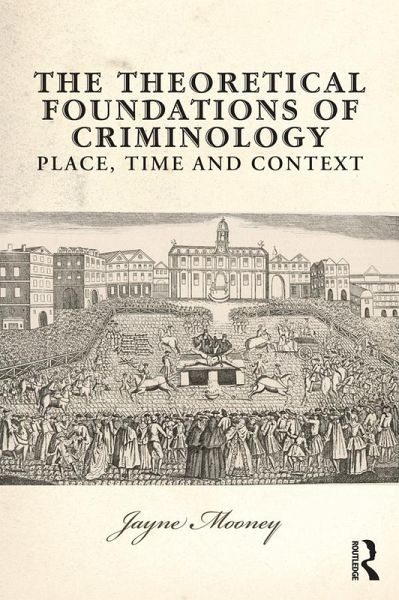
To confront the challenges criminologists face today and to satisfactorily critique the theories on which criminology is founded, we need to learn from the past. To do this we must give context to both theorist and theory. Written from a critical perspective, this book brings criminological theory to life. It presents the core theories of criminology as historical and cultural products and theorists as producers of culture located in particular places, writing in specific historical periods and situated in precise intellectual networks and philosophical controversies.
This book illustrates that theory does not arise 'out of the blue' and highlights the importance of understanding how and why ideas emerge at certain points in time, why they gained currency and the influence that they have had. It follows the trajectory of criminology from pre-Enlightenment society through to the present day and the proliferation of criminological thinking. It explores:
The Theoretical Foundations of Criminology provides an invaluable contribution to the growing conversation about criminology's 'origin story' and the level that this is grounded in the idiosyncrasies of the North Atlantic world and its historical development. This book will be invaluable reading to students and academics engaged in studies of criminology and criminal justice.
This book illustrates that theory does not arise 'out of the blue' and highlights the importance of understanding how and why ideas emerge at certain points in time, why they gained currency and the influence that they have had. It follows the trajectory of criminology from pre-Enlightenment society through to the present day and the proliferation of criminological thinking. It explores:
- Setting the Stage for the Emergence of Criminology
- Classicist Criminology: The Search for Justice, Equality and the Rational 'Man'
- The Positivist Revolution, Physiognomy, Phrenology and the Science of 'Othering'
- Chicago School of Sociology: An Explosion of Ideas
- Developing a Sociological Criminology: Durkheim, Du Bois, Merton and Tannenbaum
- Feminism: Redressing the Gender Imbalance
- Confronting the Establishment: The Emergence of Critical Criminology
- From Theoretical Innovations to Political Engagement
The Theoretical Foundations of Criminology provides an invaluable contribution to the growing conversation about criminology's 'origin story' and the level that this is grounded in the idiosyncrasies of the North Atlantic world and its historical development. This book will be invaluable reading to students and academics engaged in studies of criminology and criminal justice.
Dieser Download kann aus rechtlichen Gründen nur mit Rechnungsadresse in A, B, BG, CY, CZ, D, DK, EW, E, FIN, F, GR, HR, H, IRL, I, LT, L, LR, M, NL, PL, P, R, S, SLO, SK ausgeliefert werden.
'Mooney is like the best of urban tour guides leading us through a complicated metropolitan landscape where the evolution of space is a multivalent story of corporate interests, state power, local zoning, and diverse working populations struggling to get to work, raise kids, and seek respite in a night on the town. This book is exciting because it offers us a sophisticated guide for criminological theory charted by an author with a historian's depth, and ethnographer's instincts, and a poet's heart. The writing is elegant yet accessible; the purpose clear and serious. Students of criminology will not only learn about theories and their contexts, but about the importance of theory itself for understanding the world as it is and for changing it.'
Corey Dolgan, Professor of Sociology and Criminology, Stonehill College, USA and President-Elect for the Society for the Study of Social Problems.
"This is not an ordinary criminological theory textbook. It is extraordinary. It should be widely adopted by faculty who teach criminological theory because it re-connects our discipline to its socio-historical roots, documenting applications and reform movements long overlooked. In so doing, the text offers keen insights for criminologists moving forward. Mooney provides a deep exploration into the socio-historical context of criminological thought that includes often-overlooked contributions from scholars of color and women. The mainstream criminological canon is more accurately covered by exposing the often-critical criminological roots that have shaped the debates and research agendas for more than 200 years... Despite consistent resistance over time, disembodied mainstream criminology developed as an apparatus of power. For those of us who routinely excavate and expose the roots of power, how it is defined, exercised, and resisted, Mooney's book is a treasure trove of criminological history. Criminology did not have to become an apparatus of power, and with awareness and this insightful historical lens, it may yet overcome that association."
Kimberly J Cook, Professor of Sociology and Criminology, University of North Carolina Wilmington, USA, Theoretical Criminology
Corey Dolgan, Professor of Sociology and Criminology, Stonehill College, USA and President-Elect for the Society for the Study of Social Problems.
"This is not an ordinary criminological theory textbook. It is extraordinary. It should be widely adopted by faculty who teach criminological theory because it re-connects our discipline to its socio-historical roots, documenting applications and reform movements long overlooked. In so doing, the text offers keen insights for criminologists moving forward. Mooney provides a deep exploration into the socio-historical context of criminological thought that includes often-overlooked contributions from scholars of color and women. The mainstream criminological canon is more accurately covered by exposing the often-critical criminological roots that have shaped the debates and research agendas for more than 200 years... Despite consistent resistance over time, disembodied mainstream criminology developed as an apparatus of power. For those of us who routinely excavate and expose the roots of power, how it is defined, exercised, and resisted, Mooney's book is a treasure trove of criminological history. Criminology did not have to become an apparatus of power, and with awareness and this insightful historical lens, it may yet overcome that association."
Kimberly J Cook, Professor of Sociology and Criminology, University of North Carolina Wilmington, USA, Theoretical Criminology