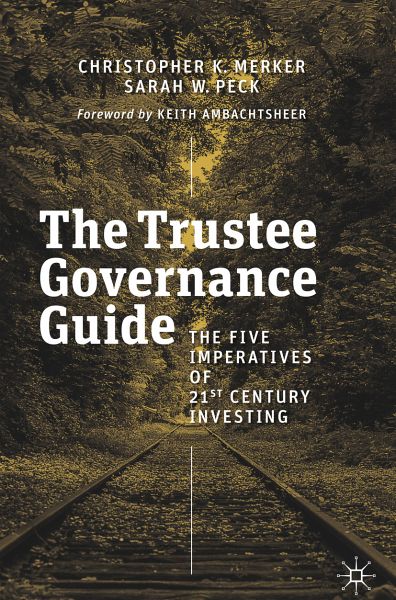
Christopher K. Merker, Sarah W. Peck
The Trustee Governance Guide (eBook, PDF)
The Five Imperatives of 21st Century Investing
28,95 €
28,95 €
inkl. MwSt.
Sofort per Download lieferbar

14 °P sammeln
28,95 €
Als Download kaufen
28,95 €
inkl. MwSt.
Sofort per Download lieferbar
14 °P sammeln
Jetzt verschenken
Alle Infos zum eBook verschenken
28,95 €
inkl. MwSt.
Sofort per Download lieferbar
Alle Infos zum eBook verschenken
14 °P sammeln

Christopher K. Merker, Sarah W. Peck
The Trustee Governance Guide (eBook, PDF)
The Five Imperatives of 21st Century Investing
- Format: PDF
- Merkliste
- Auf die Merkliste
- Bewerten Bewerten
- Teilen
- Produkt teilen
- Produkterinnerung
- Produkterinnerung

Bitte loggen Sie sich zunächst in Ihr Kundenkonto ein oder registrieren Sie sich bei
bücher.de, um das eBook-Abo tolino select nutzen zu können.
Hier können Sie sich einloggen
Sie sind bereits eingeloggt. Klicken Sie auf 2. tolino select Abo, um fortzufahren.

Bitte loggen Sie sich zunächst in Ihr Kundenkonto ein oder registrieren Sie sich bei bücher.de, um das eBook-Abo tolino select nutzen zu können.
Focuses on both structural and process factors of governance Uniquely covers related investment topics in each chapter, including asset allocation, impact investing, and alternative investing Uses the annual FEQ governance survey to U.S. Public Pension systems¿¿
- Geräte: PC
- ohne Kopierschutz
- eBook Hilfe
- Größe: 3.37MB
Andere Kunden interessierten sich auch für
Chad HaganGlobal Family Office Investing (eBook, PDF)38,95 €
Bruce VoncannonA Guidebook for Today's Asian Investor (eBook, PDF)30,95 €
Tawni Hunt FerrariniTeachers Can Be Financially Fit (eBook, PDF)20,95 €
Henrik LumholdtStrategic and Tactical Asset Allocation (eBook, PDF)48,95 €
Steffen HornDeutsche Rentenversicherung - Basis der Altersvorsorge (eBook, PDF)20,67 €
Elisabetta BasilicoSmart(er) Investing (eBook, PDF)26,95 €
Christine SahadeoFinancial Literacy and Money Script (eBook, PDF)88,95 €-
-
-
Focuses on both structural and process factors of governance Uniquely covers related investment topics in each chapter, including asset allocation, impact investing, and alternative investing Uses the annual FEQ governance survey to U.S. Public Pension systems¿¿
Dieser Download kann aus rechtlichen Gründen nur mit Rechnungsadresse in A, B, BG, CY, CZ, D, DK, EW, E, FIN, F, GR, HR, H, IRL, I, LT, L, LR, M, NL, PL, P, R, S, SLO, SK ausgeliefert werden.
Produktdetails
- Produktdetails
- Verlag: Springer International Publishing
- Seitenzahl: 140
- Erscheinungstermin: 25. Juni 2019
- Englisch
- ISBN-13: 9783030210885
- Artikelnr.: 57038312
- Verlag: Springer International Publishing
- Seitenzahl: 140
- Erscheinungstermin: 25. Juni 2019
- Englisch
- ISBN-13: 9783030210885
- Artikelnr.: 57038312
- Herstellerkennzeichnung Die Herstellerinformationen sind derzeit nicht verfügbar.
Christopher K. Merker is a Financial Advisor and a Director of Private Asset Management at Robert W. Baird & Co. Incorporated, where he provides advice and guidance to the boards and investment committees of institutional investors. He holds a PhD in investment governance and fiduciary effectiveness from Marquette University. He is past president of the CFA Society Milwaukee, and a founder and current board member of the CFA Society Milwaukee Foundation, a sister organization dedicated to promoting financial literacy. An adjunct professor of finance at Marquette University where he teaches the investment course Sustainable Finance, he is also executive director of Fund Governance Analytics, a provider of environmental, social, and governance (ESG) research and diagnostic tools for asset owners and institutional investors. He publishes Sustainable Finance, which covers current topics around governance and sustainability in investing.
Sarah W.Peck is an Associate Professor of Finance at Marquette University. Sarah earned her undergraduate degree from Yale University and a PhD from the University of Rochester. She has spent two decades researching topics in corporate governance with a focus on the board of directors publishing in The Journal of Financial Economics, The Journal of Corporate Finance, The Journal of Forensic Accounting, among others. She is director of research at Fund Governance Analytics, where she leads research into environmental, social, and governance (ESG) factors. She wrote the book Investment Ethics (2010) and pioneered an investment ethics course for CFA® educational partners. Following the 2006 pension scandal, she joined the Milwaukee County Pension board where she served as a trustee and chair of the Investment Committee for seven years. She regularly participates in panel discussions with trustees of pension funds and endowments on topics around integration of ESG into investment strategies.
1. Introduction.- Part I The First Imperative: Be Well-Governed.- 2. Crisis.- 3. Fiduciary Duty.- 4. Good Governance.- Part II The Second Imperative: Be Knowledgeable and Beware of Common Errors.- 5. Human Error and Behavioral Finance.- 6. Knowledge Not Just for Knowledge's Sake.- 7. Origins of Financial Illiteracy.- Part III The Third Imperative: Be Diversified.- 8. 30,000 Products.- 9. Theory Time.- 10. Over-Diversification.- Part IV The Fourth Imperative: Be Disciplined and Control Costs.- 11. The Active Versus Passive Debate.- 12. Active Versus Passive: The Evidence.- 13. Cost Savings and What Really Matters.- Part V The Fifth Imperative: Be Impactful.- 14. Farewell to Uncle Milt.- 15. ESG Challenges.- 16. Ok, We've Bought In...Now What?.