32,95 €
32,95 €
inkl. MwSt.
Sofort per Download lieferbar

16 °P sammeln
32,95 €
Als Download kaufen
32,95 €
inkl. MwSt.
Sofort per Download lieferbar
16 °P sammeln
Jetzt verschenken
Alle Infos zum eBook verschenken
32,95 €
inkl. MwSt.
Sofort per Download lieferbar
Alle Infos zum eBook verschenken
16 °P sammeln

Andere Kunden interessierten sich auch für
") The History of Utopian Thought (eBook, PDF)34,95 €
The History of Utopian Thought (eBook, PDF)34,95 €") Demodiversity (eBook, PDF)38,95 €
Demodiversity (eBook, PDF)38,95 €") Contemporary Readings in Marxism (eBook, PDF)38,95 €
Contemporary Readings in Marxism (eBook, PDF)38,95 €") The Commons (eBook, PDF)39,95 €
The Commons (eBook, PDF)39,95 €") A Marxist Theory of Ideology (eBook, PDF)41,95 €
A Marxist Theory of Ideology (eBook, PDF)41,95 €") Extractivism and Universality (eBook, PDF)39,95 €
Extractivism and Universality (eBook, PDF)39,95 €") Adventures in Marxist Theory (eBook, PDF)39,95 €
Adventures in Marxist Theory (eBook, PDF)39,95 €






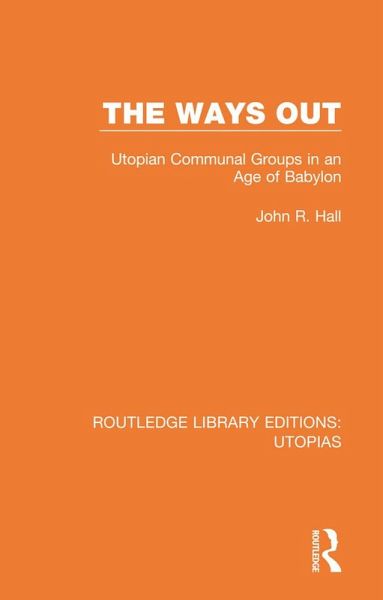
A comparative analysis of both secular and religious communal groups in contemporary America, this study, originally published in 1978, shows that contemporary communalists stand in relation to collectivism much the same as early Protestants stood in relation to individualism - as the self-proclaimed pioneers of the new age. There is great diversity among communal groups, a diversity which is found to stem from alternative orientations towards time and alternative assumptions about the cognitive status of the social world.
The author has made use of a phenomenologically derived typological framework to organize the data he has obtained through living in and visiting a number of communal groups. Within this framework, Alfred Schutz's 'mundane' phenomenology and Max Weber's interpretive sociology are employed as ways of approaching the situated sociology of knowledge in various communal groups.
Six ideal types of communal groups are described: the commune, the intentional association, the community, the warring sect, the other-worldly sect and the ecstatic association. Two of these types - the intentional association and the community - are identified as participants' efforts to demonstrate 'worldly utopian' models for the reconstruction of society at large.
The author has made use of a phenomenologically derived typological framework to organize the data he has obtained through living in and visiting a number of communal groups. Within this framework, Alfred Schutz's 'mundane' phenomenology and Max Weber's interpretive sociology are employed as ways of approaching the situated sociology of knowledge in various communal groups.
Six ideal types of communal groups are described: the commune, the intentional association, the community, the warring sect, the other-worldly sect and the ecstatic association. Two of these types - the intentional association and the community - are identified as participants' efforts to demonstrate 'worldly utopian' models for the reconstruction of society at large.
Dieser Download kann aus rechtlichen Gründen nur mit Rechnungsadresse in A, B, BG, CY, CZ, D, DK, EW, E, FIN, F, GR, HR, H, IRL, I, LT, L, LR, M, NL, PL, P, R, S, SLO, SK ausgeliefert werden.