44,95 €
inkl. MwSt.
Sofort per Download lieferbar
22 °P sammeln

Andere Kunden interessierten sich auch für
") The WhatsApp India Story (eBook, ePUB)44,95 €
The WhatsApp India Story (eBook, ePUB)44,95 €") Media Ownership in Africa in the Digital Age (eBook, PDF)41,95 €
Media Ownership in Africa in the Digital Age (eBook, PDF)41,95 €") African Language Media (eBook, PDF)41,95 €
African Language Media (eBook, PDF)41,95 €") Asian Perspectives on Digital Culture (eBook, PDF)48,95 €
Asian Perspectives on Digital Culture (eBook, PDF)48,95 €") Film, Media and Representation in Postcolonial South Asia (eBook, PDF)44,95 €
Film, Media and Representation in Postcolonial South Asia (eBook, PDF)44,95 €") Digital Research Methods and the Diaspora (eBook, PDF)38,95 €
Digital Research Methods and the Diaspora (eBook, PDF)38,95 €") The Dark Social (eBook, PDF)45,95 €
The Dark Social (eBook, PDF)45,95 €



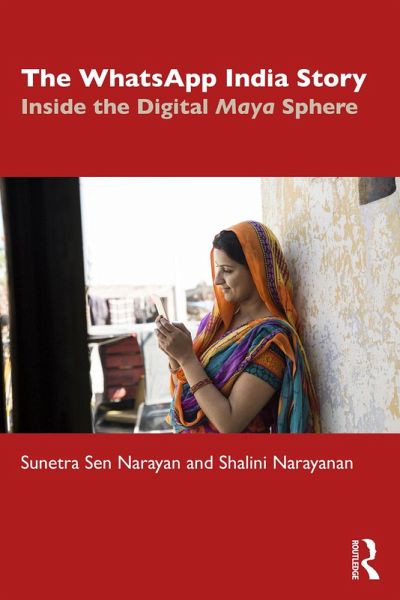
WhatsApp is used by over half a billion people in India today in all fields - in business, corporate and informal sectors, in government, for education and among friends, families and acquaintances. This book critically explores the social messaging app's rapid expansion in India and its growing influence and looks at whether, as a form of horizontal communication, it poses a challenge to more traditional structures of communication.
The book examines WhatsApp's spread in the personal and professional lives of Indians and the myriad ways in which people in India are using the app in social and business interactions, including among people living with disabilities. Using case studies, interviews, surveys and in-depth research, it analyses key aspects of WhatsApp's massive popularity and its impact on how people communicate. It also explores its impact on the psycho-social dynamics in India, including the dissemination of fake news and politically motivated content, and the consequent need for media regulation in the country.
One of the first books to analyse the pervasiveness of WhatsApp and social media apps in different areas of Indian society, this book will be of interest to scholars and students of media studies, communication studies, digital media, cultural studies, cyberculture studies, sociology and social policy and media law.
The book examines WhatsApp's spread in the personal and professional lives of Indians and the myriad ways in which people in India are using the app in social and business interactions, including among people living with disabilities. Using case studies, interviews, surveys and in-depth research, it analyses key aspects of WhatsApp's massive popularity and its impact on how people communicate. It also explores its impact on the psycho-social dynamics in India, including the dissemination of fake news and politically motivated content, and the consequent need for media regulation in the country.
One of the first books to analyse the pervasiveness of WhatsApp and social media apps in different areas of Indian society, this book will be of interest to scholars and students of media studies, communication studies, digital media, cultural studies, cyberculture studies, sociology and social policy and media law.
Dieser Download kann aus rechtlichen Gründen nur mit Rechnungsadresse in A, B, BG, CY, CZ, D, DK, EW, E, FIN, F, GR, HR, H, IRL, I, LT, L, LR, M, NL, PL, P, R, S, SLO, SK ausgeliefert werden.