Sie sind bereits eingeloggt. Klicken Sie auf 2. tolino select Abo, um fortzufahren.
Bitte loggen Sie sich zunächst in Ihr Kundenkonto ein oder registrieren Sie sich bei bücher.de, um das eBook-Abo tolino select nutzen zu können.
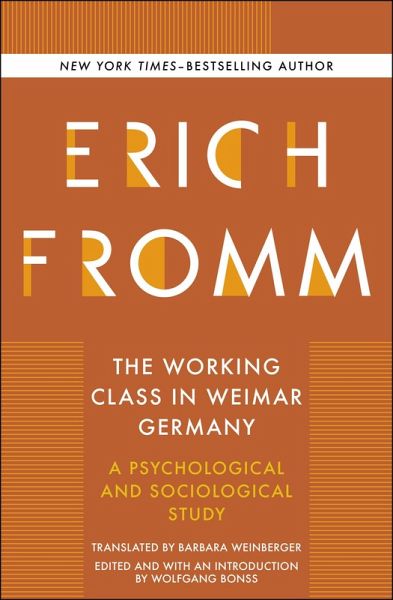
"The analysis unveils a sociotypology of [the working class] on the eve of the Third Reich, its potential for resistance as well as seduction." - Political Psychology Building upon Fromm's 1929 lecture "The Application of Psycho-Analysis to Sociology and Religious Knowledge," in which he outlined the basis for a rudimentary but far-reaching attempt at the integration of Freudian psychology with Marxist social theory, this study is an attempt to obtain evidence about the systemic connections between "psychic make-up" and social development. Originally an investigation of the social and…mehr
"The analysis unveils a sociotypology of [the working class] on the eve of the Third Reich, its potential for resistance as well as seduction." - Political Psychology Building upon Fromm's 1929 lecture "The Application of Psycho-Analysis to Sociology and Religious Knowledge," in which he outlined the basis for a rudimentary but far-reaching attempt at the integration of Freudian psychology with Marxist social theory, this study is an attempt to obtain evidence about the systemic connections between "psychic make-up" and social development. Originally an investigation of the social and psychological attitudes of two large groups in Weimar Germany, manual and white-collar workers, a questionnaire was developed to collect data about their opinions, lifestyles, and attitudes-from what books they read and their thoughts on women's work to their opinions about the German legal system and the actual distribution of power in the state. The Working Class in Weimar Germany can ultimately help us understand the establishment of fascism after 1933-that despite all the electoral successes of the Weimar Left, its members were not in the position, owning to their character structure, to prevent the victory of National Socialism.
Die Herstellerinformationen sind derzeit nicht verfügbar.
Autorenporträt
Erich Fromm (1900-1980) was a bestselling psychoanalyst and social philosopher whose views about alienation, love, and sanity in society-discussed in his books such as Escape from Freedom, The Art of Loving, The Sane Society, and To Have or To Be?-helped shape the landscape of psychology in the mid-twentieth century. Fromm was born in Frankfurt, Germany, to Jewish parents, and studied at the universities of Frankfurt, Heidelberg (where in 1922 he earned his doctorate in sociology), and Munich. In the 1930s he was one of the most influential figures at the Frankfurt Institute of Social Research. In 1934, as the Nazis rose to power, he moved to the United States. He practiced psychoanalysis in both New York and Mexico City before moving to Switzerland in 1974, where he continued his work until his death.
Es gelten unsere Allgemeinen Geschäftsbedingungen: www.buecher.de/agb
Impressum
www.buecher.de ist ein Internetauftritt der buecher.de internetstores GmbH
Geschäftsführung: Monica Sawhney | Roland Kölbl | Günter Hilger
Sitz der Gesellschaft: Batheyer Straße 115 - 117, 58099 Hagen
Postanschrift: Bürgermeister-Wegele-Str. 12, 86167 Augsburg
Amtsgericht Hagen HRB 13257
Steuernummer: 321/5800/1497
USt-IdNr: DE450055826