84,95 €
inkl. MwSt.
Sofort per Download lieferbar
42 °P sammeln

Andere Kunden interessierten sich auch für
") Personality Development Across the Lifespan (eBook, ePUB)67,95 €
Personality Development Across the Lifespan (eBook, ePUB)67,95 €") Aging and Creativity (eBook, ePUB)63,95 €
Aging and Creativity (eBook, ePUB)63,95 €") Advances in Child Development and Behavior (eBook, ePUB)70,95 €
Advances in Child Development and Behavior (eBook, ePUB)70,95 €") The Development of Early Childhood Mathematics Education (eBook, ePUB)70,95 €
The Development of Early Childhood Mathematics Education (eBook, ePUB)70,95 €") Understanding Uniqueness and Diversity in Child and Adolescent Mental Health (eBook, ePUB)51,95 €
Understanding Uniqueness and Diversity in Child and Adolescent Mental Health (eBook, ePUB)51,95 €") Handbook of Work-Family Integration (eBook, ePUB)61,95 €
Handbook of Work-Family Integration (eBook, ePUB)61,95 €") Ecological Psychology in Context (eBook, ePUB)71,95 €
Ecological Psychology in Context (eBook, ePUB)71,95 €






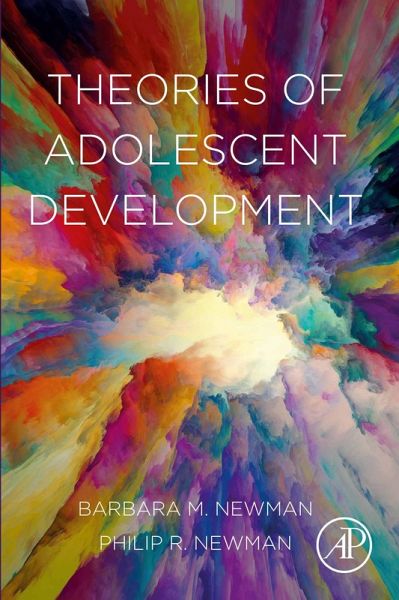
Adolescence is both universal and culturally constructed, resulting in diverse views about its defining characteristics. Theories of Adolescent Development brings together many theories surrounding this life stage in one comprehensive reference. It begins with an introduction to the nature of theory in the field of adolescence including an analysis of why there are so many theories in this field. The theory chapters are grouped into three sections: biological systems, psychological systems, and societal systems. Each chapter considers a family of theories including scope, assumptions, key concepts, contributions to the study of adolescence, approaches to measurement, applications, and a discussion of strengths and limitations of this family. A concluding chapter offers an integrative analysis, identifying five assumptions drawn from the theories that are essential guides for future research and application. Three questions provide a focus for comparison and contrast: How do the theories characterize the time and timing of adolescence? What do the theories emphasize as domains that are unfolding in movement toward maturity? Building on the perspective of Positive Youth Development, how do the theories differ in their views of developmental resources and conditions that may undermine development in adolescence? - Includes biological, psychological and sociological theories - Identifies historical roots, assumptions, key concepts, applications, measurement, strengths, and limitations of each theory - Compares and contrasts theories - Concludes with an integrated perspective across theories
Dieser Download kann aus rechtlichen Gründen nur mit Rechnungsadresse in A, B, BG, CY, CZ, D, DK, EW, E, FIN, F, GR, HR, H, IRL, I, LT, L, LR, M, NL, PL, P, R, S, SLO, SK ausgeliefert werden.
"The book will be a valuable resource for neuropsychologists, clinicians in other specialties, and students who want a comprehensive overview of the theories of adolescent development from a contemporary lens that includes discussions on theory applications and measurement. Newman and Newman have compiled a laudable work that achieves their intention to inspire a more nuanced conceptualization of adolescent development. It is sure to be an oft referenced work for those seeking to understand complex adolescent behaviors through a multi-tiered lens." --Applied Neuropsychology-Adult
"The title Theories of Adolescent Development offers a big promise-somehow distilling the myriad guiding perspectives on how young people grow, mature, and learn into a single manageable volume. Barbara and Philip Newman deliver on that promise. Drawing on their own expertise in research and teaching, they cast an incredibly wide net to cover developmental theories that look within adolescents bodies and minds and that situate them in contexts large and small, and they delve deep into each one. All in one place, readers can find a history lesson on how scientific thinking about adolescents has evolved over history, a comprehensive overview of where the field stands now, and a guide to putting theory into action." -- Robert Crosnoe, Associate Dean of Liberal Arts, University of Texas at Austin, and Past President of the Society for Research on Adolescence
"The new Theories of Adolescent Development book by Newman and Newman is quite simply a delightful, productive, and provocative read - and I am not one to call most theory books delightful but this one is both clear and comprehensive. Each chapter is an easy read and the structure of each are parallel making comparisons cumulative and useful. I found the book productive in the ways it provided insights useful for new learners as well as seasoned researchers and active practitioners. Definitely would have used this to better inform my teaching of adolescent development but also in offering a richer understanding of adolescent development at upper undergraduate and graduate levels. Chapters from this book provide a richness, clarity and depth too often lacking when talking about theories of adolescent development and their interrelationships and application. I can imagine many graduate students working on theses I would refer to different chapters as well as people who train practitioners and want a sense of what we know and how we know it. The book would also be useful to the new breeds of youth workers who are digging it to better understand the roots of the field. The inclusion in each chapter of implications for practice and measurement as well as the strengths and limits of each approach is wonderfully done and extremely useful. As a scholar who has moved from trying to understand adolescent development to one that has come to focus on youth development and now seeks to use knowledge to improve development, I found the book both provocative and reflective of much of what we now know about both positive youth development and risk taking as what we need to challenge. In short, this is not only a must have book but a must read one for anyone trying to understand, teach, study, or support the development of young people in today s world. Fortunately for us all, it is also a wonderful read with great insights that are readily accessed." -- Dale A. Blyth, Ph.D., Professor Emeritus and Howland Endowed Chair in Youth Development, College of Education and Human Development, University of Minnesota
"The title Theories of Adolescent Development offers a big promise-somehow distilling the myriad guiding perspectives on how young people grow, mature, and learn into a single manageable volume. Barbara and Philip Newman deliver on that promise. Drawing on their own expertise in research and teaching, they cast an incredibly wide net to cover developmental theories that look within adolescents bodies and minds and that situate them in contexts large and small, and they delve deep into each one. All in one place, readers can find a history lesson on how scientific thinking about adolescents has evolved over history, a comprehensive overview of where the field stands now, and a guide to putting theory into action." -- Robert Crosnoe, Associate Dean of Liberal Arts, University of Texas at Austin, and Past President of the Society for Research on Adolescence
"The new Theories of Adolescent Development book by Newman and Newman is quite simply a delightful, productive, and provocative read - and I am not one to call most theory books delightful but this one is both clear and comprehensive. Each chapter is an easy read and the structure of each are parallel making comparisons cumulative and useful. I found the book productive in the ways it provided insights useful for new learners as well as seasoned researchers and active practitioners. Definitely would have used this to better inform my teaching of adolescent development but also in offering a richer understanding of adolescent development at upper undergraduate and graduate levels. Chapters from this book provide a richness, clarity and depth too often lacking when talking about theories of adolescent development and their interrelationships and application. I can imagine many graduate students working on theses I would refer to different chapters as well as people who train practitioners and want a sense of what we know and how we know it. The book would also be useful to the new breeds of youth workers who are digging it to better understand the roots of the field. The inclusion in each chapter of implications for practice and measurement as well as the strengths and limits of each approach is wonderfully done and extremely useful. As a scholar who has moved from trying to understand adolescent development to one that has come to focus on youth development and now seeks to use knowledge to improve development, I found the book both provocative and reflective of much of what we now know about both positive youth development and risk taking as what we need to challenge. In short, this is not only a must have book but a must read one for anyone trying to understand, teach, study, or support the development of young people in today s world. Fortunately for us all, it is also a wonderful read with great insights that are readily accessed." -- Dale A. Blyth, Ph.D., Professor Emeritus and Howland Endowed Chair in Youth Development, College of Education and Human Development, University of Minnesota