42,95 €
42,95 €
inkl. MwSt.
Sofort per Download lieferbar

21 °P sammeln
42,95 €
Als Download kaufen
42,95 €
inkl. MwSt.
Sofort per Download lieferbar
21 °P sammeln
Jetzt verschenken
Alle Infos zum eBook verschenken
42,95 €
inkl. MwSt.
Sofort per Download lieferbar
Alle Infos zum eBook verschenken
21 °P sammeln

Andere Kunden interessierten sich auch für
") Thessaloniki (eBook, PDF)42,95 €
Thessaloniki (eBook, PDF)42,95 €") Critical Approaches to Genocide (eBook, ePUB)42,95 €
Critical Approaches to Genocide (eBook, ePUB)42,95 €") A History of Modern Germany (eBook, ePUB)39,95 €
A History of Modern Germany (eBook, ePUB)39,95 €") The Routledge Atlas of the Holocaust (eBook, ePUB)38,95 €
The Routledge Atlas of the Holocaust (eBook, ePUB)38,95 €") The Routledge Atlas of the Holocaust (eBook, ePUB)27,95 €
The Routledge Atlas of the Holocaust (eBook, ePUB)27,95 €") Dictators and Autocrats (eBook, ePUB)0,00 €
Dictators and Autocrats (eBook, ePUB)0,00 €") The Metaphysics of Race (eBook, ePUB)42,95 €
The Metaphysics of Race (eBook, ePUB)42,95 €







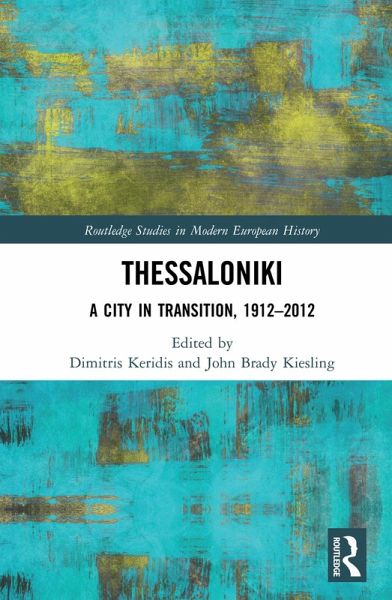
This book shares the conclusions of a remarkable conference marking the centennial of Thessaloniki's incorporation into the Greek state in 1912. Like its Roman and Byzantine predecessors, Ottoman Salonica was the metropolis of a huge, multi-ethnic Balkan hinterland, a center of modernization/westernization, and the de facto capital of Sephardic Judaism. The powerful attraction it exerted on competing local nationalisms, including the Young Turks, gave it a paradigmatic role in the transition from imperial to national rule in southeastern Europe.
Twenty-three articles cover the multicultural physiognomy of a 'Levantine' city. They describe the mechanisms for cultivating national consciousness (including education, journalism, the arts, archaeology, and urban planning), the relationship between national identity, religious identity, and an evolving socialist labor movement, anti-Semitism, and the practical issues of governing and assimilating diverse non-Greek populations after Greece's military victory in 1912. Analysis of this transformation extends chronologically through the arrival of Greek refugees from Turkey and the Black Sea in 1923, the Holocaust, the Greek civil war, and the new waves of migration after 1990. These processes are analyzed on multiple levels, including civil administration, land use planning, and the treatment of Thessaloniki's historic monuments.
This work underscores the importance of cities and their local histories in shaping the key national narratives that drove development in southeastern Europe. Those lessons are highly relevant today, as Europe reacts to renewed migratory pressures and the rise of new nationalist movements, and draws lessons, valid or otherwise, from the nation-building experiments of the previous century.
Twenty-three articles cover the multicultural physiognomy of a 'Levantine' city. They describe the mechanisms for cultivating national consciousness (including education, journalism, the arts, archaeology, and urban planning), the relationship between national identity, religious identity, and an evolving socialist labor movement, anti-Semitism, and the practical issues of governing and assimilating diverse non-Greek populations after Greece's military victory in 1912. Analysis of this transformation extends chronologically through the arrival of Greek refugees from Turkey and the Black Sea in 1923, the Holocaust, the Greek civil war, and the new waves of migration after 1990. These processes are analyzed on multiple levels, including civil administration, land use planning, and the treatment of Thessaloniki's historic monuments.
This work underscores the importance of cities and their local histories in shaping the key national narratives that drove development in southeastern Europe. Those lessons are highly relevant today, as Europe reacts to renewed migratory pressures and the rise of new nationalist movements, and draws lessons, valid or otherwise, from the nation-building experiments of the previous century.
Dieser Download kann aus rechtlichen Gründen nur mit Rechnungsadresse in A, B, BG, CY, CZ, D, DK, EW, E, FIN, F, GR, HR, H, IRL, I, LT, L, LR, M, NL, PL, P, R, S, SLO, SK ausgeliefert werden.