0,49 €
inkl. MwSt.
Sofort per Download lieferbar
0 °P sammeln

Andere Kunden interessierten sich auch für
") Through the Looking-Glass, and What Alice Found There (eBook, ePUB)1,99 €
Through the Looking-Glass, and What Alice Found There (eBook, ePUB)1,99 €") Alice's Adventures in Wonderland & Alice Through the Looking-Glass Alice in Wonderland (eBook, ePUB)1,99 €
Alice's Adventures in Wonderland & Alice Through the Looking-Glass Alice in Wonderland (eBook, ePUB)1,99 € (eBook, ePUB)") The Adventures of Tom Sawyer (Summarized Edition) (eBook, ePUB)0,49 €
The Adventures of Tom Sawyer (Summarized Edition) (eBook, ePUB)0,49 € (eBook, ePUB)") The Life and Adventures of Santa Claus (Summarized Edition) (eBook, ePUB)0,49 €
The Life and Adventures of Santa Claus (Summarized Edition) (eBook, ePUB)0,49 € (eBook, ePUB)") Little Lord Fauntleroy (Summarized Edition) (eBook, ePUB)0,49 €
Little Lord Fauntleroy (Summarized Edition) (eBook, ePUB)0,49 € (eBook, ePUB)") Little Women (Summarized Edition) (eBook, ePUB)0,49 €
Little Women (Summarized Edition) (eBook, ePUB)0,49 € (eBook, ePUB)") Anne of Green Gables (Summarized Edition) (eBook, ePUB)0,49 €
Anne of Green Gables (Summarized Edition) (eBook, ePUB)0,49 €
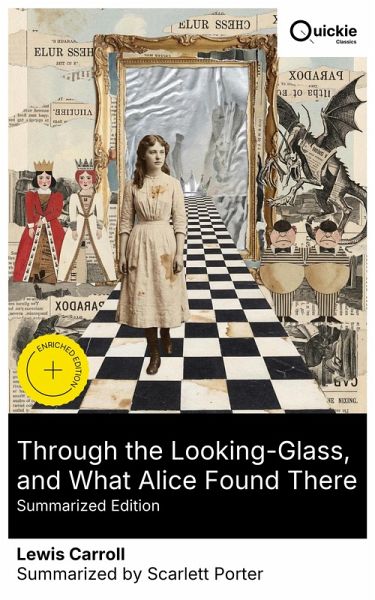
Through the Looking-Glass, and What Alice Found There transforms the nursery into a mirror-world where language, time, and social ritual invert. Framed as a chess problem-Alice's promotion from pawn to queen-the tale marries rigorous sequencing to antic reversals, from 'jam to-morrow' logic to living chessmen. Carroll extends Victorian nonsense: 'Jabberwocky' coins portmanteau, parodic verses and Tweedle debates probe how rules create and stifle sense. Cooler than Wonderland, it is a rule-bound romp, enlivened by Tenniel's incisive illustrations. Behind "Lewis Carroll" stood Charles Lutwidge Dodgson, Oxford mathematician and logician, whose taste for puzzles, paradox, and precise argument shapes the book's design. His friendships with children, notably the Liddells, supplied an audience for imaginative rigor, while Christ Church routines and Victorian pedagogy offered forms-moral verse, etiquette, memorization-to parody and test. The result channels a scholar's love of constraint into play. For readers of children's literature, linguistics, mathematics, or intellectual history, Looking-Glass is both delightful and exacting. Approach it for glittering wordplay and chessboard architecture; stay for its inquiry into how rules govern meaning and identity. It rewards re-reading, each pass revealing new symmetries in a world built to think as nimbly as it laughs. Quickie Classics summarizes timeless works with precision, preserving the author's voice and keeping the prose clear, fast, and readable-distilled, never diluted. Enriched Edition extras: Introduction · Synopsis · Historical Context · Author Biography · Brief Analysis · 4 Reflection Q&As · Editorial Footnotes.
Dieser Download kann aus rechtlichen Gründen nur mit Rechnungsadresse in A, B, BG, CY, CZ, D, DK, EW, E, FIN, F, GR, H, IRL, I, LT, L, LR, M, NL, PL, P, R, S, SLO, SK ausgeliefert werden.