
54,95 €
54,95 €
inkl. MwSt.
Sofort per Download lieferbar

27 °P sammeln
54,95 €
Als Download kaufen
54,95 €
inkl. MwSt.
Sofort per Download lieferbar
27 °P sammeln
Jetzt verschenken
Alle Infos zum eBook verschenken
54,95 €
inkl. MwSt.
Sofort per Download lieferbar
Alle Infos zum eBook verschenken
27 °P sammeln

Andere Kunden interessierten sich auch für
") World, Affectivity, Trauma (eBook, PDF)28,95 €
World, Affectivity, Trauma (eBook, PDF)28,95 €") Trauma and Human Existence (eBook, PDF)28,95 €
Trauma and Human Existence (eBook, PDF)28,95 €") The Abyss of Madness (eBook, PDF)41,95 €
The Abyss of Madness (eBook, PDF)41,95 €") Confronting Disaster (eBook, PDF)29,95 €
Confronting Disaster (eBook, PDF)29,95 €") Clinical Phenomenology and Cognitive Psychology (eBook, PDF)47,95 €
Clinical Phenomenology and Cognitive Psychology (eBook, PDF)47,95 €") The Phenomenology of Pregnancy and Early Motherhood (eBook, PDF)38,95 €
The Phenomenology of Pregnancy and Early Motherhood (eBook, PDF)38,95 €") Time and Timelessness (eBook, ePUB)54,95 €
Time and Timelessness (eBook, ePUB)54,95 €



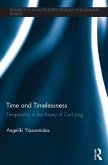
Time and Timelessness examines the development of Jung's understanding of time throughout his opus, and the ways in which this concept has affected key elements of his work. In this book Yiassemides suggests that temporality plays an important role in many of Jung's central ideas, and is closely interlinked with his overall approach to the psyche and the cosmos at large.
Jung proposed a profound truth: that time is relative at large. To appreciate the whole of our experience we must reach beyond causality and temporal linearity, to develop an approach that allows for multidimensional and synchronistic experiences. Jung's understanding surpassed Freud's dichotomous approach which restricted timelessness to the unconscious; his time theory allows us to reach beyond the everyday time-bound world into a greater realm, rich with meaning and connection.
Included in the book:
-Jung's time theory
-the death of time
-time and spatial metaphors
-the role of time in precognition, telepathy and synchronicity
-Unus mundus and time
-a comparison of Freud's and Jung's time theories: temporal directionality, dimensionality, and the role of timelessness.
This book is the first to explore time and timelessness in a systematic manner from a Jungian perspective, and the first to investigate how the concept of time affected the overall development of Jung's theory. It will be key reading for psychoanalytic scholars and clinicians, as well as those working in the field of phenomenological philosophy.
Jung proposed a profound truth: that time is relative at large. To appreciate the whole of our experience we must reach beyond causality and temporal linearity, to develop an approach that allows for multidimensional and synchronistic experiences. Jung's understanding surpassed Freud's dichotomous approach which restricted timelessness to the unconscious; his time theory allows us to reach beyond the everyday time-bound world into a greater realm, rich with meaning and connection.
Included in the book:
-Jung's time theory
-the death of time
-time and spatial metaphors
-the role of time in precognition, telepathy and synchronicity
-Unus mundus and time
-a comparison of Freud's and Jung's time theories: temporal directionality, dimensionality, and the role of timelessness.
This book is the first to explore time and timelessness in a systematic manner from a Jungian perspective, and the first to investigate how the concept of time affected the overall development of Jung's theory. It will be key reading for psychoanalytic scholars and clinicians, as well as those working in the field of phenomenological philosophy.
Dieser Download kann aus rechtlichen Gründen nur mit Rechnungsadresse in A, B, BG, CY, CZ, D, DK, EW, E, FIN, F, GR, HR, H, IRL, I, LT, L, LR, M, NL, PL, P, R, S, SLO, SK ausgeliefert werden.
'This book is long overdue. Today it is more than welcome. And it is more than useful. It is precious. By the questions the book poses, and by the questions which arise through the work of the author.We will return.'- Christian Gaillard, Cahiers Jungiens de Psychanalyse
'In summary, this is an engaging book that brings out a crucial dimension of Jung's theories. Viewing the evolution of his thinking from the perspective of temporality is a rich experience. The writing is clear and, considering the complexity of the topic, the ideas are approachable. Overall it is a stimulating and worthwhile work, and I would definitely recommend it to those who want to gain a new perspective on Jung's basic ideas, as well as those who are particularly interested in temporality and its intriguing vicissitudes.'- Ladson Hinton, Society of Jungian Analysts of Northern California, Journal of Analytical Psychology
'In summary, this is an engaging book that brings out a crucial dimension of Jung's theories. Viewing the evolution of his thinking from the perspective of temporality is a rich experience. The writing is clear and, considering the complexity of the topic, the ideas are approachable. Overall it is a stimulating and worthwhile work, and I would definitely recommend it to those who want to gain a new perspective on Jung's basic ideas, as well as those who are particularly interested in temporality and its intriguing vicissitudes.'- Ladson Hinton, Society of Jungian Analysts of Northern California, Journal of Analytical Psychology