22,95 €
22,95 €
inkl. MwSt.
Sofort per Download lieferbar

11 °P sammeln
22,95 €
Als Download kaufen
22,95 €
inkl. MwSt.
Sofort per Download lieferbar
11 °P sammeln
Jetzt verschenken
Alle Infos zum eBook verschenken
22,95 €
inkl. MwSt.
Sofort per Download lieferbar
Alle Infos zum eBook verschenken
11 °P sammeln

Andere Kunden interessierten sich auch für
") Invisible North (eBook, ePUB)6,99 €
Invisible North (eBook, ePUB)6,99 €") Black Boy (eBook, ePUB)9,49 €
Black Boy (eBook, ePUB)9,49 €![Black Boy [Seventy-fifth Anniversary Edition] (eBook, ePUB)]( "Black Boy [Seventy-fifth Anniversary Edition] (eBook, ePUB)") Black Boy [Seventy-fifth Anniversary Edition] (eBook, ePUB)1,33 €
Black Boy [Seventy-fifth Anniversary Edition] (eBook, ePUB)1,33 €") Theory of Water (eBook, ePUB)13,95 €
Theory of Water (eBook, ePUB)13,95 €") Sitting Bull Champion of the Sioux (eBook, ePUB)4,99 €
Sitting Bull Champion of the Sioux (eBook, ePUB)4,99 €") Becoming Little Shell (eBook, ePUB)7,99 €
Becoming Little Shell (eBook, ePUB)7,99 €") Highway of Tears (eBook, ePUB)14,83 €
Highway of Tears (eBook, ePUB)14,83 €


![Black Boy [Seventy-fifth Anniversary Edition] (eBook, ePUB)](https://bilder.buecher.de/produkte/58/58416/58416760m.jpg "Black Boy [Seventy-fifth Anniversary Edition] (eBook, ePUB)")




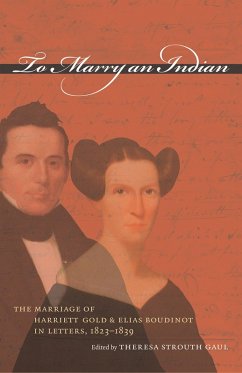
When nineteen-year-old Harriett Gold, from a prominent white family in Cornwall, Connecticut, announced in 1825 her intention to marry a Cherokee man, her shocked family initiated a spirited correspondence debating her decision to marry an Indian. Eventually, Gold’s family members reconciled themselves to her wishes, and she married Elias Boudinot in 1826. After the marriage, she returned with Boudinot to the Cherokee Nation, where he went on to become a controversial political figure and editor of the first Native American newspaper. Providing rare firsthand documentation of race relations in the early nineteenth-century United States, this volume collects the Gold family correspondence during the engagement period as well as letters the young couple sent to the family describing their experiences in New Echota (capital of the Cherokee Nation) during the years prior to the Cherokee Removal. In an introduction providing historical and social contexts, Theresa Strouth Gaul offers a literary reading of the correspondence, highlighting the value of the epistolary form and the gender and racial dynamics of the exchange. As Gaul demonstrates, the correspondence provides a factual accompaniment to the many fictionalized accounts of contacts between Native Americans and Euroamericans and supports an increasing recognition that letters form an important category of literature.
Dieser Download kann aus rechtlichen Gründen nur mit Rechnungsadresse in A, D ausgeliefert werden.