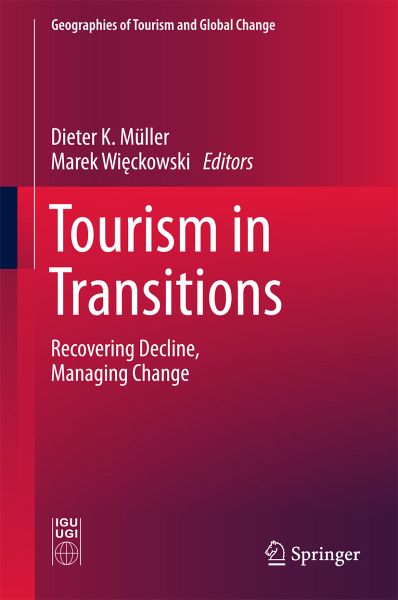
Tourism in Transitions (eBook, PDF)
Recovering Decline, Managing Change
Redaktion: Müller, Dieter K.; Wieckowski, Marek
72,95 €
72,95 €
inkl. MwSt.
Sofort per Download lieferbar

36 °P sammeln
72,95 €
Als Download kaufen
72,95 €
inkl. MwSt.
Sofort per Download lieferbar
36 °P sammeln
Jetzt verschenken
Alle Infos zum eBook verschenken
72,95 €
inkl. MwSt.
Sofort per Download lieferbar
Alle Infos zum eBook verschenken
36 °P sammeln

Tourism in Transitions (eBook, PDF)
Recovering Decline, Managing Change
Redaktion: Müller, Dieter K.; Wieckowski, Marek
- Format: PDF
- Merkliste
- Auf die Merkliste
- Bewerten Bewerten
- Teilen
- Produkt teilen
- Produkterinnerung
- Produkterinnerung

Bitte loggen Sie sich zunächst in Ihr Kundenkonto ein oder registrieren Sie sich bei
bücher.de, um das eBook-Abo tolino select nutzen zu können.
Hier können Sie sich einloggen
Sie sind bereits eingeloggt. Klicken Sie auf 2. tolino select Abo, um fortzufahren.

Bitte loggen Sie sich zunächst in Ihr Kundenkonto ein oder registrieren Sie sich bei bücher.de, um das eBook-Abo tolino select nutzen zu können.
Introduces the concept of transition into the study of tourism geographies
Assesses the relationship between event-driven change and tourism geographies
Addresses an international readership with case studies from Europe, America, Asia, and Africa
- Geräte: PC
- ohne Kopierschutz
- eBook Hilfe
- Größe: 5.01MB
Andere Kunden interessierten sich auch für
Perspectives on Rural Tourism Geographies (eBook, PDF)88,95 €
Latin American Heritage (eBook, PDF)40,95 €
Luigi La RicciaLandscape Planning at the Local Level (eBook, PDF)96,95 €
Alternative Tourism in Turkey (eBook, PDF)72,95 €
Stefano R. L. CampanaMapping the Archaeological Continuum (eBook, PDF)48,95 €
Chet Van DuzerHenricus Martellus's World Map at Yale (c. 1491) (eBook, PDF)88,95 €
Progress in French Tourism Geographies (eBook, PDF)40,95 €-
-
-
Introduces the concept of transition into the study of tourism geographies
Assesses the relationship between event-driven change and tourism geographies
Addresses an international readership with case studies from Europe, America, Asia, and Africa
Assesses the relationship between event-driven change and tourism geographies
Addresses an international readership with case studies from Europe, America, Asia, and Africa
Dieser Download kann aus rechtlichen Gründen nur mit Rechnungsadresse in A, B, BG, CY, CZ, D, DK, EW, E, FIN, F, GR, HR, H, IRL, I, LT, L, LR, M, NL, PL, P, R, S, SLO, SK ausgeliefert werden.
Produktdetails
- Produktdetails
- Verlag: Springer International Publishing
- Seitenzahl: 203
- Erscheinungstermin: 21. August 2017
- Englisch
- ISBN-13: 9783319643250
- Artikelnr.: 52940477
- Verlag: Springer International Publishing
- Seitenzahl: 203
- Erscheinungstermin: 21. August 2017
- Englisch
- ISBN-13: 9783319643250
- Artikelnr.: 52940477
- Herstellerkennzeichnung Die Herstellerinformationen sind derzeit nicht verfügbar.
Dieter K. Müller holds a PhD from Umeå University, Sweden, where he is now employed as a professor. Currently, he is dean of the Faculty of Social Science and chairperson for the IGU Commission Geography, Leisure and Global Change. His research main interests are tourism and regional development, mobility and tourism in peripheral areas, more specifically, all aspects of second homes and second-home related mobility, Sami tourism, nature-based tourism, tourism labor markets, regional development and rural change particularly in Northern peripheries and Polar areas. Müller has recently published the following books; Nordic Tourism (2009, together with C.M. Hall and J. Saarinen); Polar Tourism: A Tool for Regional Development (2011 with Grenier); and New Issues in Polar Tourism (2013 with Lemelin and Lundmark). Currently he is working on a book on Arctic Indigenous Tourism together with Arvid Viken, University of Tromsø. Marek Wi¿ckowski is a professor at the Insitute of the Geography and Spatial Organization at the Polish Academy of Sciences in Warsaw. In 2014 he was nominated as the director of the Scientific Center of the Polish Academy of Sciences in Paris. During his post-doc program (2002-2004) he worked as a researcher at the ENS LSH in Lyon (France). Wi¿ckowski prepared his PhD thesis on cross-border cooperation between Poland and Slovakia and his habilitation on tourism development in the Polish borderlands. His research interests in tourism include tourism development in borderlands (e.g. relationships between tourism and borders), tourism development in mountains and protected areas, mobility aspects, accessibility to tourism destinations and self-catering accommodation. Today Wi¿ckowski is also editor-in-chief for Geographia Polonica.
Chapter 1. Tourism and transition (Dieter K. Müller).- Chapter 2. Challenges to the resilience of Whistler's journey towards sustainability (Alison Gill).- Chapter 3. Capabilities and limitations for developing a public use program in conservation units of the state of Amazonas, Brazil: The case of Igapó - Açú sustainable development reserve (Davis Gruber Sansolo).- Chapter 4. Maritime cruises: oligopoly, centralization of capital and corporate use of Brazilian territory (Rita de Cássia Ariza da Cruz).- Chapter 5. Cruise tourism: from regional saturation towards global dynamic equilibrium (Denis Ceric).- Chapter 6. Chances and problems of development based on art tourism in the Seto Inland Sea (Carolin Funck).- Chapter 7. Transitions in community sense of place across tourism development stages: the role of Glipin county, Colorado (Patricia A. Stokowoski).- Chapter 8. Second home tourism: social and economic impacts in developing countries like South Africa (Anette Hay).- Chapter 9.