32,95 €
32,95 €
inkl. MwSt.
Sofort per Download lieferbar

16 °P sammeln
32,95 €
Als Download kaufen
32,95 €
inkl. MwSt.
Sofort per Download lieferbar
16 °P sammeln
Jetzt verschenken
Alle Infos zum eBook verschenken
32,95 €
inkl. MwSt.
Sofort per Download lieferbar
Alle Infos zum eBook verschenken
16 °P sammeln

Andere Kunden interessierten sich auch für
") Toward a Feminist Lacanian Left (eBook, PDF)32,95 €
Toward a Feminist Lacanian Left (eBook, PDF)32,95 €") A Lacanian Conception of Populism (eBook, ePUB)31,95 €
A Lacanian Conception of Populism (eBook, ePUB)31,95 €") Paradoxes in Lacanian Psychoanalysis (eBook, ePUB)25,95 €
Paradoxes in Lacanian Psychoanalysis (eBook, ePUB)25,95 €") The Marx Through Lacan Vocabulary (eBook, ePUB)37,95 €
The Marx Through Lacan Vocabulary (eBook, ePUB)37,95 €") Lacan and Capitalist Discourse (eBook, ePUB)18,95 €
Lacan and Capitalist Discourse (eBook, ePUB)18,95 €") Lacanian Fantasy (eBook, ePUB)32,95 €
Lacanian Fantasy (eBook, ePUB)32,95 €") Lacanian Psychoanalysis (eBook, ePUB)21,95 €
Lacanian Psychoanalysis (eBook, ePUB)21,95 €



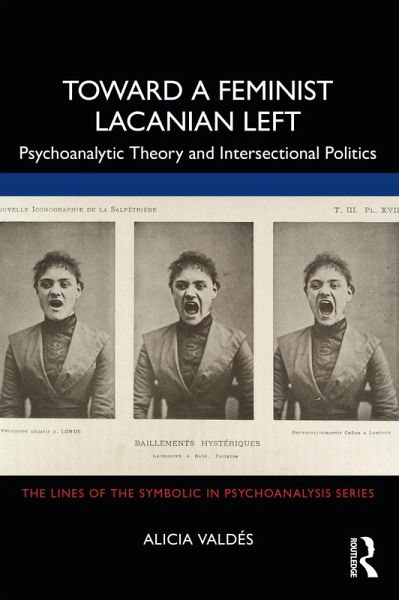
While traditional feminist readings on antagonism have pivoted around the sole axis of sex and/or gender, a broader and intersectional approach to antagonism is much needed; this book offers an innovative, feminist, and discursive reading on the Lacanian concept of sexual position as a way to problematize the concepts of political antagonism and political subjects.
Can Lacanian psychoanalysis offer new grounds for feminist politics? This discursive mediation of Lacan's work presents a new theoretical framework upon which to articulate proposals for intersectional political theory. The first part of this book develops the theoretical framework, and the second part applies it to the construction of woman's identity in European politics and economy. It concludes with notes for a feminist political and economic praxis through community currencies and municipalism.
The interdisciplinary approach of this book will appeal to scholars interested in the fields of psychoanalysis, feminisms, and political philosophy as well as multidisciplinary scholars interested in discourse theory, sexuality and gender studies, cultural studies, queer theory, and continental philosophy. Students at master's and PhD level will also find this a useful feminist introduction to Lacanian psychoanalysis, discourse, and gender.
Can Lacanian psychoanalysis offer new grounds for feminist politics? This discursive mediation of Lacan's work presents a new theoretical framework upon which to articulate proposals for intersectional political theory. The first part of this book develops the theoretical framework, and the second part applies it to the construction of woman's identity in European politics and economy. It concludes with notes for a feminist political and economic praxis through community currencies and municipalism.
The interdisciplinary approach of this book will appeal to scholars interested in the fields of psychoanalysis, feminisms, and political philosophy as well as multidisciplinary scholars interested in discourse theory, sexuality and gender studies, cultural studies, queer theory, and continental philosophy. Students at master's and PhD level will also find this a useful feminist introduction to Lacanian psychoanalysis, discourse, and gender.
Dieser Download kann aus rechtlichen Gründen nur mit Rechnungsadresse in A, B, BG, CY, CZ, D, DK, EW, E, FIN, F, GR, HR, H, IRL, I, LT, L, LR, M, NL, PL, P, R, S, SLO, SK ausgeliefert werden.
"Offering a compelling feminist engagement with the Lacanian Left, this book allows reconfiguring the notion of the sexual position in ways that question and decenter the Master's Discourse. In so doing, it grapples with stimulating questions of subjectivation, oppression, symbolic identification, and the act, while remaining committed to the possibility of developing a critical analysis of how political subjects emerge within unequal power relations. Attending closely to feminist theories of performativity and precariousness, Alicia Valdés provides an engaging meditation on the complicated questions and conditions that might articulate a feminist Lacanian Left as an alternative framework for contemporary political theory and praxis."
Athena Athanasiou, Professor of Social Anthropology, Panteion University of Social and Political Sciences, Greece
"Tracing a feminist and intersectional reading of the political Left, Valdés deploys fundamental Lacanian concepts (structure, sexuation, jouissance, fantasy, object a, the four discourses) to offer a critical analysis of contemporary Left politics and the discourses that support them. Aiming at a meaningful intersectional ontology, the book foregrounds the tendency of discourses, including Leftist ones, to non-inclusivity. The feminine 'not-all' is posed as both revealing the androcentric 'all' and as an alienator and disrupter of a seamless masculinity, and is what proffers a social bond that is more collectivist and inclusive. Read this book to bolster a psychoanalytically informed feminist political consciousness fit for the twenty-first century!"
Eve Watson, Senior Lecturer at Institute of Integrative Counselling and Psychotherapy (IICP), Ireland
"In recent years, the Lacanian Left has facilitated the dynamic development of psychoanalytic political theory. How do feminism and intersectionality interact with this orientation? Alicia Valdes argues that, apart from being plausible, such a mutual engagement could also have significant impact both at the level of conceptual refinement and at the level of socio-political praxis. Her argumentation is bound to greatly influence the crucial debate around psychoanalytic feminism(s) and to help dispel mutual suspicions and misunderstandings."
Yannis Stavrakakis, Professor of Political Science, Aristotle University of Thessaloniki, Greece
Athena Athanasiou, Professor of Social Anthropology, Panteion University of Social and Political Sciences, Greece
"Tracing a feminist and intersectional reading of the political Left, Valdés deploys fundamental Lacanian concepts (structure, sexuation, jouissance, fantasy, object a, the four discourses) to offer a critical analysis of contemporary Left politics and the discourses that support them. Aiming at a meaningful intersectional ontology, the book foregrounds the tendency of discourses, including Leftist ones, to non-inclusivity. The feminine 'not-all' is posed as both revealing the androcentric 'all' and as an alienator and disrupter of a seamless masculinity, and is what proffers a social bond that is more collectivist and inclusive. Read this book to bolster a psychoanalytically informed feminist political consciousness fit for the twenty-first century!"
Eve Watson, Senior Lecturer at Institute of Integrative Counselling and Psychotherapy (IICP), Ireland
"In recent years, the Lacanian Left has facilitated the dynamic development of psychoanalytic political theory. How do feminism and intersectionality interact with this orientation? Alicia Valdes argues that, apart from being plausible, such a mutual engagement could also have significant impact both at the level of conceptual refinement and at the level of socio-political praxis. Her argumentation is bound to greatly influence the crucial debate around psychoanalytic feminism(s) and to help dispel mutual suspicions and misunderstandings."
Yannis Stavrakakis, Professor of Political Science, Aristotle University of Thessaloniki, Greece