49,95 €
49,95 €
inkl. MwSt.
Sofort per Download lieferbar

25 °P sammeln
49,95 €
Als Download kaufen
49,95 €
inkl. MwSt.
Sofort per Download lieferbar
25 °P sammeln
Jetzt verschenken
Alle Infos zum eBook verschenken
49,95 €
inkl. MwSt.
Sofort per Download lieferbar
Alle Infos zum eBook verschenken
25 °P sammeln

Andere Kunden interessierten sich auch für
") Transcending the Self (eBook, PDF)49,95 €
Transcending the Self (eBook, PDF)49,95 €") Doubt, Conviction and the Analytic Process (eBook, ePUB)39,95 €
Doubt, Conviction and the Analytic Process (eBook, ePUB)39,95 €") Seduction, Surrender, and Transformation (eBook, ePUB)37,95 €
Seduction, Surrender, and Transformation (eBook, ePUB)37,95 €") Coming to Life in the Consulting Room (eBook, ePUB)32,95 €
Coming to Life in the Consulting Room (eBook, ePUB)32,95 €") Relationality (eBook, ePUB)41,95 €
Relationality (eBook, ePUB)41,95 €") Forced Endings in Psychotherapy and Psychoanalysis (eBook, ePUB)41,95 €
Forced Endings in Psychotherapy and Psychoanalysis (eBook, ePUB)41,95 €") Psychic Threats and Somatic Shelters (eBook, ePUB)41,95 €
Psychic Threats and Somatic Shelters (eBook, ePUB)41,95 €



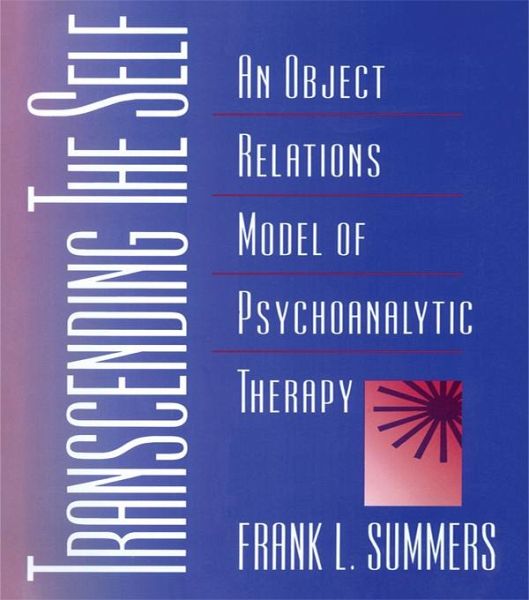
Despite the popularity of object relations theories, these theories are often abstract, with the relation between theory and clinical technique left vague and unclear. Now, in Transcending the Self: An Object Relations Model of Psychoanalytic Therapy, Summers answers the need for an integrative object relations model that can be understood and applied by the clinician in the daily conduct of psychoanalytic therapy.
Drawing on recent infancy research, developmental psychology, and the works of major theorists, including Bollas, Benjamin, Fairbairn, Guntrip, Kohut, and Winnicott, Summers melds diverse object-relational contributions into a coherent viewpoint with broad clinical applications. The object relations model emerges as a distinct amalgam of interpersonal/relational and interpretive perspectives. It is a model that can help patients undertake the most gratifying and treacherous of personality journeys: that aiming at the transcendence of the childhood self. Self-transcendence, in Summers' sense, means moving beyond the profound limitations of early life via the therapeutically mediated creation of a newly meaningful and authentic sense of self.
Following two chapters that present the empirical and theoretical basis of the model, he launches into clinical applications by presenting the concept of therapeutic action that derives from the model. Then, in three successive chapters, he applies the model to patients traditionally conceptualized as borderline, narcissistic, and neurotic. He concludes with a chapter that addresses more broadly the craft of conducting psychoanalytic therapy.
Filled with richly detailed case discussions, Transcending the Self provides practicing clinicians with a powerful demonstration of how psychoanalytic therapy informed by an object relations model can effect radical personality change. It is an outstanding example of integrative theorizing in the service of a real-world therapeutic approach.
Drawing on recent infancy research, developmental psychology, and the works of major theorists, including Bollas, Benjamin, Fairbairn, Guntrip, Kohut, and Winnicott, Summers melds diverse object-relational contributions into a coherent viewpoint with broad clinical applications. The object relations model emerges as a distinct amalgam of interpersonal/relational and interpretive perspectives. It is a model that can help patients undertake the most gratifying and treacherous of personality journeys: that aiming at the transcendence of the childhood self. Self-transcendence, in Summers' sense, means moving beyond the profound limitations of early life via the therapeutically mediated creation of a newly meaningful and authentic sense of self.
Following two chapters that present the empirical and theoretical basis of the model, he launches into clinical applications by presenting the concept of therapeutic action that derives from the model. Then, in three successive chapters, he applies the model to patients traditionally conceptualized as borderline, narcissistic, and neurotic. He concludes with a chapter that addresses more broadly the craft of conducting psychoanalytic therapy.
Filled with richly detailed case discussions, Transcending the Self provides practicing clinicians with a powerful demonstration of how psychoanalytic therapy informed by an object relations model can effect radical personality change. It is an outstanding example of integrative theorizing in the service of a real-world therapeutic approach.
Dieser Download kann aus rechtlichen Gründen nur mit Rechnungsadresse in A, B, BG, CY, CZ, D, DK, EW, E, FIN, F, GR, HR, H, IRL, I, LT, L, LR, M, NL, PL, P, R, S, SLO, SK ausgeliefert werden.
"In this very thoughtful and important work, Frank Summers presents a unique integration of ego psychological and relational theories and then, relying on several extended clinical examples, demonstrates the implications of this integrative viewpoint for understanding the nature of therapeutic action in psychoanalytic therapy with a wide range of patients. Highly recommended as both a theoretical and clinical contribution."
- Sidney J. Blatt, Ph.D., Yale University
"Dr. Summers presents us with a new paradigm for psychoanalytic technique that is most welcome at this time. He uses in-depth clinical case illustrations to compare the relevant ideas of ego psychology, relational psychoanalysis, and object relations theories, and then creatively adds his own stamp in the form of his astute appreciation of "transference." His notion of self-transcendence calls to mind Michelangelo's remark that, in creating a sculpture, he simply cut away excess marble in order to free the image he always knew was there. To this simile, Dr. Summers adds the clinical insight that the analysand's latent potential, as it becomes freed from its symptom signifiers, becomes an enthusiastic coparticipant in the transcending process. This very worthwhile contribution to the technique of psychoanalytic therapy is warmly recommended to all mental health professionals."
- James S. Grotstein, M.D., Training and Supervising Analyst, Los Angeles Psychoanalytic Institute
- Sidney J. Blatt, Ph.D., Yale University
"Dr. Summers presents us with a new paradigm for psychoanalytic technique that is most welcome at this time. He uses in-depth clinical case illustrations to compare the relevant ideas of ego psychology, relational psychoanalysis, and object relations theories, and then creatively adds his own stamp in the form of his astute appreciation of "transference." His notion of self-transcendence calls to mind Michelangelo's remark that, in creating a sculpture, he simply cut away excess marble in order to free the image he always knew was there. To this simile, Dr. Summers adds the clinical insight that the analysand's latent potential, as it becomes freed from its symptom signifiers, becomes an enthusiastic coparticipant in the transcending process. This very worthwhile contribution to the technique of psychoanalytic therapy is warmly recommended to all mental health professionals."
- James S. Grotstein, M.D., Training and Supervising Analyst, Los Angeles Psychoanalytic Institute