39,95 €
39,95 €
inkl. MwSt.
Sofort per Download lieferbar

20 °P sammeln
39,95 €
Als Download kaufen
39,95 €
inkl. MwSt.
Sofort per Download lieferbar
20 °P sammeln
Jetzt verschenken
Alle Infos zum eBook verschenken
39,95 €
inkl. MwSt.
Sofort per Download lieferbar
Alle Infos zum eBook verschenken
20 °P sammeln

Andere Kunden interessierten sich auch für
") Transfiction and Bordering Approaches to Theorizing Translation (eBook, ePUB)39,95 €
Transfiction and Bordering Approaches to Theorizing Translation (eBook, ePUB)39,95 €") Dictionary of Translation Studies (eBook, PDF)26,95 €
Dictionary of Translation Studies (eBook, PDF)26,95 €") Multilingualism in the Chinese Diaspora Worldwide (eBook, PDF)49,95 €
Multilingualism in the Chinese Diaspora Worldwide (eBook, PDF)49,95 €") Apropos of Ideology (eBook, PDF)46,95 €
Apropos of Ideology (eBook, PDF)46,95 €") Queer Theory and Translation Studies (eBook, PDF)38,95 €
Queer Theory and Translation Studies (eBook, PDF)38,95 €") Spaces of Multilingualism (eBook, PDF)0,00 €
Spaces of Multilingualism (eBook, PDF)0,00 €") Narratives of Mistranslation (eBook, PDF)19,95 €
Narratives of Mistranslation (eBook, PDF)19,95 €



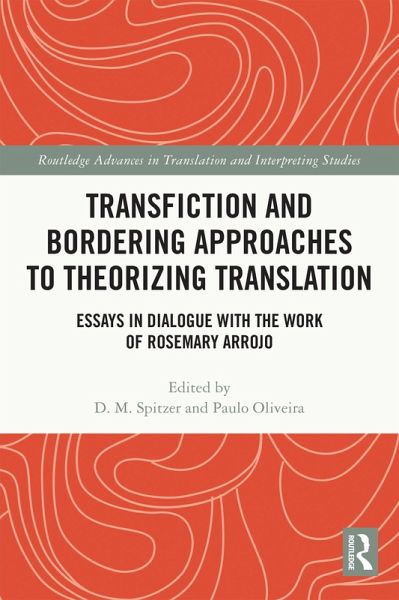
This collection seeks to expand the centers from which scholars theorize translation, building on themes in Rosemary Arrojo's pioneering work on transfiction and the influence of bordering disciplines in investigating and elucidating questions central to the field of translation studies.
Chapters by scholars around the world theorize translation from diverse perspectives, drawing on a wide range of literatures, genres, and media, including fiction, philosophy, drama, and film. Half the chapters explore the influence of Rosemary Arrojo's work on transfiction and the ways in which fictional representations of translators and translation can shed new light on theoretical concerns. The other chapters look to fields outside translation studies, such as linguistics, media studies, and philosophy, to demonstrate the ways in which the key thinkers and theories that have influenced Arrojo's work can be seen in other disciplines and in turn, encourage further cross-disciplinary research interrogating key questions in the field.
The collection makes the case for a multi-layered approach to theorizing translation, one which accounts for the rich possibilities in revisiting existing work and thinking outside disciplinary boundaries in order to advance the field. This book will be of interest to students and scholars in translation studies and comparative literature.
Chapters by scholars around the world theorize translation from diverse perspectives, drawing on a wide range of literatures, genres, and media, including fiction, philosophy, drama, and film. Half the chapters explore the influence of Rosemary Arrojo's work on transfiction and the ways in which fictional representations of translators and translation can shed new light on theoretical concerns. The other chapters look to fields outside translation studies, such as linguistics, media studies, and philosophy, to demonstrate the ways in which the key thinkers and theories that have influenced Arrojo's work can be seen in other disciplines and in turn, encourage further cross-disciplinary research interrogating key questions in the field.
The collection makes the case for a multi-layered approach to theorizing translation, one which accounts for the rich possibilities in revisiting existing work and thinking outside disciplinary boundaries in order to advance the field. This book will be of interest to students and scholars in translation studies and comparative literature.
Dieser Download kann aus rechtlichen Gründen nur mit Rechnungsadresse in A, B, BG, CY, CZ, D, DK, EW, E, FIN, F, GR, HR, H, IRL, I, LT, L, LR, M, NL, PL, P, R, S, SLO, SK ausgeliefert werden.
"As a tribute to the thought of Rosemary Arrojo on translation, this anthology dispenses with the laudatory gesture. [...] The reader will find in texts that cross several fields new critical and theoretical reflection, inspired from the original interweaving of language, fiction, theory and translation developed by the Brazilian scholar."
---Susana Kampff Lages, Professor of German Language and Literature,
Universidade Federal Fluminense (Rio de Janeiro, Brazil)
"Transfiction and Bordering Approaches to Theorizing Translation asks all the right impertinent questions-this volume is essential, anti-essential, reading [...] like Arrojo's own work which built the house for the noisy ghosts of translation looming in these pages, this text serves as rightful homage and epistemic challenge."
--- Richard Kelly Washbourne, Professor of Spanish Translation, Kent State University (USA)
"In this enlightening volume, 15 emerging and established scholars travel through Rosemary Arrojo's central research fields and dialogue with her under a transdisciplinary perspective. Covering a wide range of genres and media, the contributions expand and renegotiate some of Arrojo's pivotal thoughts, suggesting new paths in Translation Studies research."
---Michaela Wolf, Professor of Translation Studies, Universität Graz (Austria)
---Susana Kampff Lages, Professor of German Language and Literature,
Universidade Federal Fluminense (Rio de Janeiro, Brazil)
"Transfiction and Bordering Approaches to Theorizing Translation asks all the right impertinent questions-this volume is essential, anti-essential, reading [...] like Arrojo's own work which built the house for the noisy ghosts of translation looming in these pages, this text serves as rightful homage and epistemic challenge."
--- Richard Kelly Washbourne, Professor of Spanish Translation, Kent State University (USA)
"In this enlightening volume, 15 emerging and established scholars travel through Rosemary Arrojo's central research fields and dialogue with her under a transdisciplinary perspective. Covering a wide range of genres and media, the contributions expand and renegotiate some of Arrojo's pivotal thoughts, suggesting new paths in Translation Studies research."
---Michaela Wolf, Professor of Translation Studies, Universität Graz (Austria)